

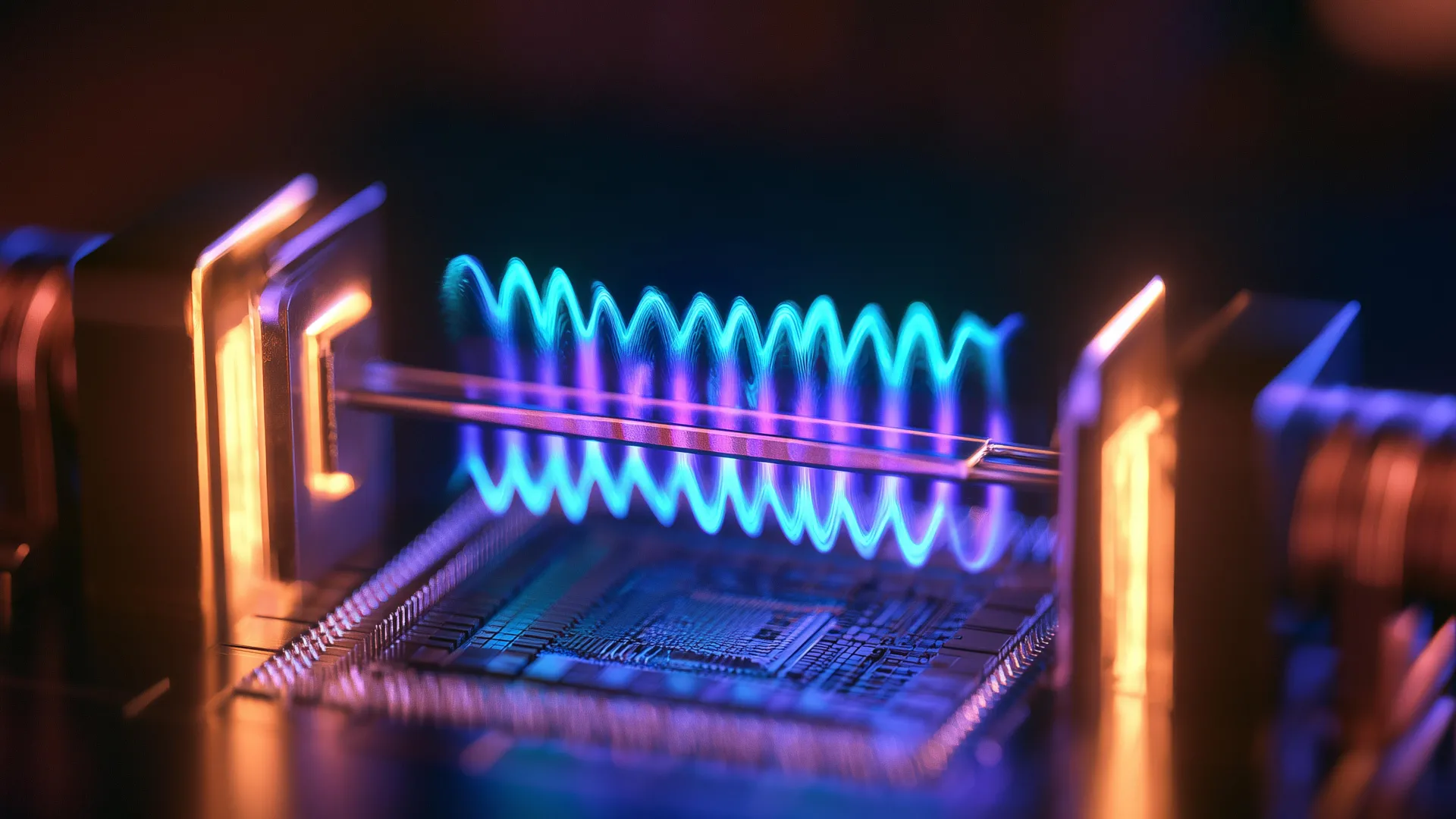
Scientists at ETH Zurich have demonstrated a new approach to quantum computer design that separates information processing from storage using mechanical vibrations. Led by physicist Yiwen Chu, the team created a system where microscopic resonators hold quantum information in patterns of vibration, which a superconducting qubit can access and manipulate as needed. This architecture mirrors the design of conventional computers, where a central processing unit works alongside dedicated memory.
The research, published in Science, addresses a fundamental challenge in quantum computing: maintaining precise control over delicate quantum states while reliably storing and retrieving information. Existing quantum systems often use electromagnetic memory alongside superconducting qubits, a combination that offers accurate control but requires significant physical space. Mechanical resonators offer several potential advantages over electromagnetic approaches, including smaller size, support for multiple vibration patterns to store more information simultaneously, and longer storage times before quantum information degrades.
Chu’s team successfully demonstrated that their vibration-based memory system can perform quantum computations by testing two fundamental computational techniques: the quantum Fourier transform and period finding. Both operations require the system to coordinate multiple quantum states with considerable precision. The experimental results confirmed that the architecture can handle straightforward calculations as well as more demanding quantum operations, establishing that mechanical resonators represent a viable alternative to electromagnetic storage in quantum systems.
The researchers determined that their architecture possesses the essential capabilities required for a general-purpose, programmable quantum computer capable of performing arbitrary quantum computations. However, the team acknowledged that scaling the technology to larger systems while maintaining precision and reliability remains a significant challenge. Practical quantum computers with sufficient power for widespread scientific and industrial use remain some distance away, though this breakthrough represents a meaningful step toward that goal.
Article Attribution | Read More at Article Source
Article summary produced by Claude AI