

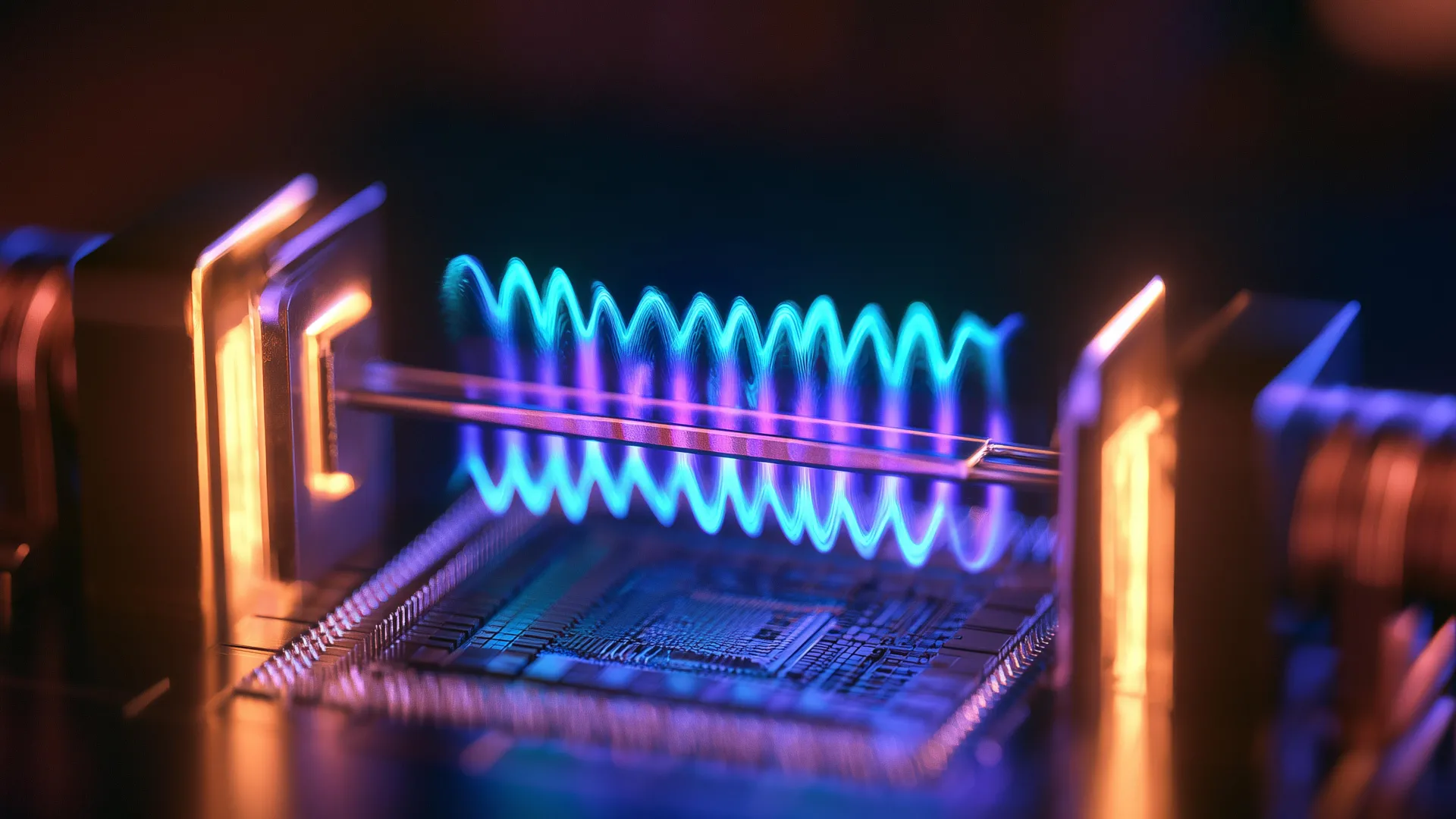
Scientists at ETH Zurich have created a novel quantum computing architecture that uses microscopic mechanical vibrations to serve as quantum memory, drawing an unexpected parallel to the functioning of musical instruments. Led by physicist Yiwen Chu, the team has developed a system where vibrations occur at frequencies far beyond human hearing within a tiny quantum chip, enabling efficient information processing with flexible working memory capabilities. The research, published in the journal Science, demonstrates that this approach provides a foundation for developing quantum computers capable of performing computations that are infeasible for conventional machines.
The breakthrough represents a departure from conventional quantum computer design by giving information processing and storage more distinct operational roles. The system mirrors the architecture of everyday digital computers, where a central processing unit handles calculations while separate random access memory holds information. In Chu’s quantum system, a superconducting qubit functions as the processor, while a separate quantum memory temporarily stores information needed during calculations. Rather than storing information electromagnetically as is typical, the new system stores it through mechanical vibrations within microscopic structures called mechanical resonators.
The mechanical resonator approach offers several potential advantages over existing electromagnetic memory systems used in quantum computing. Mechanical resonators are substantially smaller, allowing for more compact designs and easier expansion of quantum devices into larger, more capable systems. They can support numerous different vibration patterns, potentially enabling simultaneous storage of more information than conventional electromagnetic memory. Additionally, mechanical vibrations can preserve quantum states for longer periods before stored information deteriorates, which could facilitate more complex calculations requiring information availability across multiple processing steps.
The experimental demonstration published in Science marks the first successful pairing of mechanical resonators with superconducting qubits for quantum computations. The research team tested the system’s capabilities using two fundamental computational techniques: the quantum Fourier transform and period finding, both requiring precise coordination of multiple quantum states. The successful completion of these tasks confirmed that the architecture can store, control, and maintain coherent relationships among multiple quantum states simultaneously, providing evidence that the system supports genuine quantum computation.
The researchers established that their new architecture possesses the essential capabilities required for a programmable, general-purpose quantum computer. However, transitioning from laboratory demonstrations to practical, large-scale systems remains a significant challenge. The team continues investigating how to scale the technology while preserving the precision and reliability achieved in experimental settings. Widespread practical quantum computers remain some distance away, though this mechanical vibration approach represents a promising direction for future development.
Article Attribution | Read More at Article Source
Article summary produced by Claude AI