

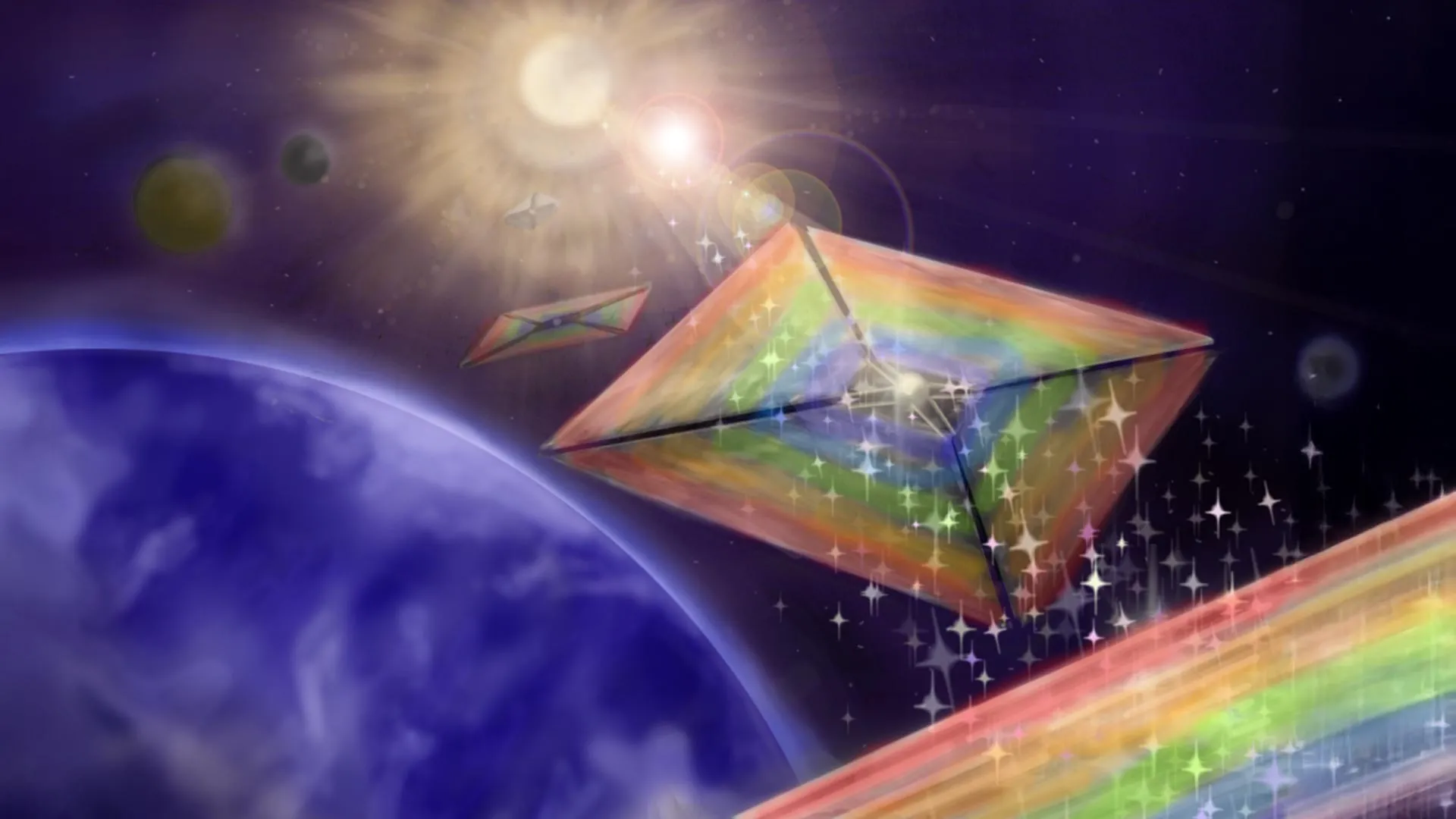
Scientists at the Harbin Institute of Technology have identified a counterintuitive challenge for laser-propelled spacecraft designed to travel between stars. Their research, presented in a recent paper, reveals that at approximately 75% of the speed of light, photons intended to accelerate a solar sail begin producing resistance instead.
Solar sails represent a theoretical propulsion method that harnesses radiation pressure from light to move spacecraft through space. Rather than relying on conventional chemical rockets, this approach uses powerful lasers to push lightweight reflective surfaces to extreme velocities. The technology could potentially enable missions to nearby stars within reasonable timeframes, far faster than conventional propulsion systems would allow.
The Harbin Institute researchers examined three mechanisms by which photons transfer momentum to a sail: direct impact of incoming light, reflection off the sail’s surface, and diffuse scattering where photons are absorbed and reemitted randomly. At relativistic speeds, however, the Doppler effect causes incoming laser light to shift toward the red end of the spectrum, reducing its ability to transfer momentum effectively. This phenomenon alone makes acceleration progressively more difficult as spacecraft approach higher speeds.
The critical discovery concerns relativistic light aberration, an effect that becomes pronounced near three-quarters light speed. At these velocities, the apparent direction of scattered light shifts dramatically from the sail’s perspective. Light scattered in the forward direction imparts recoil momentum backward, creating drag that partially counteracts the propulsion system’s forward thrust. While the laser still generates net forward force allowing continued acceleration, this effect reduces overall propulsion efficiency.
The study did not account for all obstacles interstellar spacecraft would face, including resistance from interstellar dust and the extreme thermal challenges of directing powerful lasers at thin materials. Researchers suggest that advanced metamaterials and photonic crystals engineered to interact with specific light wavelengths could help address these challenges and potentially manipulate the identified relativistic effects to improve spacecraft stability and orientation control.
Article Attribution | Read More at Article Source
Article summary produced by Claude AI