

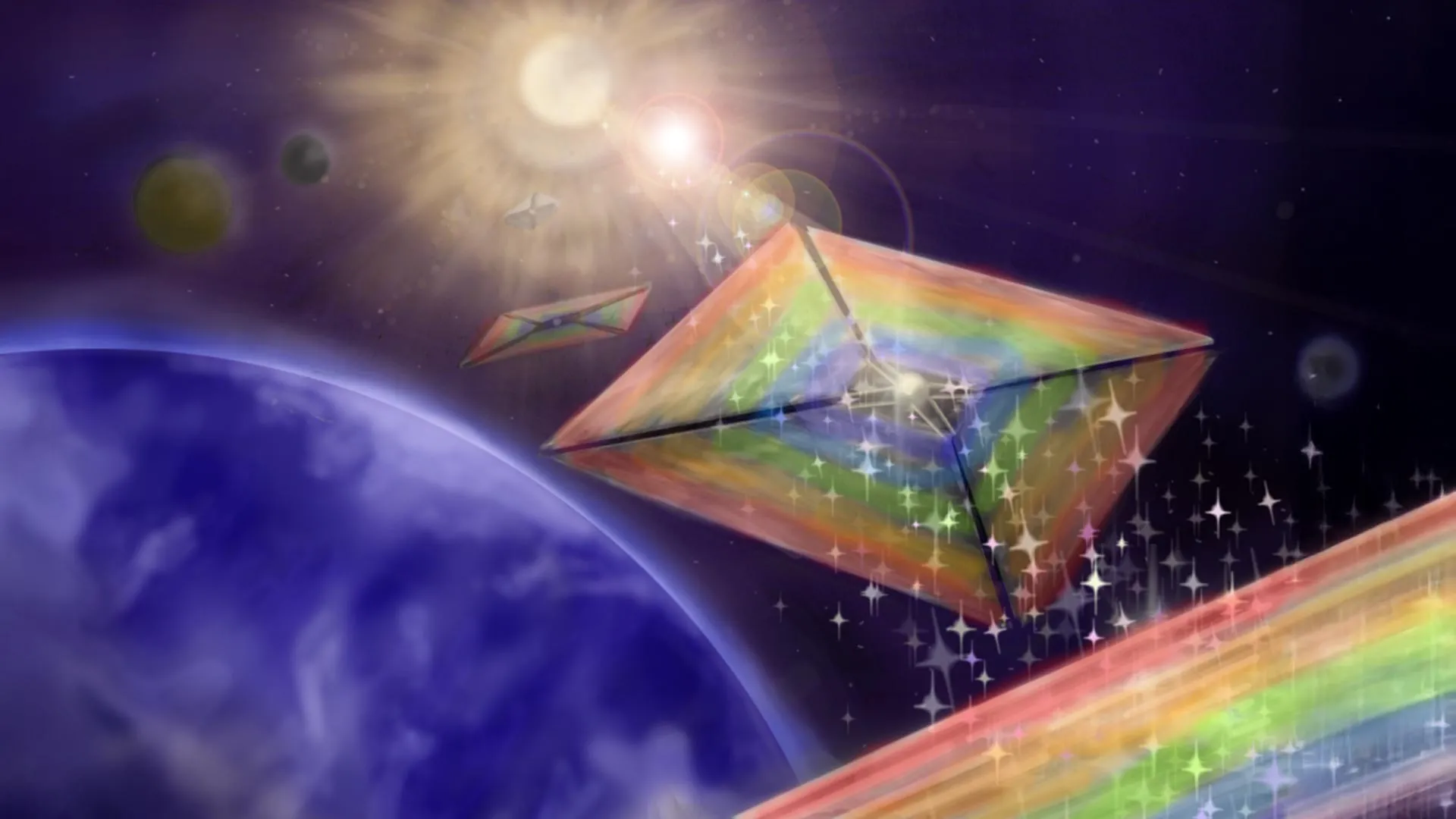
Scientists investigating laser-powered solar sail propulsion have identified a counterintuitive challenge that emerges at extreme velocities. Conventional rockets cannot achieve the speeds necessary for practical interstellar travel, making alternative propulsion methods essential. Solar sails represent one promising approach, using the momentum of light to gradually accelerate spacecraft through space. Proposed interstellar missions envision employing powerful lasers to push these sails to substantial fractions of light speed, potentially enabling missions to nearby stars.
Researchers from the Harbin Institute of Technology examined how light interacts with solar sails traveling at relativistic speeds. Their analysis identified three mechanisms through which photons transfer momentum: incident light striking the sail directly, specular reflection from the sail’s surface, and diffuse scattering from absorbed photons. Each mechanism contributes differently to spacecraft acceleration. As a sail accelerates away from its laser source, relativistic effects become increasingly significant. The incoming laser light undergoes a Doppler effect, shifting to lower frequencies from the sail’s perspective. This redshift reduces the momentum transferred by all three mechanisms, making acceleration progressively more difficult as velocities increase.
At approximately 75% of light speed, the researchers identified a particularly unusual phenomenon. Relativistic light aberration causes diffusely scattered light to concentrate increasingly toward the spacecraft’s forward direction. Since emitting light produces recoil, this scattering effect begins generating drag opposing the spacecraft’s motion rather than assisting it. This creates a paradoxical situation where some of the light intended to propel the craft actually resists its acceleration. Despite this effect, the overall laser-generated force remains positive, allowing continued acceleration but at reduced efficiency.
The study simplifies several real-world complexities not addressed in the analysis. Resistance from interstellar gas and dust, thermal challenges from directing extremely powerful lasers at delicate sails, and the material science requirements for durable, efficient reflective surfaces all present additional obstacles. Researchers suggest that advanced metamaterials and photonic crystals engineered to interact with specific light wavelengths could help address these challenges. Such materials might even transform relativistic effects into advantages, potentially enabling self-correcting spacecraft orientation during acceleration, though practical laser-sail systems capable of reaching other stars remain far from realization.
Article Attribution | Read More at Article Source
Article summary produced by Claude AI