

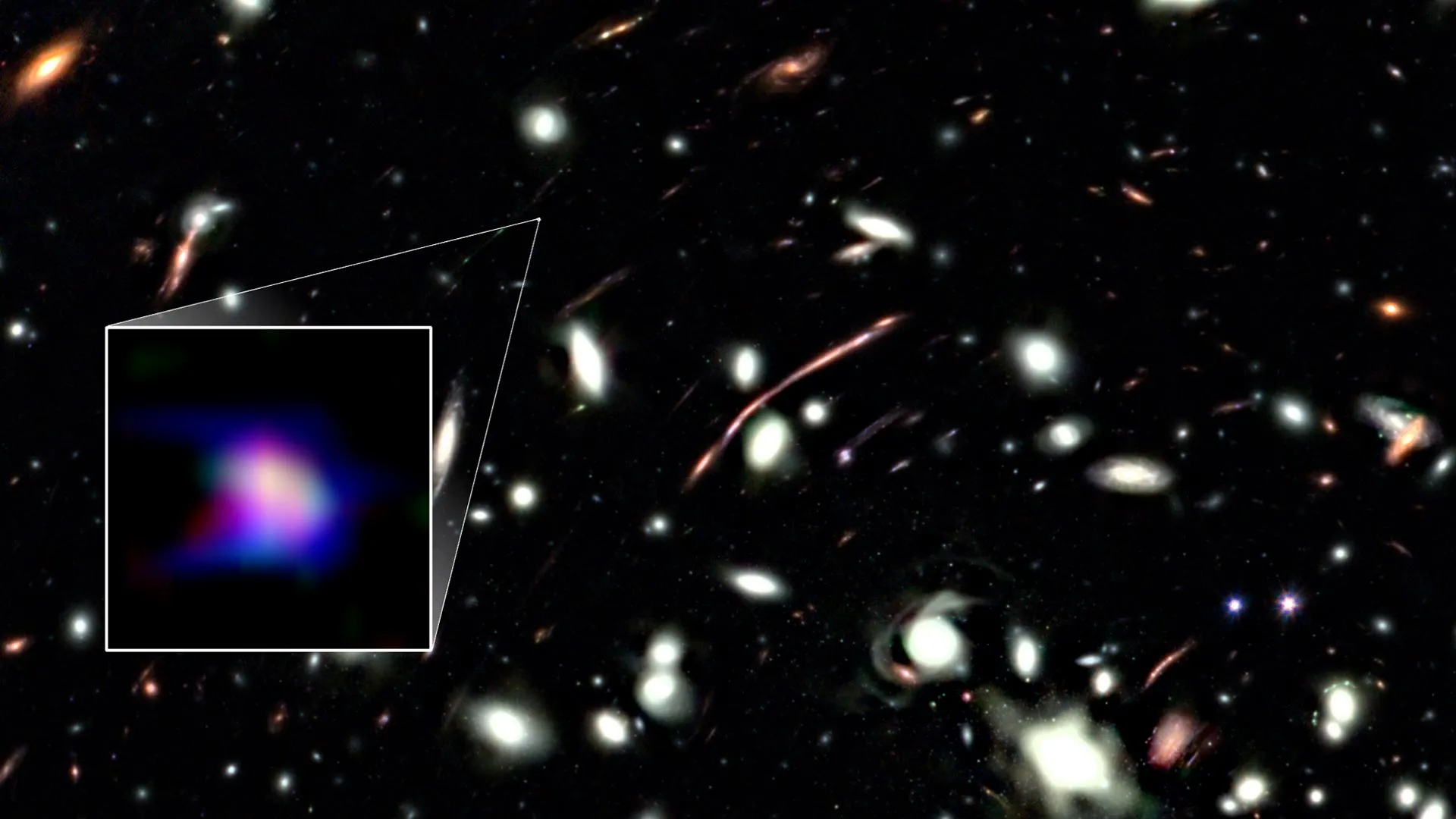
An international research team led by Associate Professor Kimihiko Nakajima of Kanazawa University has announced the discovery of LAP1-B, an ancient galaxy observed through the James Webb Space Telescope. The galaxy existed approximately 800 million years after the Big Bang, making it one of the earliest known star-forming systems. Using gravitational lensing from a foreground galaxy cluster to magnify the distant object’s light by a factor of 100, the team conducted more than 30 hours of spectroscopic observations to analyze the galaxy’s chemical composition.
The observations revealed that LAP1-B contains an oxygen abundance of roughly 0.42% of the Sun’s oxygen levels, or approximately 1/240th the solar value. This measurement establishes LAP1-B as the most chemically primitive star-forming galaxy discovered to date. Oxygen abundance serves as a key indicator of chemical evolution in galaxies, since the element is produced within stars and released into surrounding regions during stellar explosions. A galaxy with such minimal oxygen content has undergone relatively little chemical enrichment, offering astronomers a rare window into conditions present during the universe’s earliest stages of galaxy formation.
Beyond its extreme oxygen scarcity, LAP1-B exhibited other distinctive characteristics. The team detected an unusually high ratio of carbon to oxygen relative to the galaxy’s overall heavy element content, along with exceptionally energetic ionizing radiation. These features align closely with theoretical predictions about the chemical outputs from the universe’s first-generation stars, known as Population III stars. These primordial stars formed from gas containing virtually no heavy elements and produced the carbon and oxygen essential for life through nuclear reactions before exploding and dispersing these elements throughout the cosmos.
The discovery provides direct observational evidence of conditions in the early universe and may help explain the origins of ancient, faint galaxies observed near the Milky Way today. The findings demonstrate how the James Webb Space Telescope’s advanced infrared capabilities enable astronomers to study objects previously considered too distant and faint for detailed analysis, fundamentally advancing understanding of cosmic chemical evolution and the universe’s earliest epochs.
Article Attribution | Read More at Article Source
Article summary produced by Claude AI