

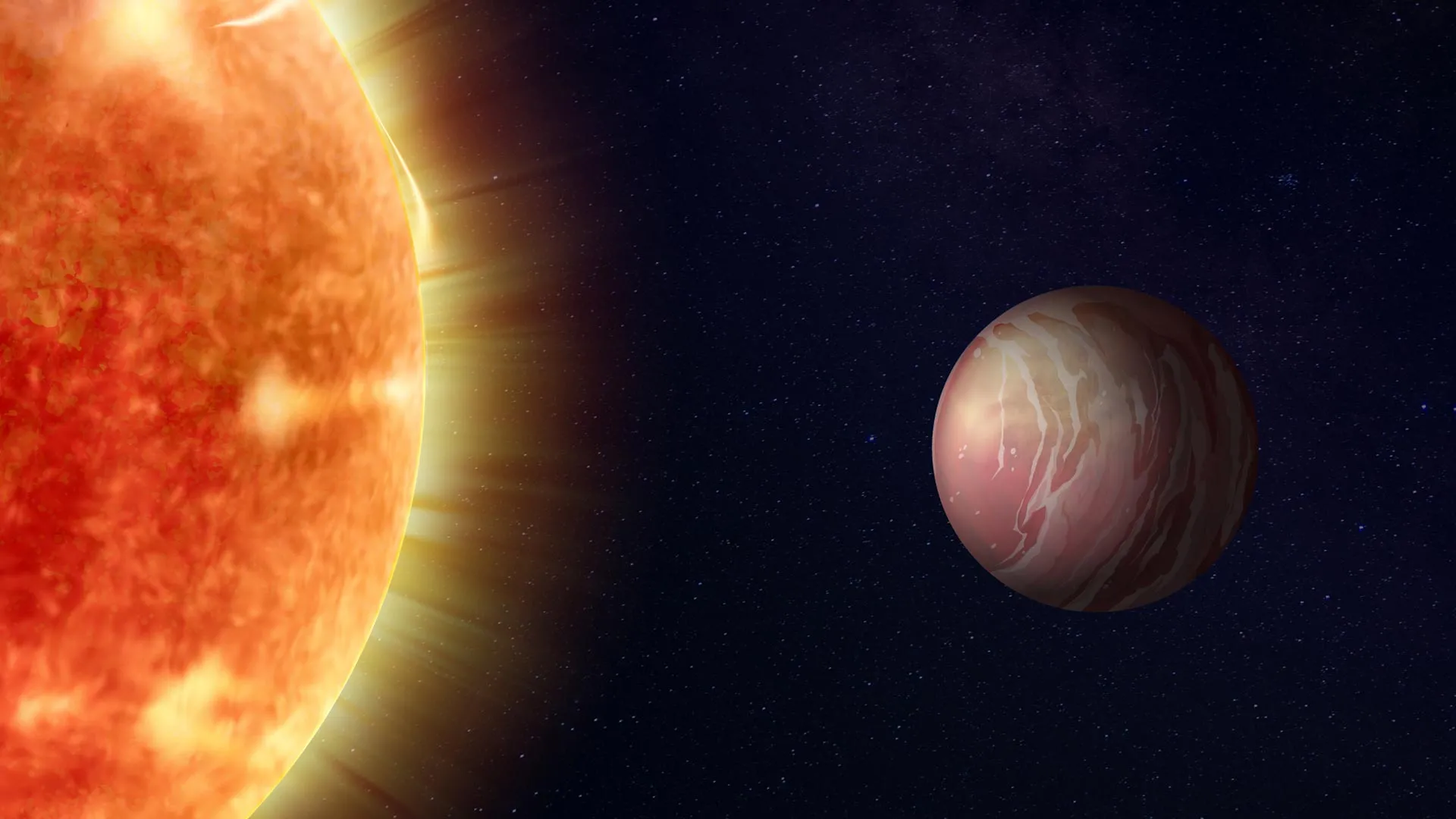
An international research team has reported unexpected findings regarding TOI-561 b, a rocky exoplanet approximately 280 light-years from Earth that orbits extremely close to its host star. Using the James Webb Space Telescope, scientists monitored nearly four complete orbits of the planet over a period of 37 hours and found evidence suggesting the presence of a substantial atmosphere, despite conditions that would typically be incompatible with atmospheric retention.
The observations revealed that TOI-561 b reflects approximately 75% of incoming starlight—a proportion comparable to Venus. This high reflectivity contradicts earlier predictions that expected the dayside to be significantly hotter. Climate simulations conducted by the research team suggest that clouds containing silicate minerals, including silicon dioxide and magnesium silicate, may form over the planet’s dayside. These clouds could function as a natural reflective barrier, preventing stellar radiation from reaching the surface and reflecting much of the energy back into space.
The discovery raises fundamental questions about atmospheric composition and longevity on such extreme worlds. Scientists have yet to determine the exact gases comprising TOI-561 b’s atmosphere, though possibilities include a thick carbon dioxide layer similar to Venus or an atmosphere dominated by sulfur dioxide produced by volcanic activity. The research team proposes that a global ocean of molten lava covering the planet’s surface may continuously replenish atmospheric gases, potentially explaining how the planet has retained an atmosphere despite billions of years of intense stellar radiation.
The findings challenge current theoretical models predicting that heavily irradiated rocky planets should lose their atmospheres over geological timescales. Professor Lisa Dang, who led the project, indicated that future observations using JWST at longer wavelengths may reveal additional details about atmospheric composition and help clarify the mechanisms sustaining such an atmosphere. The research contributes to broader understanding of exoplanet atmospheres and the diversity of conditions that can exist on distant worlds.
Article Attribution | Read More at Article Source
Article summary produced by Claude AI