

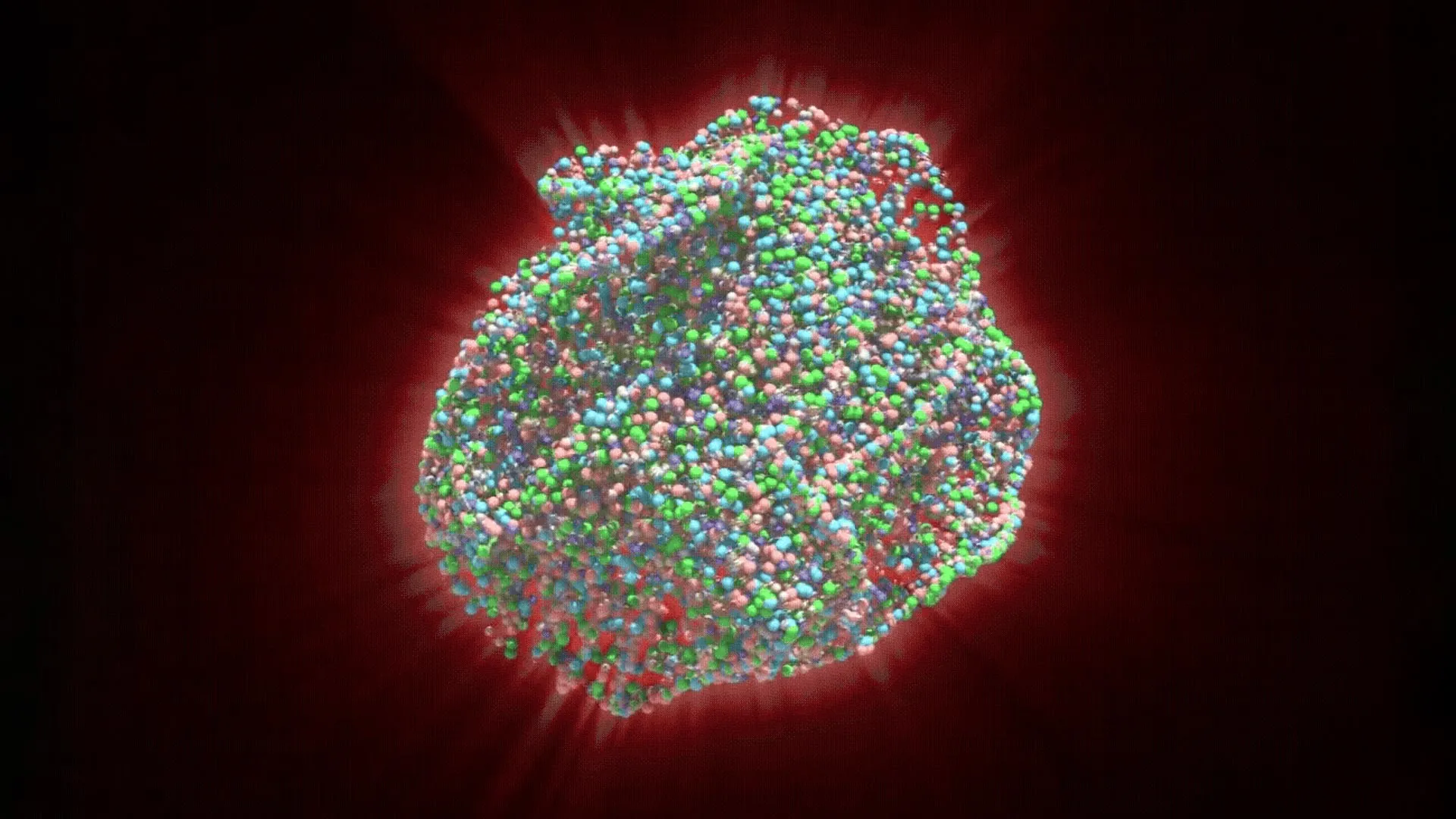
Researchers at the Large Hadron Collider have reported findings indicating that quark-gluon plasma, a primordial form of matter believed to have existed in the early universe, can be created through collisions of relatively light atomic nuclei. The discovery challenges conventional understanding about the extreme conditions required to generate this exotic state of matter.
Quark-gluon plasma forms at temperatures exceeding 100,000 times those at the sun’s center, causing particles like protons and neutrons to break apart into their constituent quarks and gluons. Scientists believe this state existed throughout the universe during the first millionths of a second following the Big Bang. For decades, researchers assumed that recreating these conditions required collisions between very heavy atomic nuclei, particularly lead, which is more than 200 times heavier than protons typically used in experiments.
All four major research collaborations at the facility—ALICE, ATLAS, CMS, and LHCb—have now reported multiple independent lines of evidence that plasma forms in collisions involving oxygen and neon nuclei. Scientists identified the plasma’s presence through several distinctive signatures, including parton energy loss, where energetic particles lose energy while traveling through the hot, dense material. ATLAS researchers observed energy differences between paired particle jets generated during such collisions, with the effect being particularly pronounced in head-on impacts expected to create larger plasma volumes.
The collaborations employed various complementary approaches to confirm their findings. CMS detected suppression in charged-particle production during lighter nuclear collisions compared with proton-proton collisions. LHCb found that particles containing charm quarks showed greater suppression in heavier neon collisions, consistent with larger plasma volumes causing more particle energy loss. ALICE compared neutral pion production across different collision types, providing evidence of parton energy loss in the lighter collisions.
Additional observations included varying suppression patterns in bound quark-antiquark pairs and anisotropic flow signatures in particle directions following collisions. These converging lines of evidence suggest that the conditions required to produce quark-gluon plasma are less restrictive than previously believed, potentially opening new avenues for investigating the universe’s earliest moments.
Article Attribution | Read More at Article Source
Article summary produced by Claude AI