

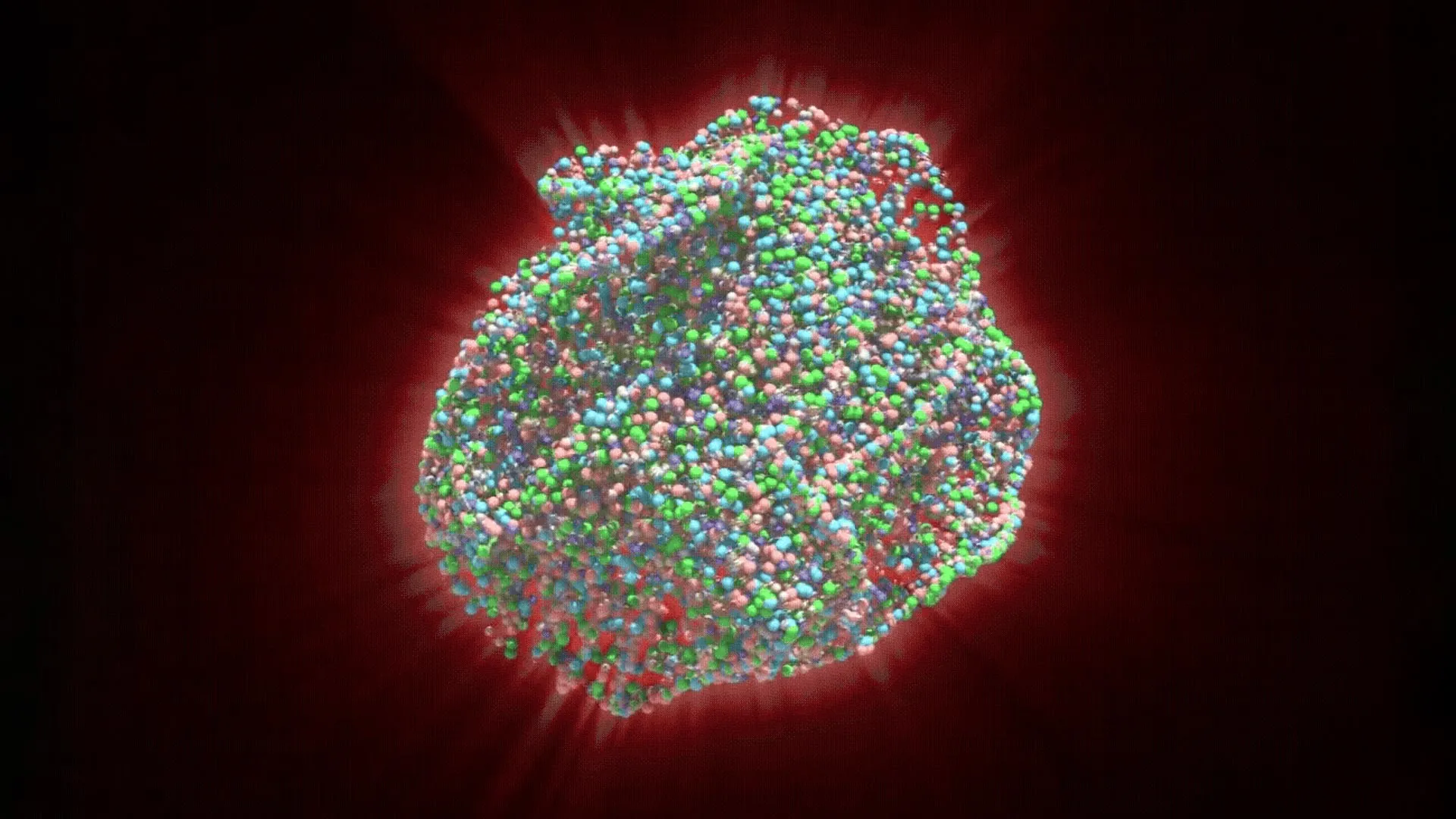
Scientists at the Large Hadron Collider have reported findings that challenge long-held assumptions about the conditions necessary to create quark-gluon plasma, an exotic state of matter believed to have existed during the universe’s earliest moments. The discovery comes one year after the first oxygen collisions were conducted at the facility. All four major research collaborations at the LHC—ALICE, ATLAS, CMS, and LHCb—have now identified signs that this primordial material can form when oxygen and neon nuclei collide at high energies.
Quark-gluon plasma is an unusual substance that forms under extreme pressure and heat, with temperatures exceeding 100,000 times those at the Sun’s center. Under such conditions, fundamental particles like protons and neutrons break apart into quarks and gluons. Physicists believe this state of matter filled the entire universe during the first millionths of a second following the Big Bang. For decades, researchers assumed that generating such plasma required collisions involving very heavy atomic nuclei, particularly lead, which weighs more than 200 times as much as individual protons.
The recent observations contradict this assumption, demonstrating that lighter nuclei can produce the necessary conditions. Multiple detection methods provided evidence of quark-gluon plasma formation. The ATLAS collaboration observed energy loss in paired particle jets produced during oxygen and neon collisions—a phenomenon expected when energetic particles travel through extremely hot, dense material. The CMS collaboration found reduced production of certain charged particles in these collisions compared to simpler proton collisions, while LHCb identified suppression patterns in particles containing charm quarks. The ALICE collaboration compared particle production across different collision types, offering what researchers described as unambiguous evidence of the underlying physical process.
Additional indicators of plasma formation emerged from studies of bound states composed of heavy and light quarks, which show different susceptibility to disruption by surrounding plasma. Researchers also detected anisotropic flow patterns in particle directions following collisions, with certain particle types showing stronger directional preferences than others. The findings collectively expand scientists’ understanding of how primordial matter can be created and provide new opportunities to investigate the conditions that existed during the universe’s earliest moments using a broader range of experimental approaches.
Article Attribution | Read More at Article Source
Article summary produced by Claude AI