

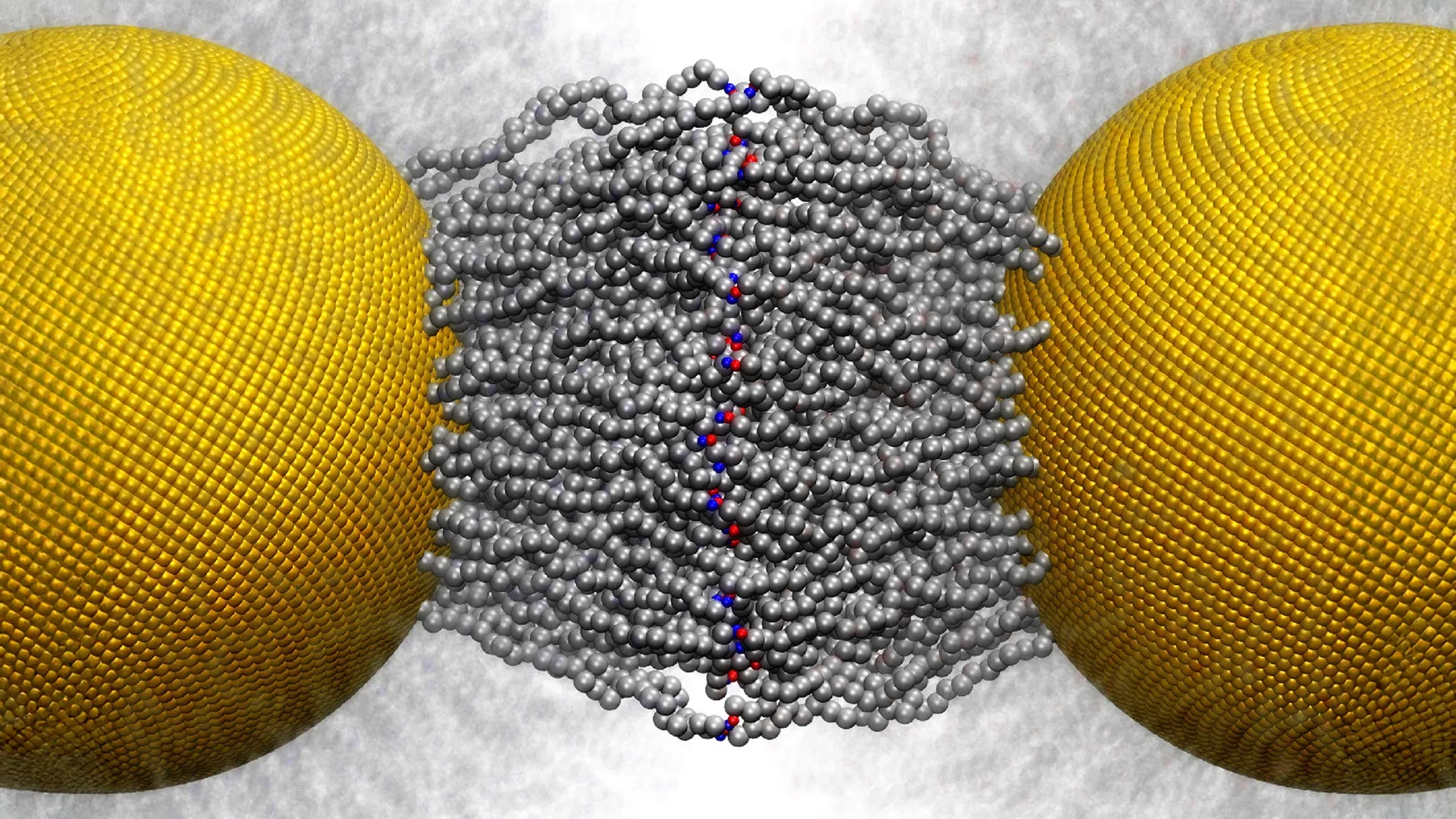
Scientists at MIT have demonstrated a counterintuitive approach to controlling how nanoparticles assemble into organized materials. Rather than adhering to the conventional strategy of using rigid molecular connectors, the research team successfully employed highly flexible connectors that adapt as particles interact. This breakthrough challenges assumptions that have guided materials science research for the past 20 years.
The ability to control nanoparticle assembly has significant implications for materials science, as the arrangement of a material’s smallest components determines its overall properties and performance. Nanoparticles are already used in drug delivery, energy storage, computing, and sensor applications, but organizing them into larger structured materials has remained challenging. Researchers have traditionally attempted to control assembly through two methods: modifying nanoparticle shapes to influence how they fit together, or altering their surfaces to direct connections. Both approaches rely on ligand molecules that attach to particle surfaces and mediate connections between neighboring particles, typically engineered to be rigid and maintain specific angles.
The MIT team, led by Rob Macfarlane, explored whether allowing ligands complete flexibility could provide superior control. The researchers equipped nanoparticles with highly flexible ligands carrying electrical charges at their ends, allowing opposite charges to attract naturally. As the connectors bend toward partners with opposite charges, they spontaneously organize the particles without requiring predetermined connection angles. This flexibility paradoxically provides greater control by allowing the ligand arrangement to optimize bond stability.
The research demonstrates that this flexible approach can produce crystal structures never before observed. The findings have potential applications across electronics, medicine, energy technologies, agriculture, and chemical manufacturing. The work appears in Nature Materials and was conducted by MIT researchers including Nicholas Sbalbi, Hana Shinzawa, and Matthew Ye, along with collaborators from the University of Delaware. The discovery offers a new tool for creating designer materials with precisely engineered properties.
Article Attribution | Read More at Article Source
Article summary produced by Claude AI