

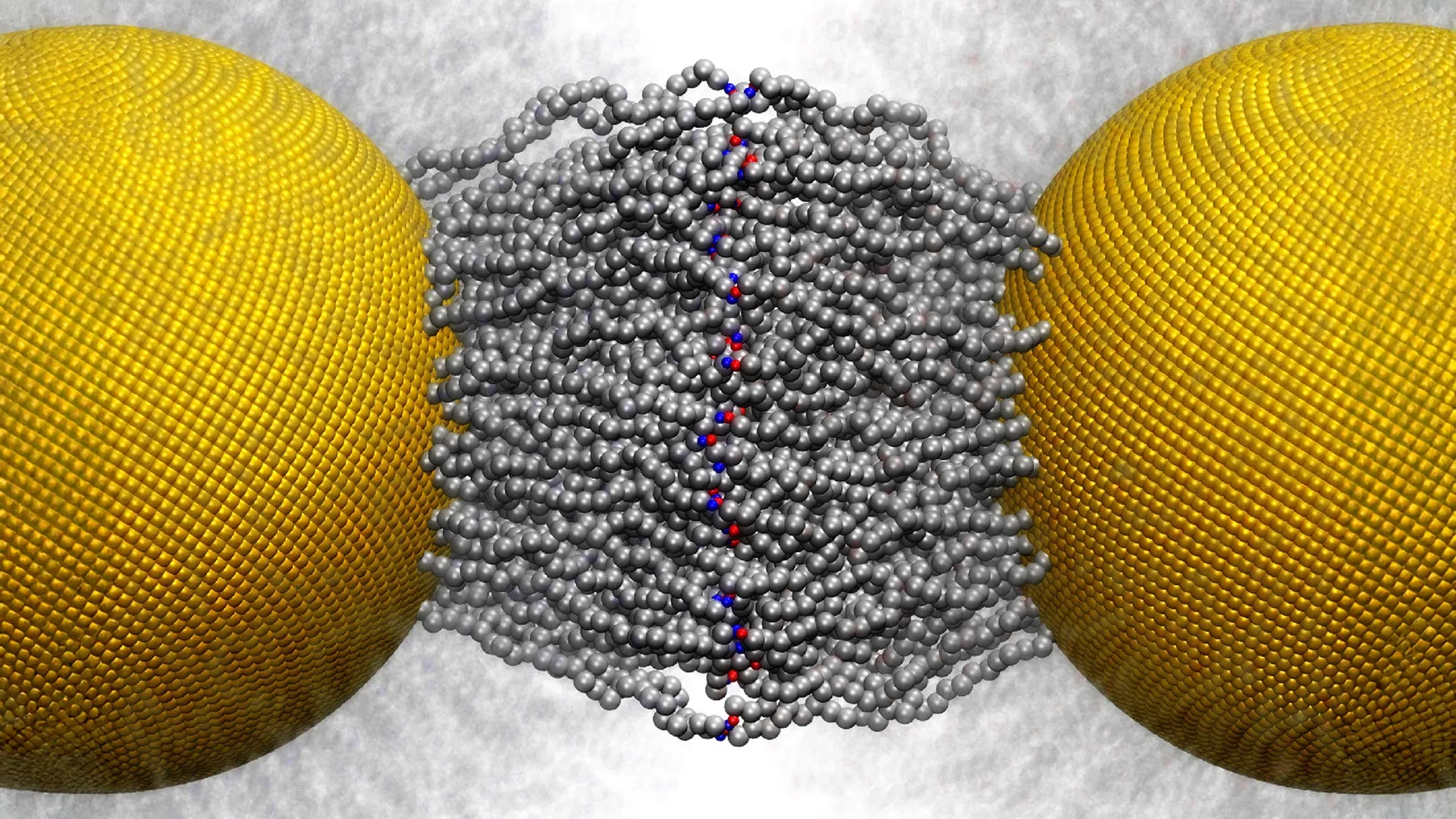
Scientists at MIT have upended conventional wisdom in materials science by demonstrating that flexible molecular connectors can guide nanoparticle assembly more effectively than rigid ones. The research team, led by Rob Macfarlane, challenged a widely held belief that has dominated the field for two decades. Rather than constraining molecular ligands to maintain fixed positions and angles, the researchers explored the opposite approach, allowing connectors to bend freely as nanoparticles interact. This counterintuitive strategy enables new forms of control over how nanoparticles organize themselves into larger structures.
The fundamental challenge in nanoparticle engineering involves controlling which particles connect to their neighbors and in what directions those connections form. Without precise control, nanoparticles tend to cluster into densely packed arrangements that limit the variety of achievable structures and their functional properties. Traditional approaches have relied on either modifying particle shapes or creating specialized sticky regions on particle surfaces. These methods often prove complicated, require custom synthesis for each application, and scale poorly for manufacturing purposes. Both strategies depend on ligands—molecular connectors that attach to particle surfaces—which scientists have historically maintained in rigid configurations.
The MIT team proposed a radical departure from this doctrine. Rather than enforcing rigid connections, they designed nanoparticles with highly flexible ligands carrying electrical charges at their ends. Positive and negative charges naturally attract one another, causing the flexible connectors to orient themselves optimally as particles approach each other. This self-organization process allows the electrical charges to regulate how many connections each particle forms, eliminating the need for predetermined bonding patterns. The flexibility of the polymer-based ligands permits them to adjust as nanoparticles assemble, with the electrical interactions determining final arrangements.
The collaborative research, involving MIT researchers Nicholas Sbalbi, Hana Shinzawa, and Matthew Ye, along with colleagues from the University of Delaware, produced crystal structures never previously observed. The findings appear in Nature Materials and suggest broad applications across electronics, pharmaceuticals, energy systems, agriculture, and chemical production. By demonstrating that maximum flexibility can achieve what rigidity could not, the work provides researchers with a fundamentally new tool for engineering materials with precisely controlled properties at the nanoscale.
Article Attribution | Read More at Article Source
Article summary produced by Claude AI