

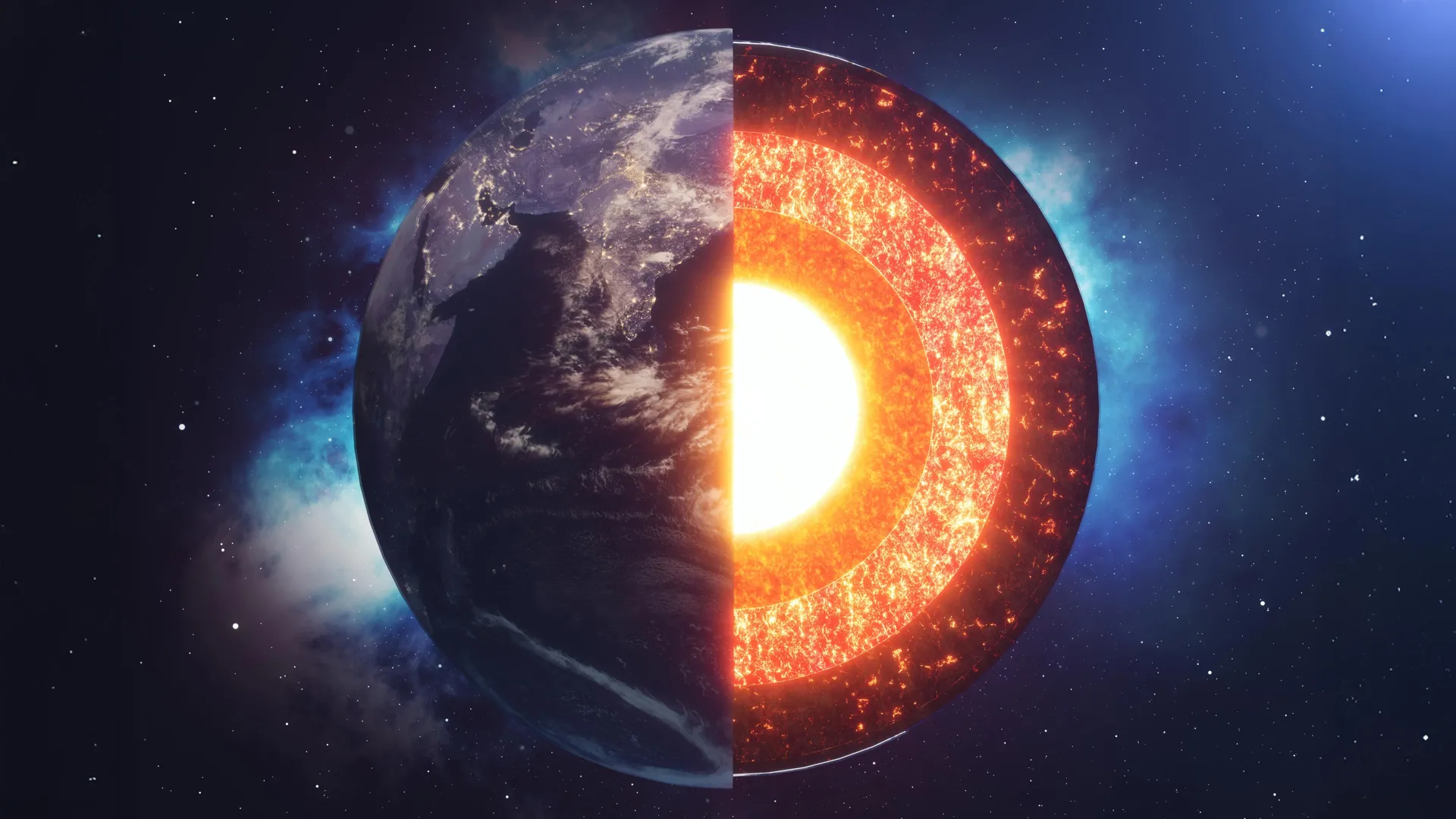
A new study published in Nature suggests that the Great Unconformity, a substantial gap in Earth’s geological record spanning over a billion years in some locations, may have resulted from the vertical movement of ancient continents driven by mantle convection deep within the planet.
The Great Unconformity refers to a dramatic interruption in rock layers found at numerous sites worldwide. At these locations, sedimentary rocks from the Cambrian period, approximately 540 million years ago, rest directly atop much older crystalline rocks such as granite that exceed one billion years in age. The intervening geological layers are absent, creating a significant break in the planetary record. This phenomenon is particularly evident in formations like the Grand Canyon and has been documented across Europe, Australia, Africa and Asia. The duration of missing geological time varies considerably between locations, ranging from roughly 200 million years to over a billion years.
Research led by PhD candidate Santosh Dhungana at the University of Wollongong examined whether mantle convection could account for this puzzle. The mantle, a layer of hot rock beneath Earth’s crust, undergoes extremely slow circulation over geological timescales. Computer simulations modeled how this process could cause ancient continental regions to rise and fall over hundreds of millions of years. The study focused on three major ancient landmasses: Laurentia in North America, Baltica in northern Europe, and North China.
According to the simulations, mantle convection elevated these continental cores during the Neoproterozoic Era, a period extending roughly one billion to 540 million years ago. As the continents remained elevated over extended periods, erosion gradually removed vast quantities of older rock, eliminating hundreds of millions of years of geological history. Following this uplift phase, the simulations indicated widespread subsidence during the Phanerozoic eon over approximately the past 540 million years. As these regions slowly sank, advancing seas covered their eroded surfaces, and new sediments accumulated above the exposed older rocks, preserving the visible boundary between geological periods.
A significant aspect of the research involved comparing the model predictions with actual geological observations. The simulations accurately predicted the geographic distribution of the Great Unconformity across the three studied continental regions, suggesting that deep mantle movements played a substantial role in creating the missing rock record. While the findings do not definitively establish mantle convection as the sole cause, they provide a testable explanation connecting surface-level geological evidence with slow processes occurring deep within Earth.
Article Attribution | Read More at Article Source
Article summary produced by Claude AI