

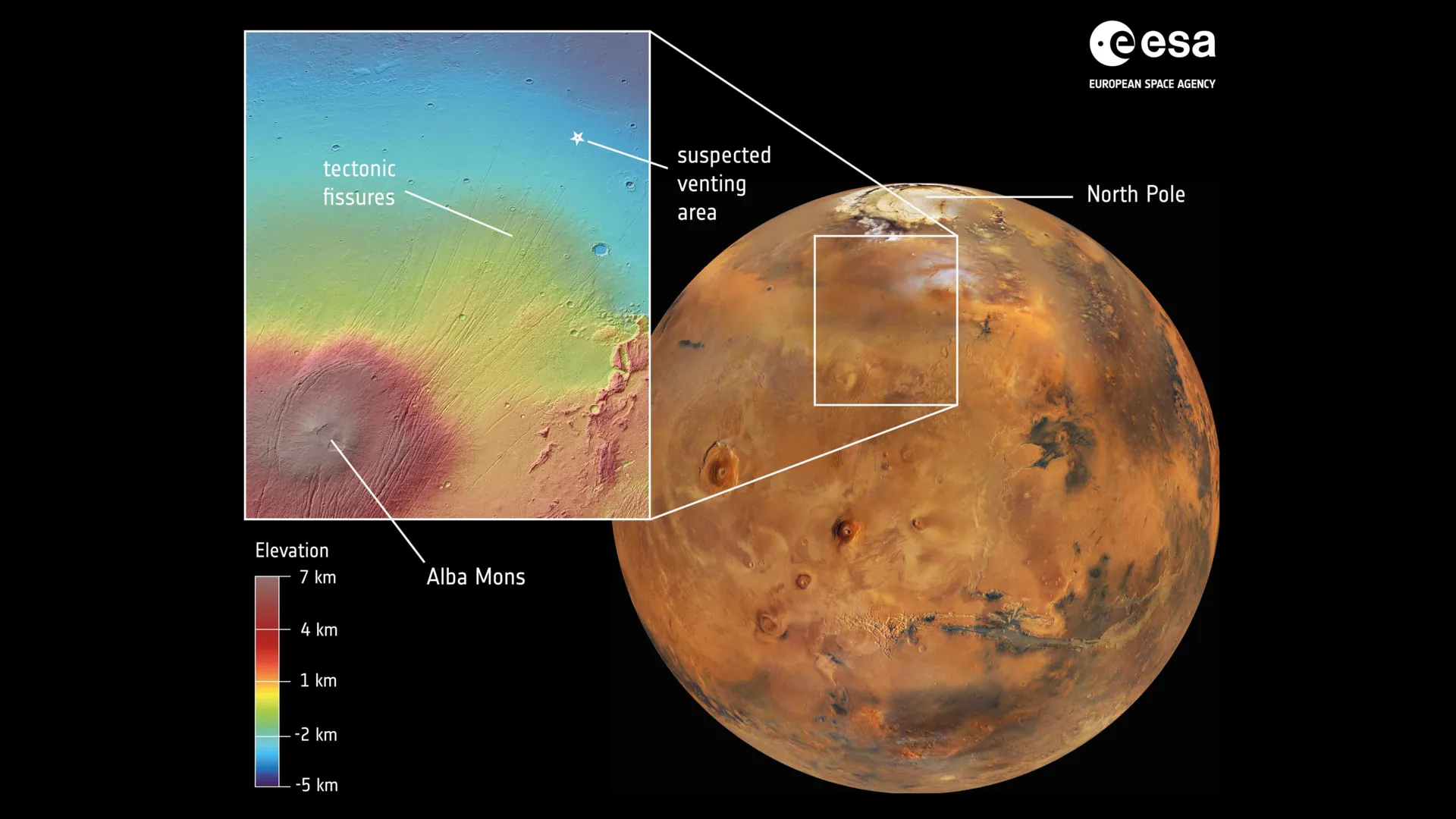
Scientists have identified elevated concentrations of hydrogen chloride gas in the Martian atmosphere near Alba Mons, one of the largest volcanoes in the Solar System, raising questions about whether volcanic processes remain active beneath Mars’ surface. The European Space Agency’s ExoMars Trace Gas Orbiter detected the gas emissions in early summer of the Martian northern hemisphere, at a time when hydrogen chloride levels typically decline due to seasonal atmospheric cycles. The unexpected gas concentrations appeared repeatedly over specific volcanic fractures on the volcano’s slopes, suggesting an underground source rather than ordinary atmospheric chemistry.
Researchers led by Alexander Trokhimovskiy combined atmospheric measurements with orbital surface observations to investigate the phenomenon. High-resolution imaging revealed narrow, relatively fresh fractures extending hundreds of meters across the surface, with unusual color variations in the surrounding terrain. These features are consistent with volcanic vents, known as fumaroles on Earth, through which underground gases escape. The team hypothesizes that extremely cold Martian winters seal fractures with ice, preventing gas release, while rising temperatures in early summer allow the ice to sublimate and open pathways for subterranean gases to reach the atmosphere.
After systematically evaluating alternative chemical explanations, the research team concluded that the hydrogen chloride likely originates from a dormant magma chamber beneath Alba Mons. While Mars hosts the Solar System’s largest volcanoes and has experienced seismic activity, scientists have never directly observed a contemporary eruption or fresh lava flow. This discovery suggests Mars may have retained sufficient internal heat to support volcanic processes into the recent geological past, and possibly continuing today.
The findings carry broader implications for understanding Mars’ habitability history. Volcanic outgassing in the planet’s distant past may have created a thicker atmosphere and warmer conditions capable of sustaining liquid water on the surface. Additionally, if magma interacts with subsurface groundwater, it could generate hydrothermal systems that might harbor life today, making such volcanic regions potential targets for astrobiological research.
Article Attribution | Read More at Article Source
Article summary produced by Claude AI