

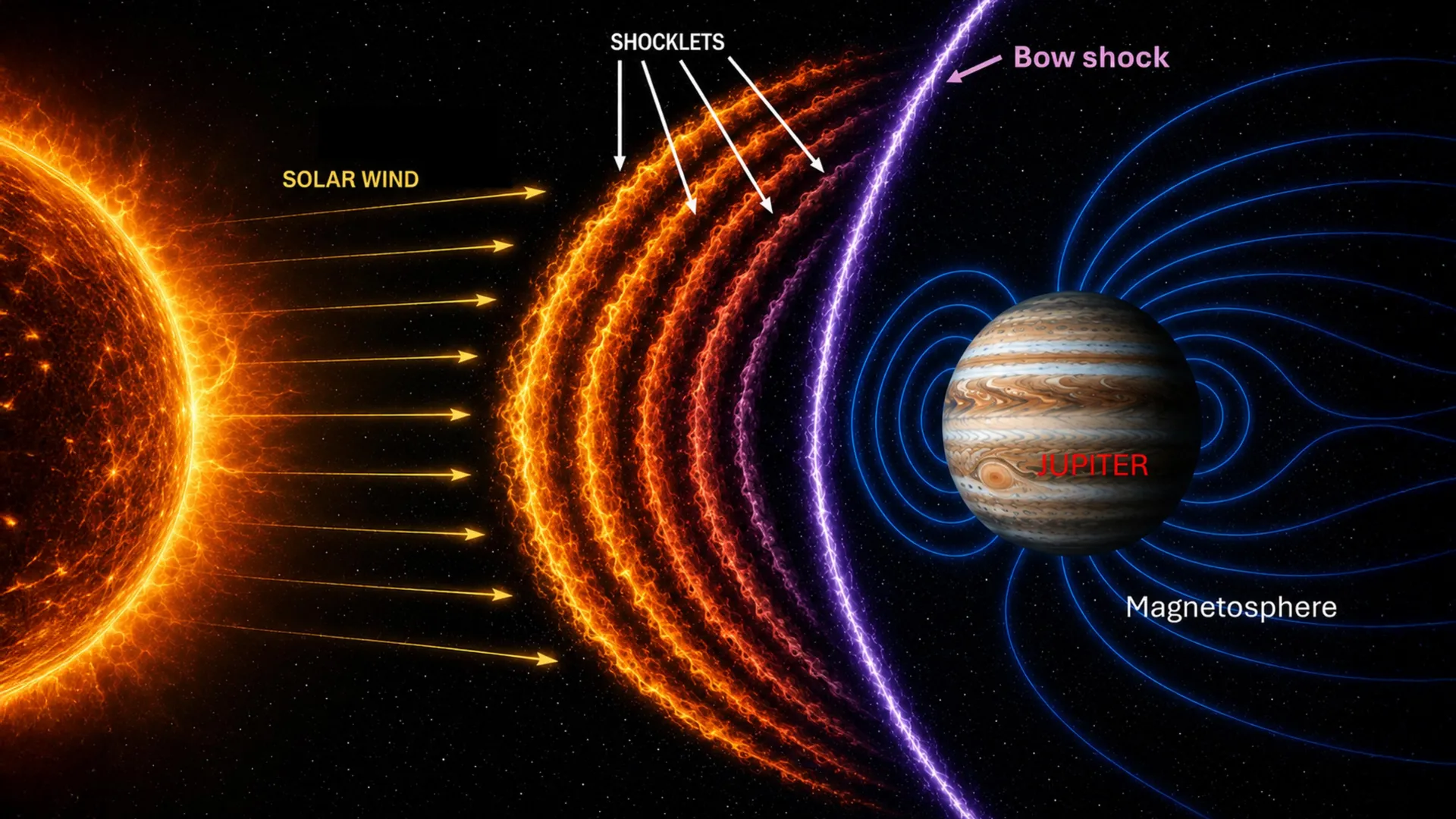
NASA’s Juno spacecraft has discovered new details about Jupiter’s magnetosphere and how the planet protects itself from solar radiation, according to research led by scientists at the University of Iowa. The study reveals that Jupiter’s bow shock—an invisible boundary where solar particles encounter the planet’s magnetic environment—operates through mechanisms significantly more complex than those protecting Earth.
The solar wind, a continuous stream of electrically charged particles from the Sun, travels through space at high speeds. When these particles approach a magnetized planet, they encounter a bow shock that slows and redirects them. While Earth relies primarily on plasma waves at a single frequency to manage this process, Jupiter employs plasma waves with multiple frequencies, or harmonics, that can interact with incoming particles in more elaborate ways. This allows Jupiter’s bow shock to transfer energy to a greater number of particles and reduce their speeds more effectively. Researchers compared the mechanism to music, where multiple frequencies played together create richer interactions than a single frequency alone.
Jupiter also employs an additional defensive structure not present at Earth. Before solar particles reach Jupiter’s main bow shock, they encounter smaller shock regions called shocklets that slow the solar wind before it reaches the primary boundary. Earth’s simpler system generally does not require these extra steps because the solar wind impact is less severe. According to Bill Kurth, a research scientist involved in the study, Earth’s configuration is sufficient for the conditions it encounters.
The findings extend beyond Jupiter’s immediate environment. Shock waves occur throughout the universe, particularly around dying stars and other astrophysical phenomena. By studying Jupiter’s bow shock in unprecedented detail, scientists can investigate energy transfer mechanisms that would be difficult to measure directly around distant stellar objects. Understanding these processes could improve scientific models of how shock waves transfer energy and shape cosmic environments.
The breakthrough resulted from observations collected by Juno in December 2024. The Juno Waves instrument, designed and built at the University of Iowa, measures electric and magnetic wave activity around Jupiter. The findings were published online on July 31 in Nature Communications.
Article Attribution | Read More at Article Source
Article summary produced by Claude AI