

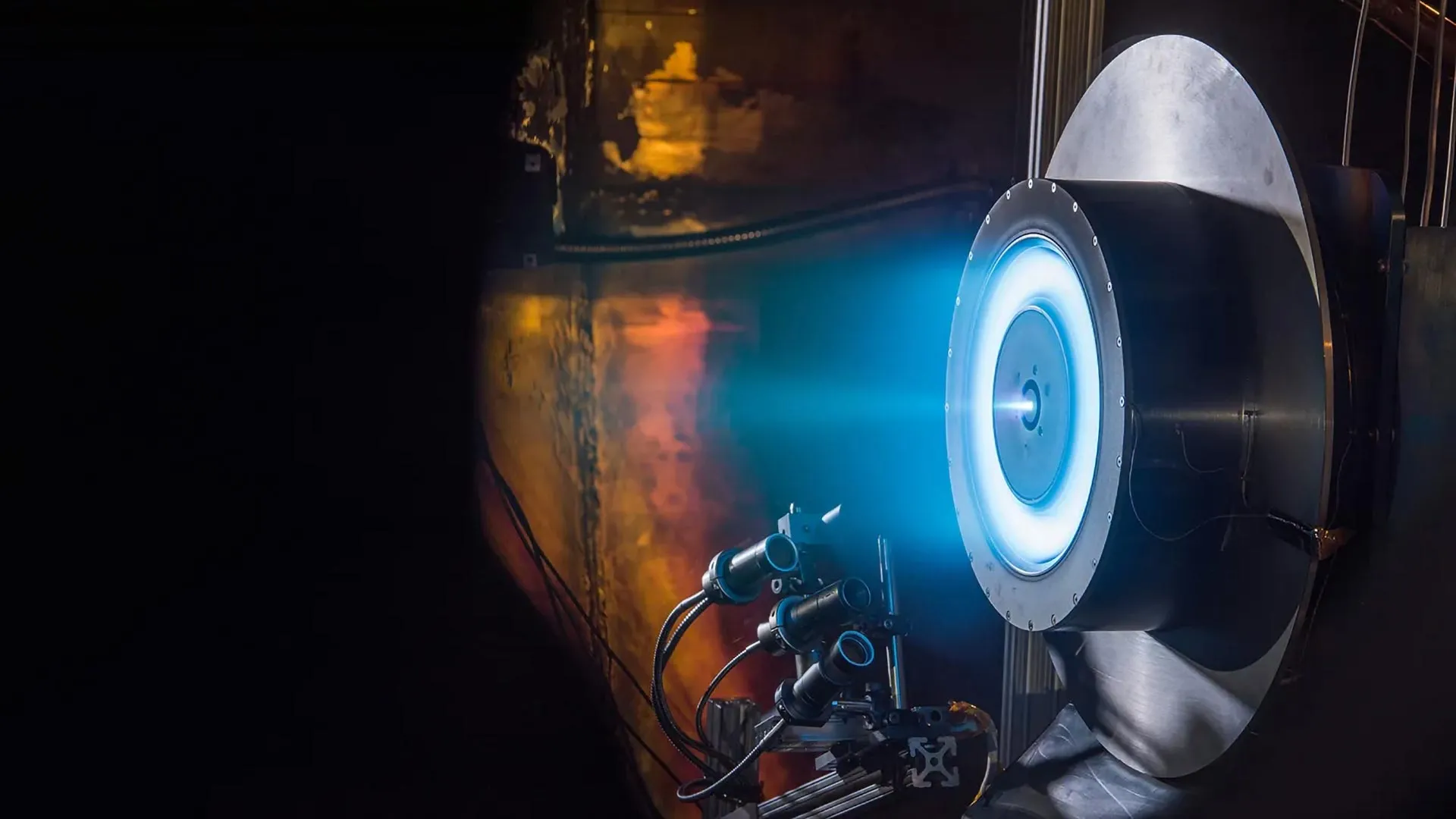
NASA has launched the Advanced Mid-Power Electric Rocket (AMPERE) Challenge, offering $500,000 in total prizes to spur development of improved electric propulsion systems. The initiative targets Hall effect thrusters operating in the mid-power range of 3 to 7 kilowatts, a class of technology identified by government agencies and aerospace experts as important for satellite operations, national defense, and space exploration missions.
Electric propulsion systems fundamentally differ from traditional chemical rockets. Rather than burning fuel to produce powerful bursts of thrust, these engines use electrical energy to accelerate charged particles and expel them at high velocities. Hall effect thrusters specifically employ electric and magnetic fields to control and accelerate charged particles. Although electric thrusters generate far less immediate thrust than chemical engines, they offer significant advantages in fuel efficiency, making them particularly valuable for extended-duration missions where spacecraft require gradual acceleration over long periods to adjust trajectories or maintain orbital positions.
The AMPERE Challenge aims to move electric propulsion technology from early-stage development toward practical evaluation and implementation. Participating companies will design and demonstrate Hall effect thruster prototypes within the specified power range. NASA will assess these prototypes using its testing facilities, evaluating performance and identifying improvement areas. This testing represents a critical step in transitioning experimental technology into reliable equipment suitable for operational space missions, which must deliver consistent performance in space’s demanding environment.
The competition will proceed across three phases, with as many as two winning teams eligible to receive up to $250,000 each. Alongside financial awards, winners gain access to NASA testing resources and technology, providing opportunities to evaluate and refine their propulsion systems while improving their readiness for future applications. Registration opened November 9, 2026, and closes January 27, 2027. The competition is restricted to companies incorporated in the United States with their primary place of business domestically.
Article Attribution | Read More at Article Source
Article summary produced by Claude AI