

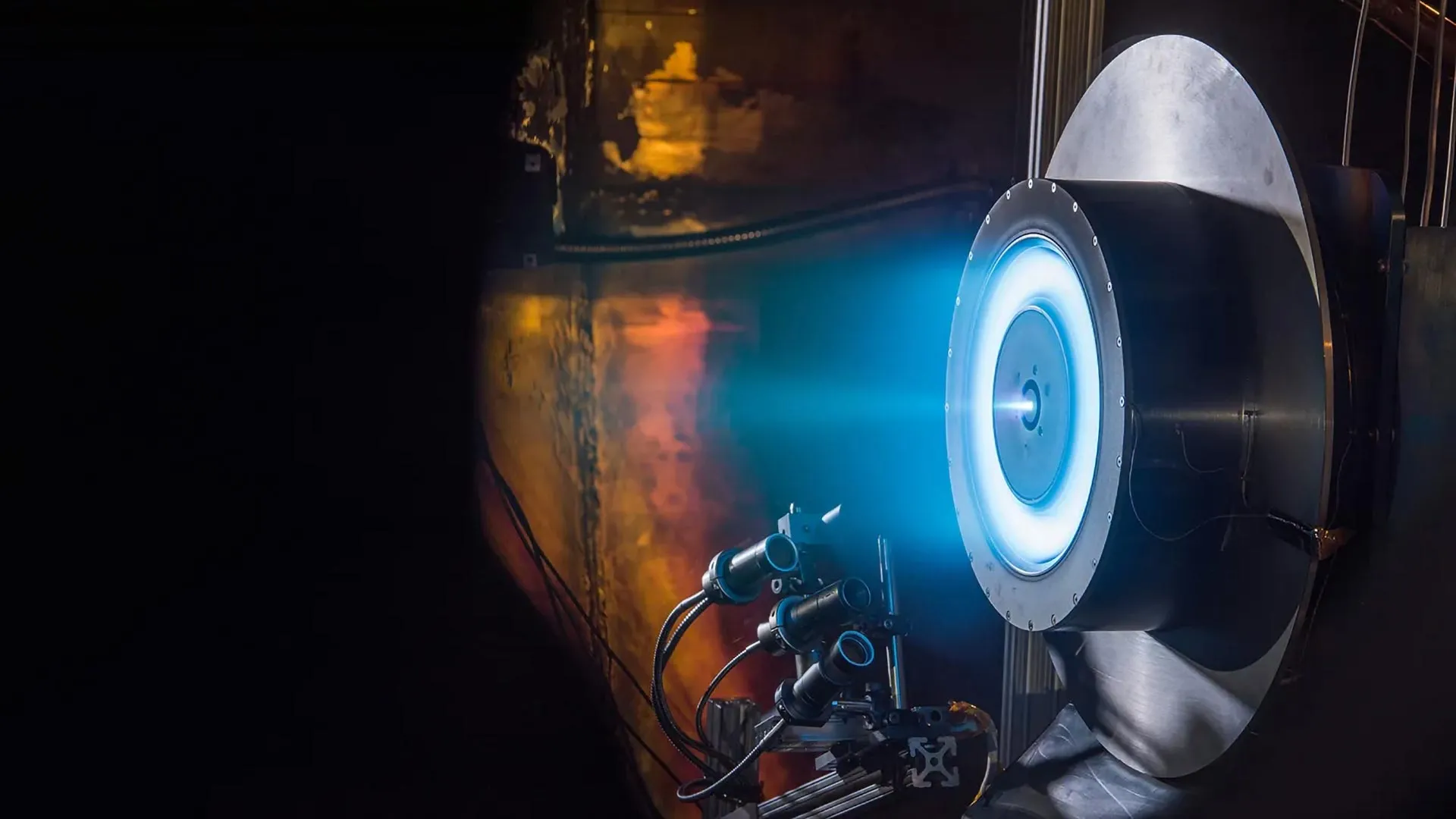
NASA has launched the Advanced Mid-Power Electric Rocket (AMPERE) Challenge, a competition aimed at accelerating development of electric propulsion systems for spacecraft. The initiative offers a total of $500,000 in cash prizes distributed across three competition phases, with winning teams eligible to receive up to $250,000 each. The competition targets mid-power Hall effect thrusters operating in the 3 to 7 kilowatt range, a capability that government and aerospace sector analysts consider essential for advancing satellite operations, national defense initiatives, and space exploration missions.
Hall effect thrusters operate by using electric and magnetic fields to accelerate charged particles at high velocities, generating thrust through the expulsion of these particles. Unlike conventional chemical rockets that produce intense bursts of thrust over brief periods, electric propulsion systems generate gentler acceleration over extended timeframes. This characteristic makes them particularly suited for long-duration space operations where spacecraft must maintain course adjustments or orbital adjustments over months or years. Though individual thrusters produce less force than chemical engines, their superior propellant efficiency and extended operational capabilities make them valuable for numerous mission profiles.
The AMPERE Challenge invites American commercial companies to design, build, and demonstrate functional prototypes of mid-power Hall effect thrusters. Participating organizations will have their systems evaluated using NASA testing facilities, providing realistic performance assessment and identifying potential improvements. Beyond the financial prizes, winning competitors gain access to NASA’s testing resources and technical expertise, offering opportunities to refine their technologies and prepare them for practical deployment in future missions.
Eligibility is restricted to companies incorporated and primarily based in the United States. Registration for the competition began November 9, 2026, with applications accepted through January 27, 2027. Through this competition, NASA aims to foster commercial innovation in electric propulsion technology while strengthening the range of advanced propulsion capabilities available for next-generation spacecraft across government and private sector applications.
Article Attribution | Read More at Article Source
Article summary produced by Claude AI