

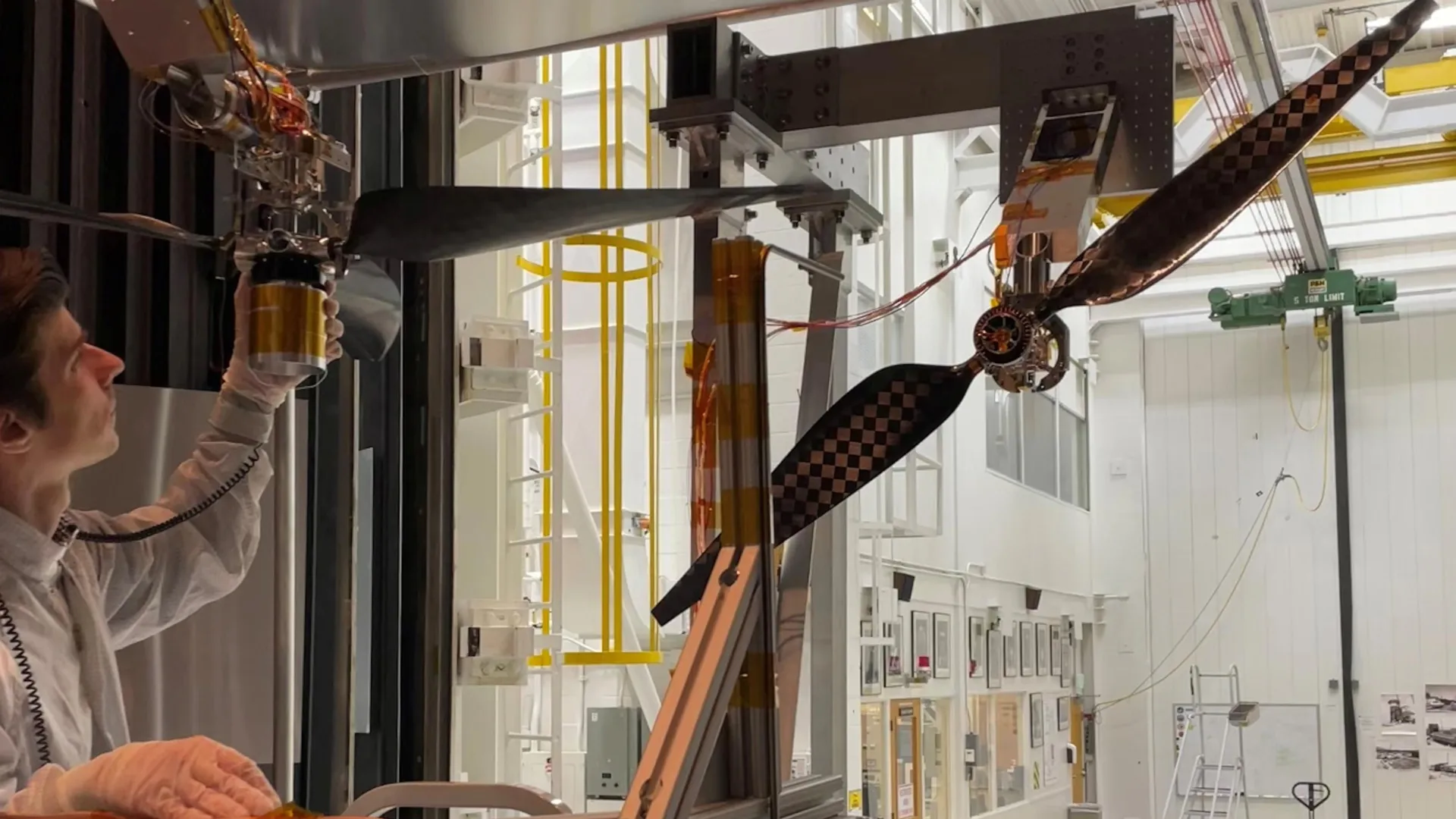
NASA conducted experimental tests of helicopter rotor blades designed for future Mars missions, pushing the technology beyond previously established safety limits. During testing in March at the Jet Propulsion Laboratory in Southern California, engineers demonstrated that specially designed rotors could operate at supersonic speeds without structural failure, marking a significant advancement in aerospace engineering for planetary exploration.
The testing focused on addressing a fundamental challenge unique to Mars exploration: the planet’s extremely thin atmosphere, which contains only about 1% of the density found at Earth’s sea level. This sparse atmosphere requires helicopter rotors to spin at exceptionally high speeds to generate sufficient lift for flight. The earlier Ingenuity helicopter, which conducted 72 successful flights on Mars, operated at conservative speeds of 2,700 revolutions per minute, keeping blade tips at Mach 0.7 as a safety margin against unpredictable conditions near the sound barrier.
Engineers used NASA’s 25-Foot Space Simulator chamber to recreate Martian atmospheric conditions by removing standard air and introducing controlled amounts of carbon dioxide, the primary component of Mars’s atmosphere. The team subjected rotor systems to progressively higher speeds and simulated wind conditions, ultimately driving blade tips to Mach 1.08—surpassing the speed of sound on Mars, which travels at approximately 540 mph due to the planet’s colder temperatures. The researchers tested two rotor designs, including one intended for the SkyFall project, a recently announced initiative aimed at developing next-generation aircraft for Mars exploration.
The successful completion of 137 test runs demonstrated that the rotors could withstand the stresses of supersonic operation. Breaking the sound barrier resulted in a 30% increase in lift capability compared to subsonic operation. This enhanced performance could enable future Mars aircraft to carry heavier scientific instruments, advanced sensors, and larger power systems, allowing for more ambitious research missions and extended flight durations across the Martian surface.
Article Attribution | Read More at Article Source
Article summary produced by Claude AI