

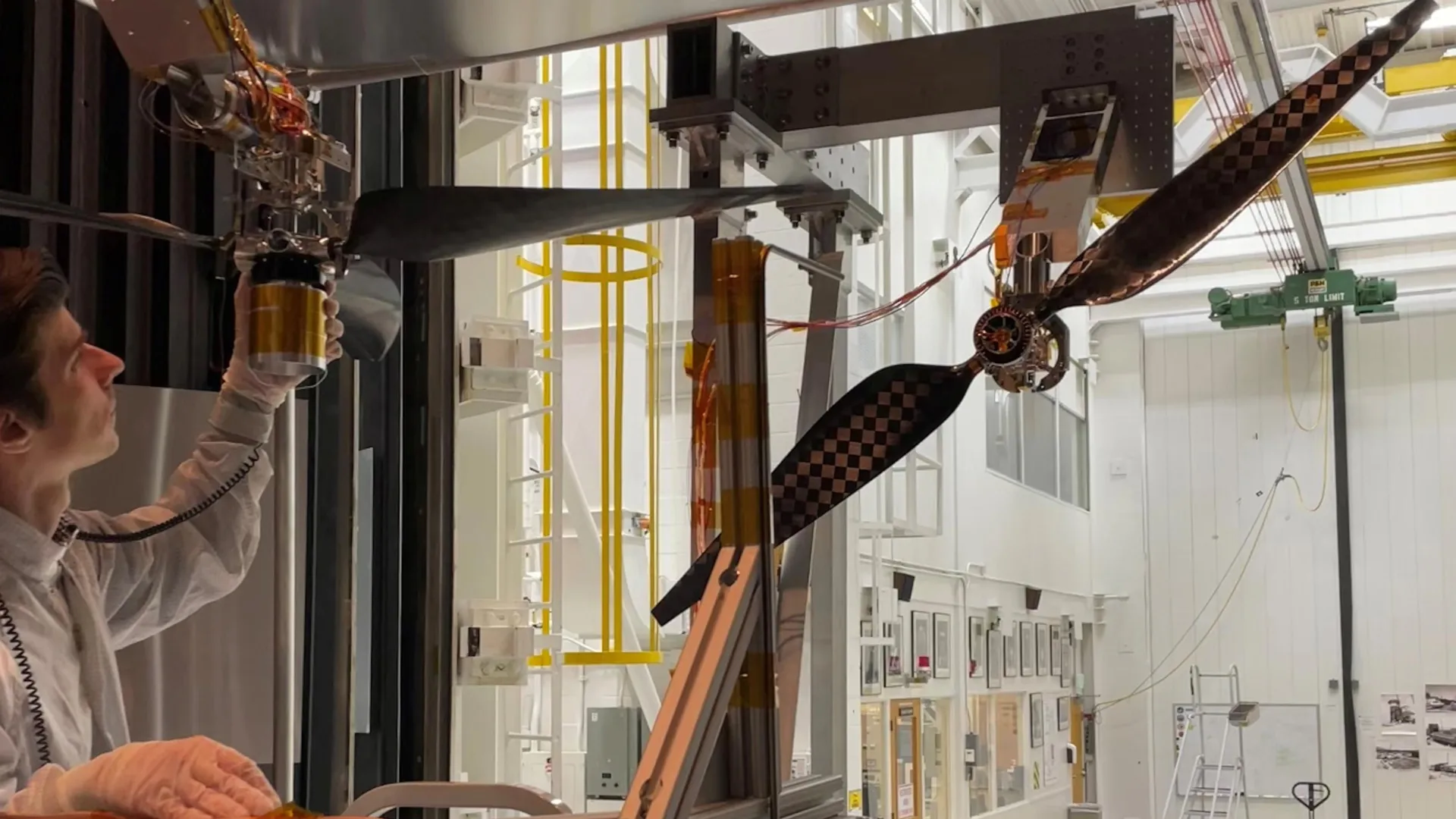
NASA engineers have demonstrated that experimental helicopter rotor blades designed for Mars operations can safely operate at supersonic speeds, marking a significant advancement in the agency’s plans for next-generation aircraft on the Red Planet. During testing conducted in March at the Jet Propulsion Laboratory in Southern California, researchers pushed rotor blade tips beyond the speed of sound without structural failure, with results from 137 test runs informing the development of more powerful aircraft capable of carrying advanced scientific instruments.
Mars presents unique aeronautical challenges due to its extremely thin atmosphere, which is only about 1% as dense as Earth’s. This sparse air requires helicopter rotors to spin at exceptionally high speeds to generate sufficient lift. The speed of sound on Mars is approximately 540 miles per hour, considerably slower than the 760 miles per hour at sea level on Earth, primarily because the Martian atmosphere is much colder and composed mainly of carbon dioxide. Engineers used a specialized chamber at JPL to recreate Martian atmospheric conditions while testing the rotors at progressively higher speeds and introducing simulated winds.
The testing program evaluated two rotor configurations. The initial three-bladed design reached 3,750 revolutions per minute, with blade tips achieving Mach 0.98 before simulated headwinds pushed the system further. The rotors ultimately exceeded Mach 1, reaching Mach 1.08, while remaining structurally intact. A second two-bladed rotor design intended for the SkyFall project achieved similar near-supersonic performance at a lower rotational rate of 3,570 revolutions per minute.
The breakthrough allows for a 30% increase in lift capability, enabling future Mars aircraft to carry heavier payloads and remain aloft longer. These advances support NASA’s broader goals for expanded aerial exploration of Mars, including the potential to transport advanced sensors and scientific instruments to investigate the planet’s atmosphere and surface from low altitudes. Such capabilities would provide valuable data for supporting future robotic and human missions to Mars.
Article Attribution | Read More at Article Source
Article summary produced by Claude AI