

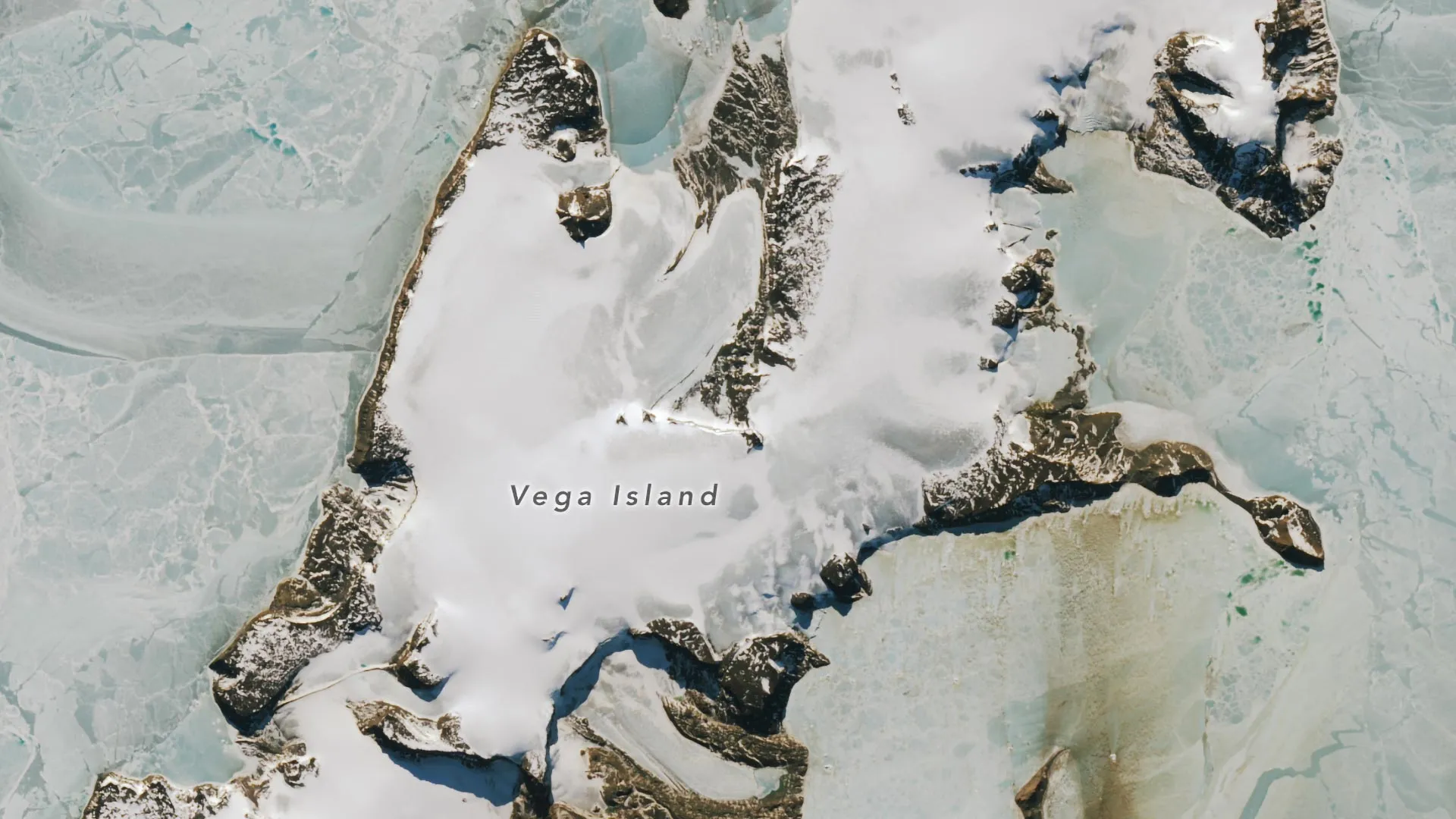
Vega Island, located in the Weddell Sea east of the Antarctic Peninsula, displays a distinctive skull-like appearance when observed from satellite imagery. The formation is created by several natural geological features, including a nunatak that resembles an eye socket, a lateral moraine outlining the mouth, and Bahía del Diablo Glacier forming the lower jaw. The island’s rocky and icy terrain appears to gaze toward nearby Devil Island.
NASA’s Landsat 9 satellite captured images of the island on March 22, 2025, and October 10, 2026, revealing dramatic seasonal variations in snow coverage. The March 2025 image showed extensive snow blanketing the terrain, consistent with typical weather patterns. By October 2026, however, significant portions of the island were free of snow, exposing darker glacier ice beneath. Glaciologist Mauri Pelto attributed the unusual snow loss to warm winter conditions in 2026, particularly in June, along with sublimation processes and wind-driven snow removal.
The exposed ice poses potential consequences for glacier dynamics. Fresh snow reflects solar radiation, while darker exposed ice absorbs more energy, leading to accelerated melting as temperatures rise and daylight increases during warmer months. Scientists suggest that even modest new snowfall from spring storms could temporarily slow the melting process by providing reflective cover.
Vega Island’s glaciers have been under scientific observation for decades. Research dating to 1982 identified four ice caps and 29 glaciers across the island. Devil’s Bay Glacier has been specifically monitored since the Antarctic summer of 1998-1999, with measurements indicating overall mass reduction. Satellite observations spanning recent decades document continued ice loss across multiple glaciers, with increasing bedrock exposure visible.
Beyond its geological significance, Vega Island holds historical importance from early Antarctic exploration. The Swedish Antarctic Expedition of 1901-1903 became separated during their mission, with groups forced to endure the Antarctic winter at different locations. After their ship was destroyed by pack ice, the explorers faced extreme survival challenges. Two groups reunited in spring 1903 at Cape Well-met, located near the skull formation’s forehead, before an Argentinean expedition rescued the survivors.
Article Attribution | Read More at Article Source
Article summary produced by Claude AI