

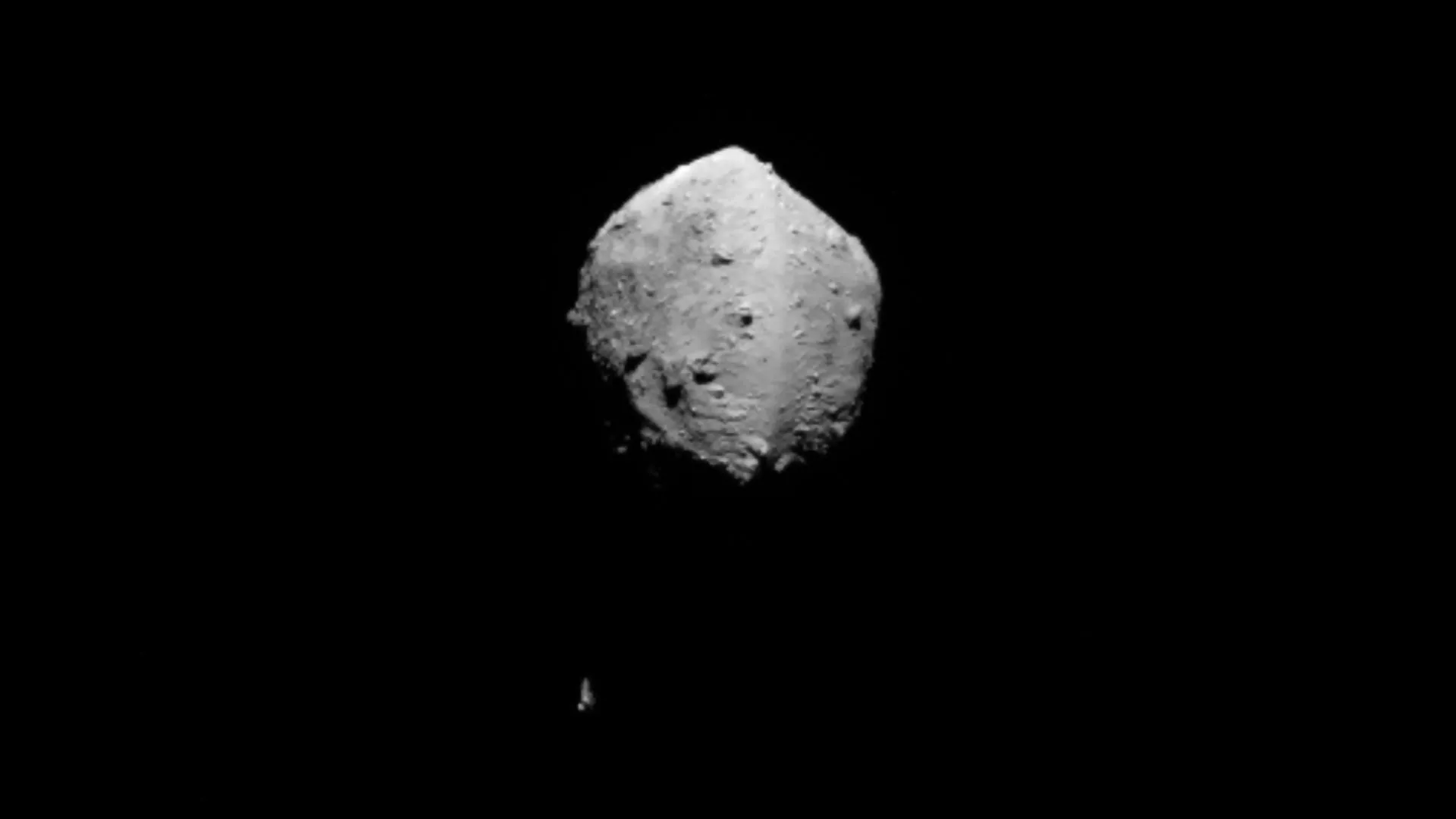
The European Space Agency’s Hera spacecraft has obtained its initial detailed photographs of the Didymos binary asteroid system, providing scientists with fresh observational data from the site of NASA’s landmark kinetic impact demonstration. The images were acquired from a distance of 60 kilometers using Hera’s monochromatic imaging equipment, revealing surface features of the primary asteroid while Dimorphos, the smaller body, remained largely in shadow.
In September 2022, NASA’s DART spacecraft deliberately collided with Dimorphos at approximately 6.1 kilometers per second, reducing the time required for the smaller asteroid to orbit its larger companion by roughly 33 minutes—a result that exceeded initial scientific expectations. The collision marked the first instance of humanity measurably altering an object’s orbital path through deliberate action. Hera’s newly captured imagery shows a previously unobserved side of Didymos, featuring a central equatorial ridge, multiple boulders, craters, and what appear to be groove or ridge patterns across its surface.
Scientists are investigating whether impact debris ejected during the DART collision may have traveled across the approximately one-kilometer separation between the two asteroids and contributed to the newly visible surface characteristics on Didymos. Understanding the physical mechanisms underlying the orbit alteration will be central to Hera’s investigation, potentially enabling more accurate predictions for future asteroid deflection attempts.
After traveling for two years to reach the system, located 196.8 million kilometers from Earth, Hera is now conducting a detailed examination of the impact site. The mission aims to transform kinetic impact deflection from a successful experimental demonstration into a reliable planetary defense technique. Additional detailed imagery of both asteroids is scheduled for release later in November, offering further insight into this historic experiment in space-based planetary protection.
Article Attribution | Read More at Article Source
Article summary produced by Claude AI