

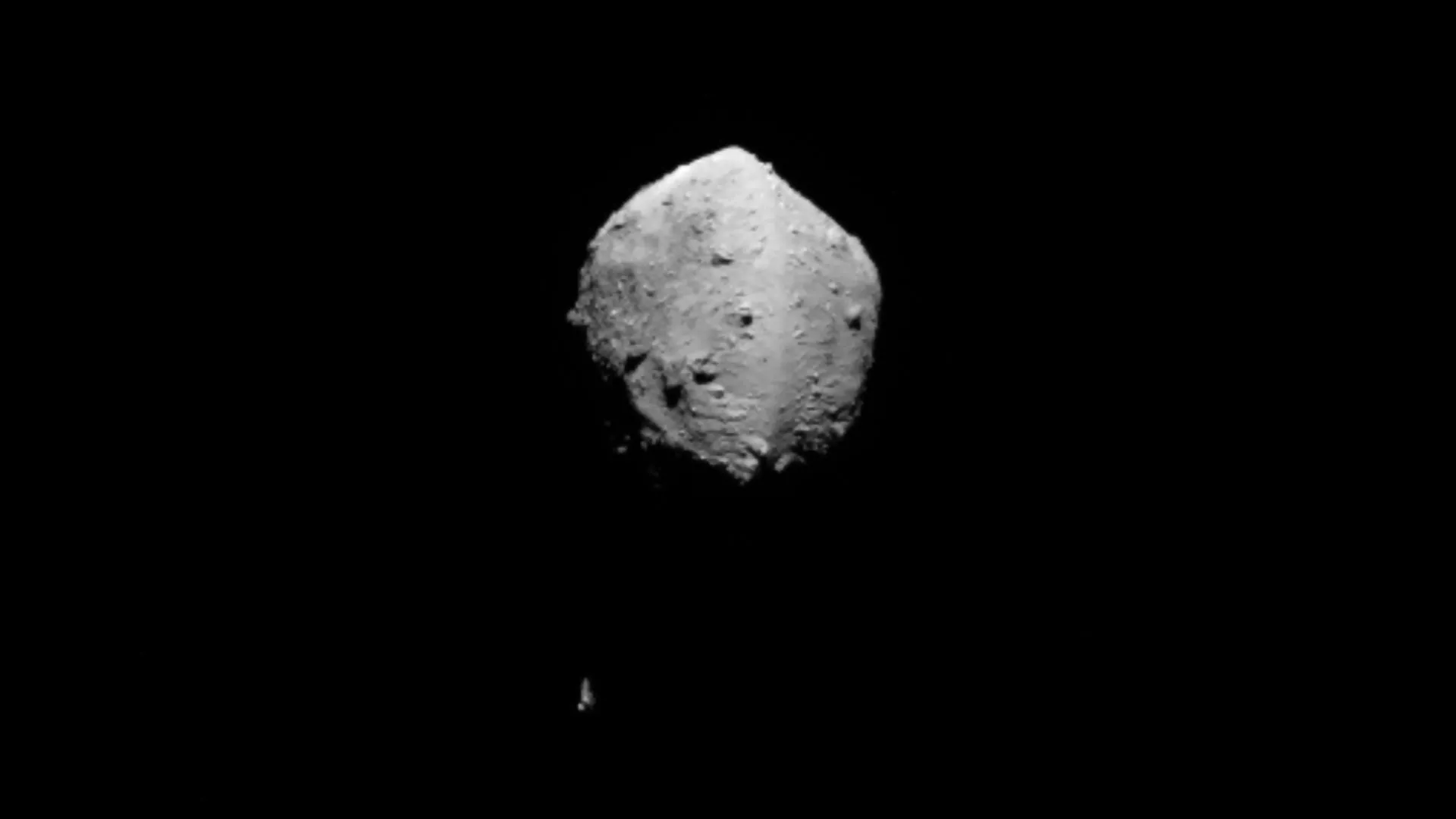
The European Space Agency’s Hera spacecraft has obtained its first detailed photographs of the Didymos binary asteroid system, providing scientists with new data about the site of NASA’s deliberate asteroid deflection test. The images were captured from a distance of 60 kilometers using Hera’s monochromatic Asteroid Framing Camera, which operates in black and white. The photographs reveal the larger asteroid, Didymos, measuring 780 meters in diameter, while the smaller Dimorphos, which spans 151 meters across, remains largely shadowed in the image.
The newly visible side of Didymos displays features that differ markedly from previously observed portions of the asteroid. Scientists note the presence of a central ridge along the equator, multiple boulders, impact craters, and what appear to be grooves or ridge patterns across the surface. These newly revealed characteristics prompt questions about the asteroid’s geological development and whether the impact on Dimorphos may have altered its larger companion. When NASA’s DART spacecraft collided with Dimorphos on September 26, 2022, at approximately 6.1 kilometers per second, the collision ejected material into space. Researchers anticipate that some debris traveled across the approximately one-kilometer gap separating the two asteroids and may have reached Didymos.
The DART mission successfully demonstrated that a kinetic impact could measurably alter an asteroid’s orbit, reducing Dimorphos’s orbital period around Didymos by roughly 33 minutes. This represented a substantially larger effect than scientists had initially predicted. Hera’s investigation will help researchers understand the physical mechanisms underlying this result and may improve predictions for future asteroid deflection attempts.
After a two-year journey, Hera has arrived at the binary system located 196.8 million kilometers from Earth. The spacecraft is now conducting a detailed examination of the collision site to document the consequences of NASA’s groundbreaking experiment. Mission officials indicate that additional detailed images of both asteroids are scheduled for release on November 25, which will provide more comprehensive data about the system. The findings may help establish kinetic impact deflection as a reliable planetary defense strategy against potentially hazardous asteroids.
Article Attribution | Read More at Article Source
Article summary produced by Claude AI