

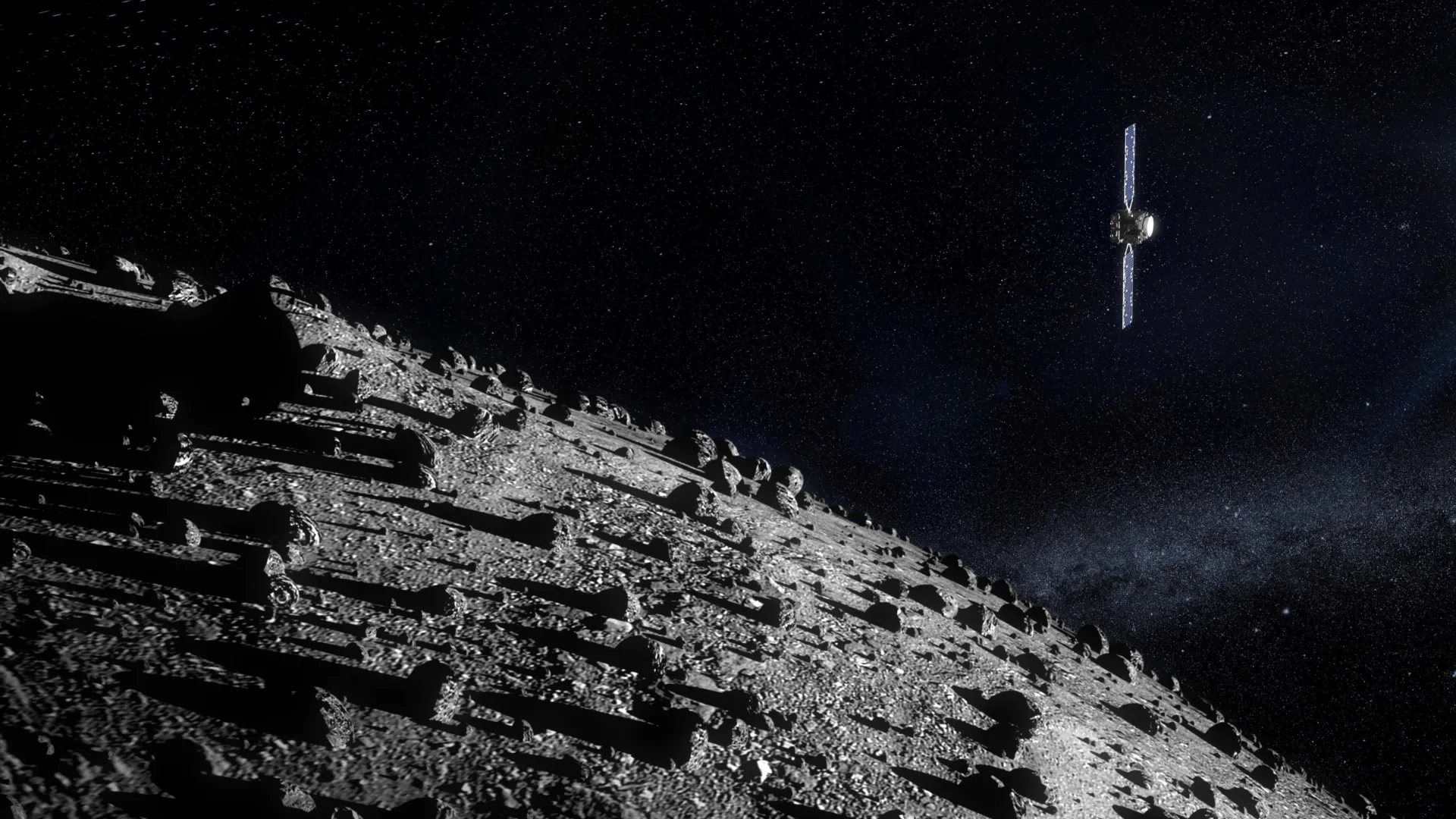
The European Space Agency’s Hera spacecraft has achieved a significant milestone in its mission to study the aftermath of a planetary defense experiment. The spacecraft’s onboard camera has successfully resolved the binary asteroid system Didymos and Dimorphos as distinct objects rather than appearing as a single point of light, marking the first time the two bodies have been visually separated by Hera’s instruments. The asteroids currently remain approximately 197 million kilometers from Earth.
The breakthrough image was obtained on October 18 using Hera’s Asteroid Framing Camera when the spacecraft was approximately 1,280 kilometers away from its targets. Prior to this achievement, the asteroid system had appeared to the spacecraft’s instruments as a single dot. Dimorphos, the smaller member of the pair, measures roughly 151 meters across, while its larger companion Didymos spans approximately 780 meters in diameter. The smaller asteroid orbits its primary body at an average distance of 1.15 kilometers.
Hera’s investigation focuses on understanding the results of a groundbreaking experiment conducted four years earlier. In 2022, NASA’s Double Asteroid Redirection Test spacecraft deliberately collided with Dimorphos at high speed, demonstrating that human technology could alter an asteroid’s trajectory. The impact altered Dimorphos’s orbital period around Didymos by approximately 33 minutes and ejected debris thousands of kilometers into space. However, the orbital change exceeded predictions from computer simulations, prompting questions about the asteroid’s composition and structural properties.
Scientists have yet to determine whether the collision created a crater on Dimorphos or significantly modified its shape. Detailed measurements of the asteroid’s mass, internal structure, and composition are needed to explain the impact’s effectiveness. Over the coming months, Hera will conduct a comprehensive investigation using multiple scientific instruments and will deploy small satellites to gather close-range observations. These findings are expected to improve understanding of how asteroids respond to kinetic impacts and strengthen planetary defense strategies for potential future threats.
Article Attribution | Read More at Article Source
Article summary produced by Claude AI