

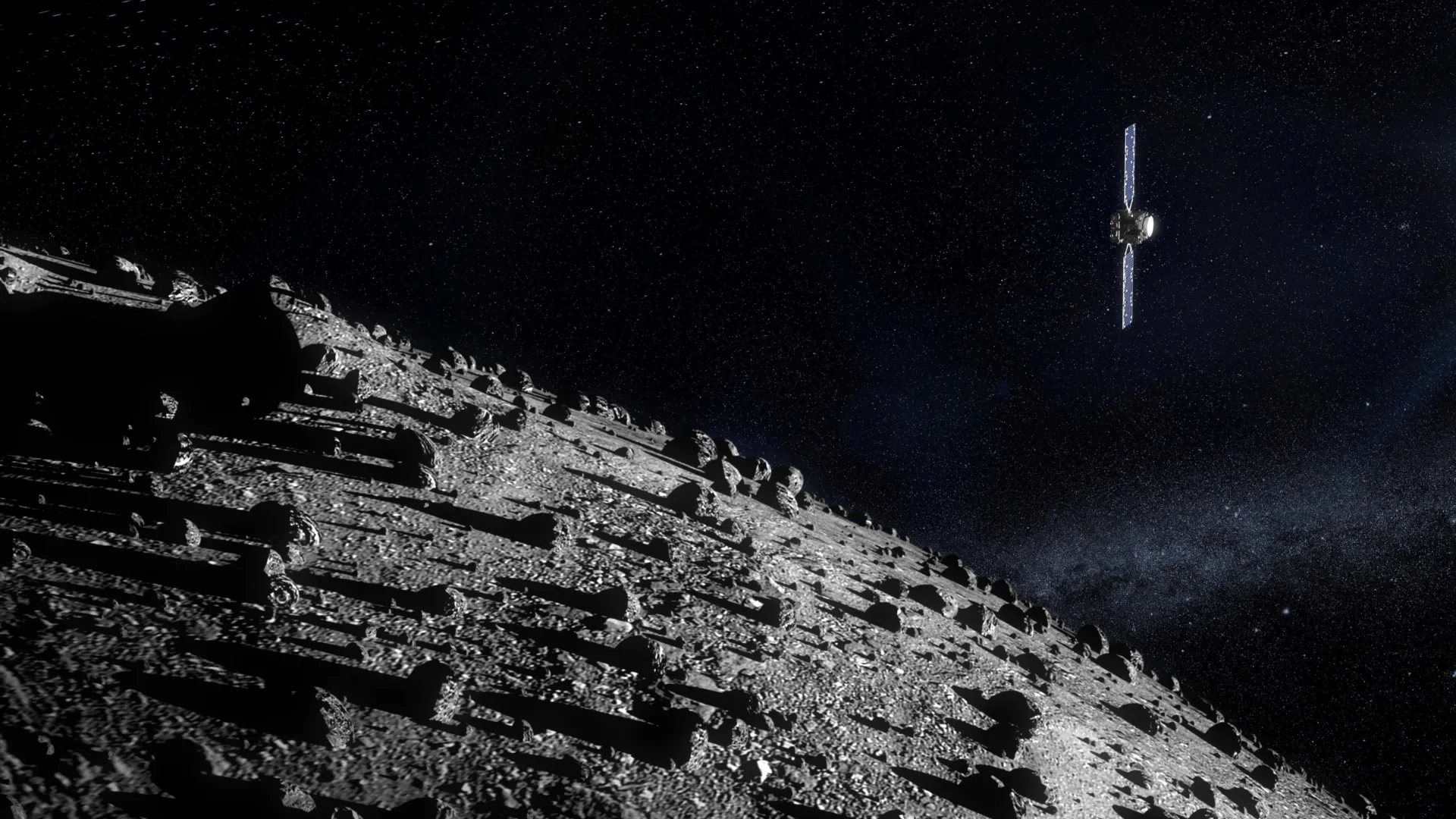
The European Space Agency’s Hera spacecraft has achieved a significant milestone in its mission to study the aftermath of a deliberate asteroid collision. On October 18, the spacecraft’s Asteroid Framing Camera captured the first resolved images of Didymos and Dimorphos as distinct objects rather than a single point of light. At the time of the observation, Hera was positioned approximately 1,280 kilometers from the asteroid pair, which remains about 197 million kilometers from Earth.
The two asteroids represent substantial celestial bodies. Dimorphos measures roughly 151 meters in diameter, comparable to the Great Pyramid of Giza, while its larger companion Didymos spans approximately 780 meters across. Dimorphos orbits Didymos at an average distance of 1.15 kilometers, traveling at a velocity of approximately 18 centimeters per second. Earlier in October, Hera completed a series of thruster firings to reduce its approach speed to 20 meters per second, allowing mission controllers to carefully manage the spacecraft’s continued approach to the system.
Hera’s investigation will examine the consequences of a historic planetary defense experiment conducted four years prior. On September 26, 2022, NASA’s Double Asteroid Redirection Test (DART) spacecraft deliberately collided with Dimorphos at roughly 6.1 kilometers per second. The impact ejected debris up to 10,000 kilometers into space and altered the asteroid’s orbital period around Didymos by approximately 33 minutes. The collision demonstrated that kinetic impact could modify an asteroid’s trajectory, an outcome with significant implications for future planetary defense strategies.
The DART impact produced unexpected results that scientists continue investigating. The orbital change exceeded predictions from computer simulations, raising questions about Dimorphos’s physical composition and structural properties. Researchers lack definitive information regarding whether the collision created a crater, substantially reshaped the asteroid, or produced other significant structural modifications. Hera’s detailed examination will employ multiple scientific instruments and deploy small CubeSat satellites to gather observations from close range, with investigations eventually including landing operations. These measurements will help scientists refine their understanding of asteroid impact mechanics and improve the reliability of kinetic deflection as a planetary defense method.
Article Attribution | Read More at Article Source
Article summary produced by Claude AI