

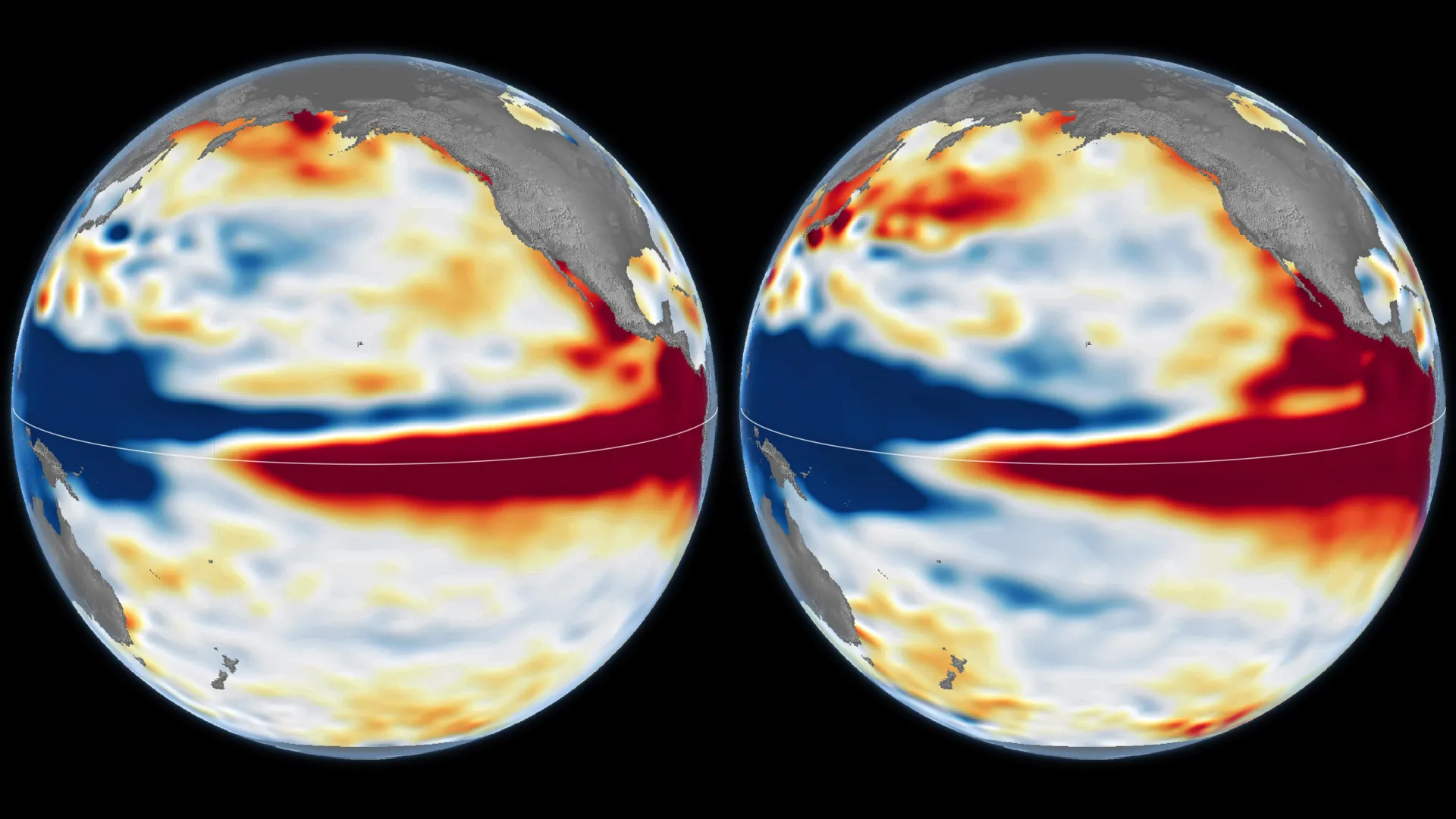
NASA scientists are monitoring an exceptionally intense El Niño phenomenon that satellite observations suggest may become as powerful as or potentially larger than the renowned 1997-98 event. Using 35 years of satellite data, researchers have identified notable similarities between the current conditions and previous major El Niño episodes, though each event develops through distinct pathways and produces varying regional effects.
El Niño emerges from a complex interaction between ocean temperatures and atmospheric winds in the equatorial Pacific. Under typical conditions, trade winds direct warm surface water toward the western Pacific, creating a gradient in sea level and temperature. When trade winds weaken, warm water migrates eastward across the ocean, potentially reinforcing itself through atmospheric feedback mechanisms. Josh Willis, a project scientist at NASA’s Jet Propulsion Laboratory, noted that while the fundamental process remains consistent, individual El Niño events differ substantially in their spatial patterns and atmospheric responses.
Satellite altimetry measurements, which detect ocean surface height variations linked to water temperature, provide a consistent basis for comparing events across decades. NASA’s analysis of data from October 1997 and October 2026 reveals striking parallels, including pronounced east-west sea level gradients and unusually warm water extending along the equator toward South America. Despite the 2026 event intensifying more rapidly than its 1997 predecessor, the spatial distribution of warm water shows remarkable similarity, suggesting potentially comparable weather consequences for regions including California and the southern United States.
However, the 2015-16 El Niño demonstrates that similar overall strength does not guarantee identical regional impacts. Although that event featured comparable ocean warming and sea level elevation, the warm water did not extend as strongly toward South America, resulting in different precipitation patterns centered over Central America and the southeastern United States rather than California. The National Oceanic and Atmospheric Administration forecast an 83 percent probability of strong to very strong El Niño conditions during the first three months of 2027, though scientists continue monitoring developments to determine specific regional effects.
Article Attribution | Read More at Article Source
Article summary produced by Claude AI