

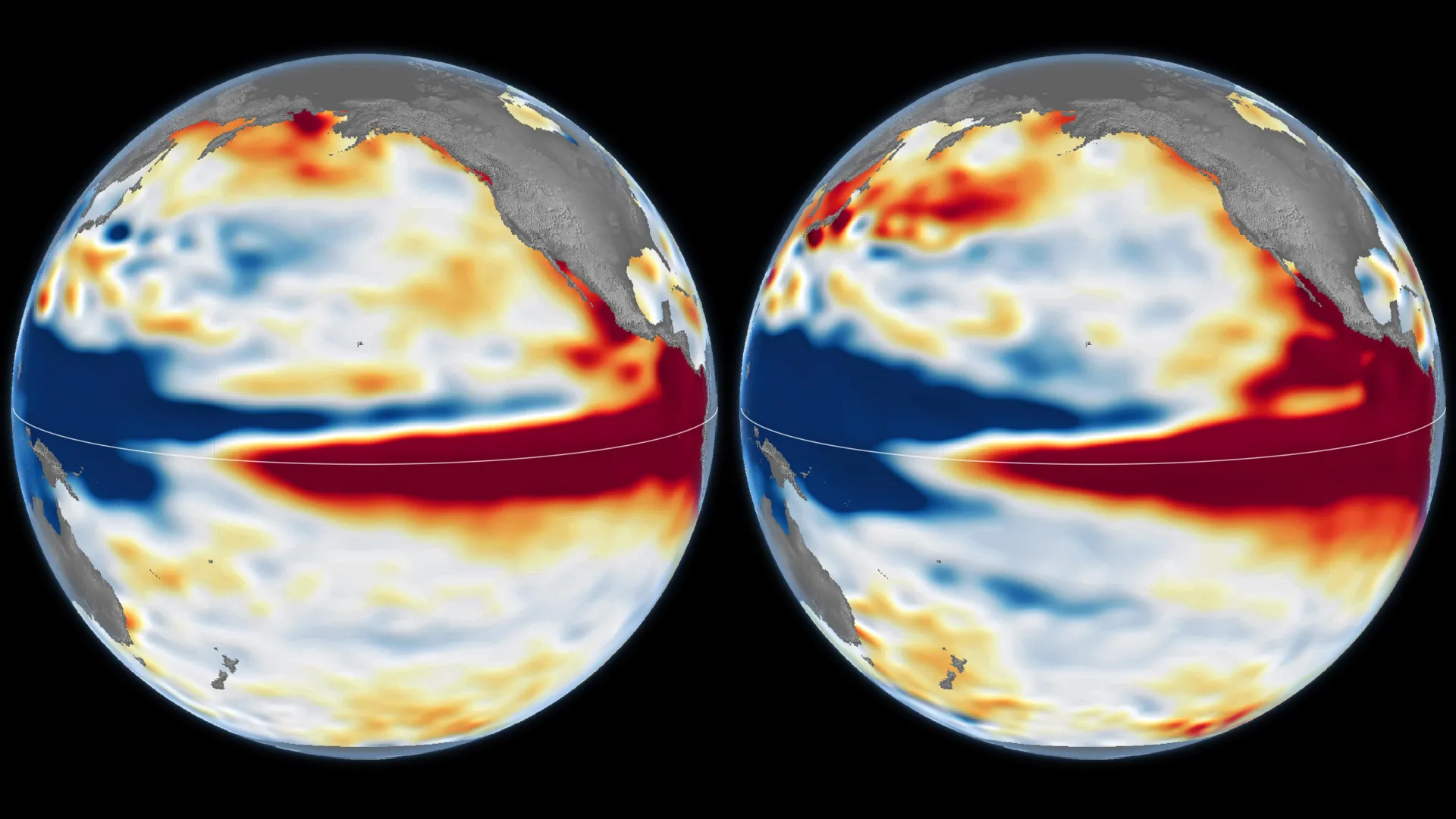
NASA researchers have identified an exceptionally strong El Niño developing in 2026 that may become as powerful as or exceed the legendary 1997-98 event. Using 35 years of satellite observations from successive missions, scientists are comparing current ocean conditions with some of the strongest El Niño episodes on record. El Niño represents a recurring climate cycle that typically occurs every two to seven years, characterized by elevated ocean temperatures across portions of the equatorial Pacific. These temperature shifts can disrupt global atmospheric circulation and generate weather disturbances far beyond the Pacific region.
The development of El Niño involves complex interactions between ocean and atmospheric conditions. Under typical circumstances, trade winds transport warm surface water westward across the Pacific, causing an accumulation and elevation of sea levels in that region. When trade winds diminish, this warm water begins migrating eastward, potentially weakening the winds further and creating a reinforcing cycle that spreads additional warm water across the central and eastern Pacific. Each El Niño event develops differently depending on where the warmest water concentrates and how the atmosphere responds to these changes.
NASA scientists employ satellite altimetry technology to measure subtle variations in ocean surface elevation, which reveals where heat is accumulating since warmer seawater expands and raises local sea levels. Comparison maps from October 1997 and October 2026 demonstrate striking similarities in how the two events are progressing. Both feature pronounced sea level differences across the Pacific basin, with elevated warm water extending eastward along the equator toward the South American coast. The 2026 event developed more abruptly than its 1997-98 predecessor, yet satellite measurements indicate comparable intensity and geographic distribution of warm water.
Historical records show that powerful El Niño episodes produce significant weather consequences. The 1997-98 and 2015-16 events generated destructive conditions including Indonesian and Amazon wildfires, southern African droughts, and intense precipitation events in California and other regions. However, the 2015-16 event demonstrated that similar overall strength does not guarantee identical weather impacts, as that event’s warm water did not extend as strongly toward South America, resulting in different rainfall patterns concentrated over Central America and the southeastern United States. NOAA forecasts indicate an 83 percent probability of strong to very strong El Niño conditions during early 2027, suggesting potentially significant climate impacts ahead, though exact locations of severe effects remain uncertain.
Article Attribution | Read More at Article Source
Article summary produced by Claude AI