

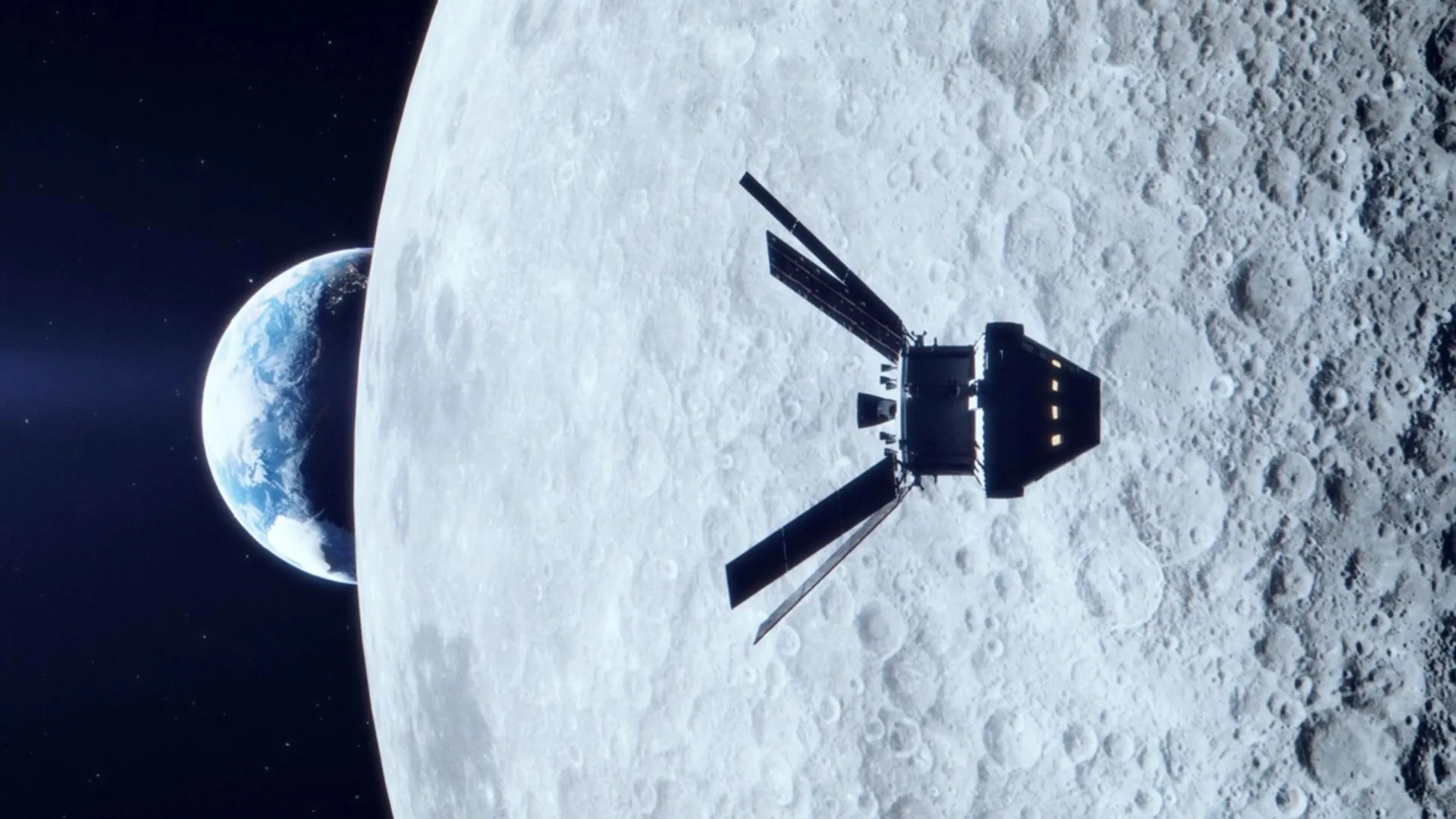
NASA’s uncrewed Artemis I mission, which traveled to the Moon in late November and early December 2022, has yielded new data on cosmic radiation exposure in the lunar environment. The Orion spacecraft carried more than 10,000 tiny crystals embedded in human-shaped mannequins to record radiation throughout the journey. Among these were experimental fluorescent lithium fluoride detectors developed by scientists at the Institute of Nuclear Physics of the Polish Academy of Sciences in Cracow, along with nearly 600 additional thermoluminescent crystal detectors.
The lithium fluoride detectors function by capturing microscopic damage caused by radiation exposure. When charged particles pass through the crystals, they create defects known as color centers. By illuminating these altered regions with blue light, which causes them to fluoresce red, researchers can examine particle tracks under a microscope. This approach offers advantages over traditional plastic detectors, which require chemical etching before analysis. However, interpreting the resulting data proved complex due to the unpredictable nature of cosmic radiation, which arrives from multiple directions with varying particle types and energy levels.
To address these challenges, the research team developed sophisticated calibration and analysis techniques, including specialized software to remove background interference. Their refined measurements aligned closely with results from established detector technologies while also identifying radiation events below the detection threshold of conventional devices. The findings appeared in the journal Radiation Measurements.
The Artemis I measurements revealed significant differences compared with earlier radiation studies conducted aboard the International Space Station more than a decade prior. In low Earth orbit, much of the radiation dose comes from low-energy protons trapped within Earth’s Van Allen radiation belts. Near the Moon, these belts are absent, resulting in a greater contribution from high-energy galactic particles. These particles carry sufficient energy to travel through the human body, producing a more uniform radiation distribution throughout the mannequins rather than the concentrated patterns observed in orbit. Despite higher overall radiation levels near the Moon, the increase proved less dramatic than initially anticipated.
Article Attribution | Read More at Article Source
Article summary produced by Claude AI