

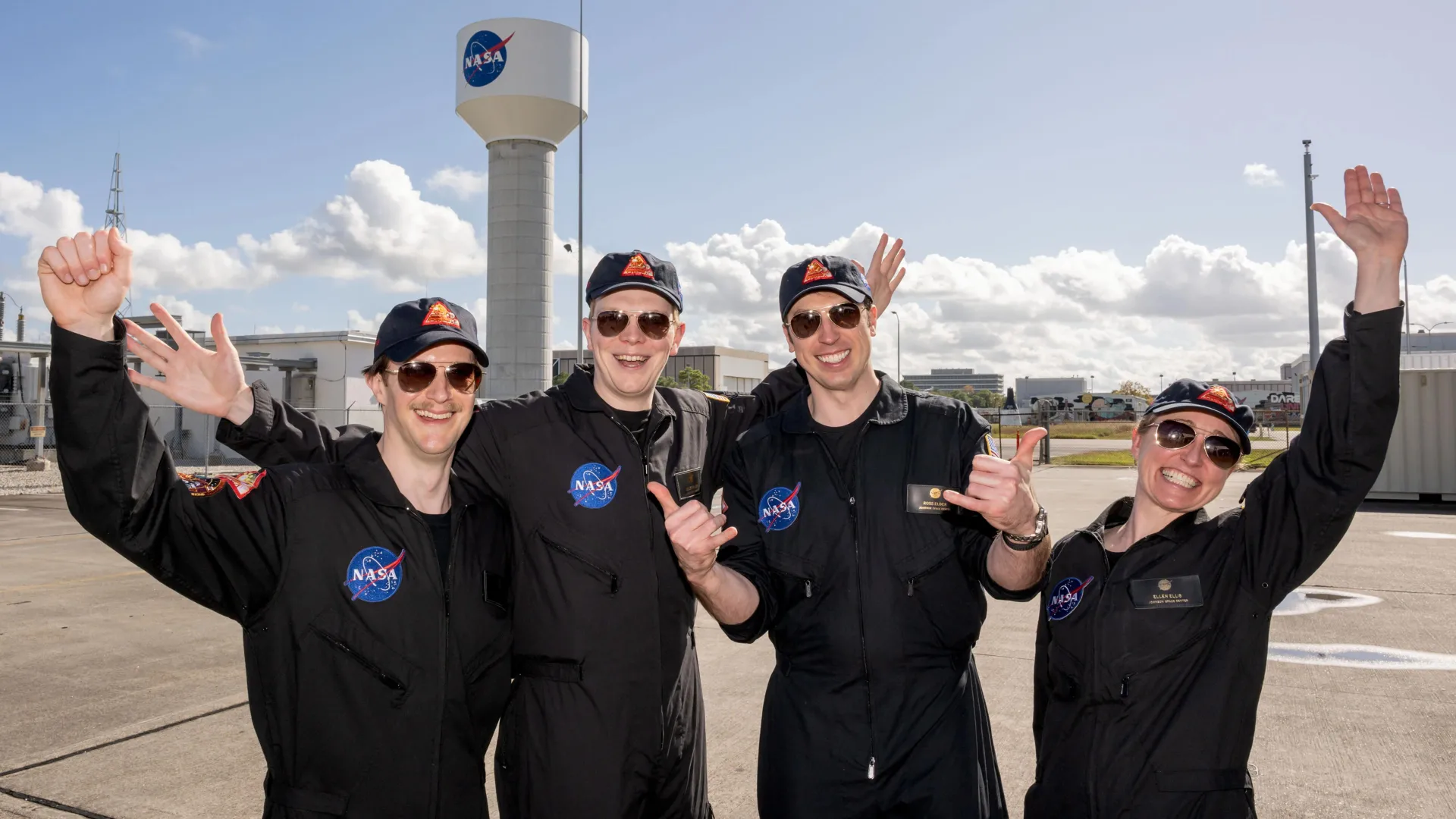
A crew of four volunteers concluded an extensive simulation designed to examine human readiness for Mars exploration, exiting their controlled environment after more than a year of isolation. The participants—Matthew Montgomery, James Spicer, Ross Elder, and Ellen Ellis—ended their mission on October 31, 2026, having spent the intervening period conducting activities comparable to those required for actual Martian missions.
The simulation was conducted under NASA’s Crew Health and Performance Exploration Analog (CHAPEA) program, which systematically investigates how individuals and groups respond to prolonged space exploration conditions. Throughout their time in the controlled habitat, the volunteers performed tasks including system operation and testing, agricultural maintenance, resource management, and extravehicular activities—the operations astronauts conduct outside spacecraft or habitats. The crew also contended with communication delays mimicking what future Mars explorers would experience, as radio signals require substantial time to traverse the distance between Earth and Mars, preventing real-time interaction with mission control.
Managing crew health and performance during extended missions away from Earth presents significant challenges for space agencies. Successful Mars expeditions will require astronauts to handle food production, equipment maintenance, environmental management, and problem-solving with limited support and in confined quarters. NASA employs analog missions—realistic simulations conducted on Earth that recreate selected conditions of space travel—as a research tool to examine human responses in controlled settings before attempting actual deep-space journeys.
The findings from Montgomery, Spicer, Elder, and Ellis’s year-long mission are expected to contribute to the planning and development of upcoming human exploration initiatives. The data gathered will inform preparations for NASA’s lunar base development and eventual crewed expeditions to Mars. Although the simulation remained entirely terrestrial, the insights gained regarding crew dynamics, resource management, and psychological adaptation could prove valuable as humanity prepares for missions to distant destinations.
Article Attribution | Read More at Article Source
Article summary produced by Claude AI