

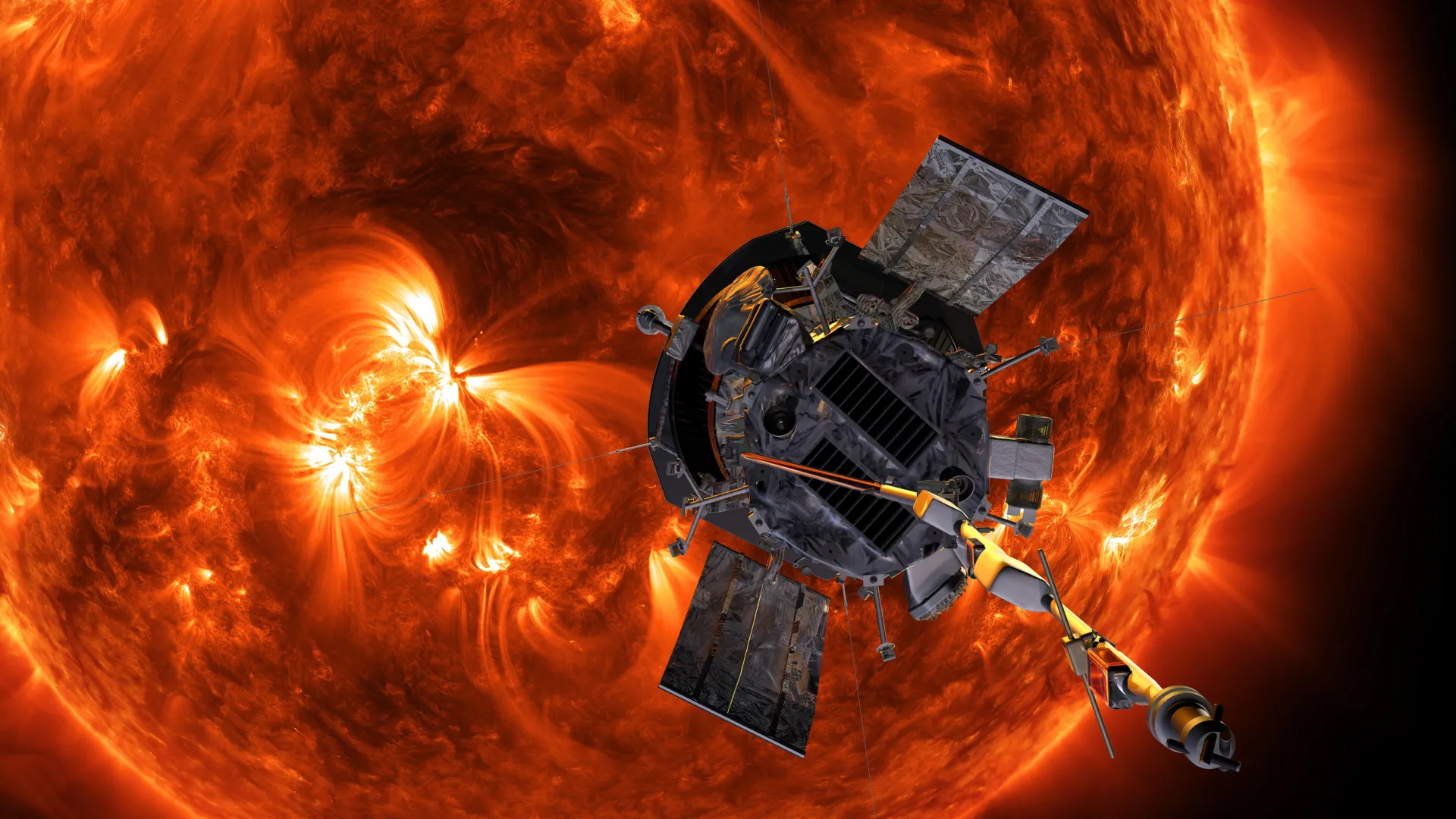
An international research collaboration has identified a previously unknown magnetic phenomenon in space plasma turbulence using data from NASA’s Parker Solar Probe. The discovery, published in The Astrophysical Journal Letters, reveals that magnetic fields within turbulent solar wind follow an organized pattern despite the overall chaotic nature of the system.
Researchers from institutions including Technische Universität Braunschweig, the University of Tokyo, Tohoku University, Kyushu University, and Osaka University analyzed precise measurements of magnetic fields and particles in the solar wind. They found that turbulent magnetic fields reverse their direction of rotation at particular wavelength ranges—a phenomenon never directly observed in space turbulence before. The reversal becomes more pronounced and shifts toward longer wavelengths as solar wind travels farther from the Sun.
The magnetic reversal occurs at a critical boundary where plasma transitions from behaving like a flowing fluid at larger scales to exhibiting dynamics governed by individual particles at smaller scales. When viewed from a direction pointing outward from the Sun, magnetic fields at larger scales rotate counterclockwise, while at much smaller scales the preferred rotation switches to clockwise. This organized pattern emerges precisely where the physical behavior of plasma fundamentally changes.
The implications of this discovery extend across multiple areas of space physics. Plasma turbulence occurs throughout the universe in Earth’s magnetosphere, solar wind, regions affected by solar eruptions, interplanetary space, and accretion disks surrounding astronomical objects. Understanding how organized patterns emerge within turbulent systems could improve scientific models used to predict geomagnetic storms and forecast space weather, which are influenced by disturbances traveling through interplanetary space following solar eruptions.
Article Attribution | Read More at Article Source
Article summary produced by Claude AI