

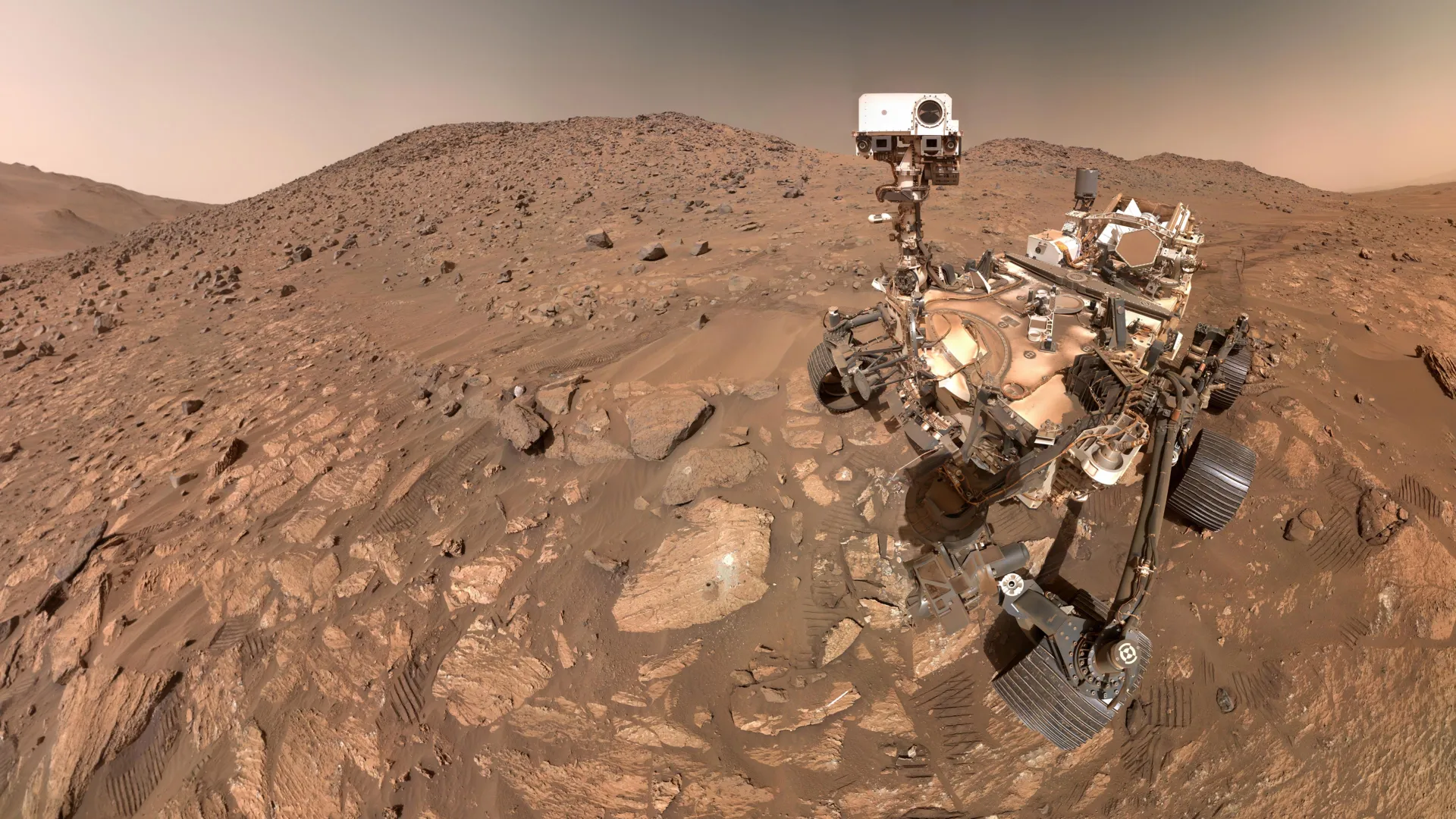
NASA’s Perseverance rover has detected organic carbon in two ancient rocks examined within Mars’ Bright Angel formation, according to research published in Science Advances. The discovery builds on a previous announcement from September 2025 regarding a potential biosignature identified in the same location. The findings provide confirmation that macromolecular carbon, a form of carbon consisting of large interconnected networks of carbon atoms, is present in mudstone rocks within Jezero crater.
Researchers used the SHERLOC instrument mounted on Perseverance’s robotic arm to investigate the rocks, employing Raman spectroscopy to identify organic compounds without damaging the samples. The technique involves shining laser light onto material to map its minerals and chemical composition. The surrounding geology indicates that billions of years ago, water flowed through a river channel into Jezero crater, carrying sediment that eventually solidified into the mudstone formations now being explored. The detected carbon exists alongside carbonate and sulfate minerals, suggesting organic material may have entered or formed within the rocks during multiple periods of Mars’ geological history.
One of the most notable aspects of the discovery is the location where organic carbon was found. The material survived only a few microns below the exposed Martian surface, representing the shallowest detection of macromolecular carbon ever reported on Mars. This finding is unexpected given that the Martian surface experiences radiation, sunlight, and chemically reactive substances that typically destroy organic molecules. Scientists attribute the survival either to the chemical durability of the carbon itself, protection provided by surrounding minerals such as clays, or a combination of both factors.
The presence of organic material at the Bright Angel formation, located more than 2,000 miles from Gale Crater where NASA’s Curiosity rover previously detected organic compounds, suggests that organic carbon may have been widely distributed across ancient Mars rather than confined to specific regions. This distribution indicates that billions of years ago, the chemical ingredients associated with life’s building blocks may have been common in ancient Martian lakes and rivers.
Despite these findings, researchers emphasize that the presence of organic carbon does not confirm that life existed on Mars. Organic compounds can form through nonbiological chemical processes. Determining whether the rocks contain fossilized microorganisms remains beyond the current capabilities of rovers exploring Mars, as neither Perseverance nor Curiosity carries the sophisticated laboratory equipment needed to definitively distinguish fossil evidence from geological processes. Scientists anticipate that future analysis of Martian samples using Earth-based laboratories could provide greater sensitivity and resolution to answer these questions.
Article Attribution | Read More at Article Source
Article summary produced by Claude AI