

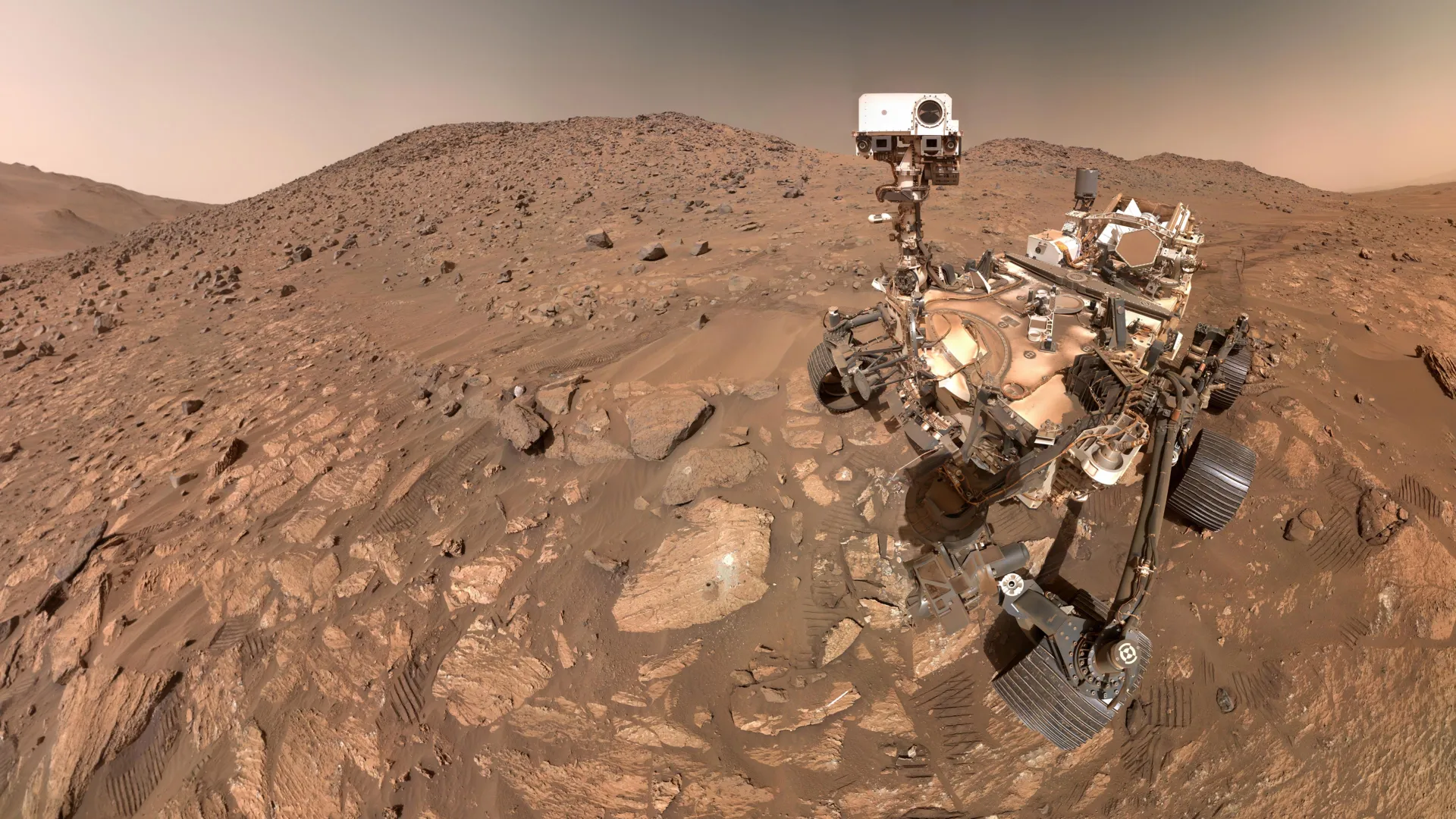
NASA’s Perseverance rover has detected organic carbon in two ancient rocks within Mars’ Bright Angel formation, marking a significant development in the search for evidence of past habitability on the Red Planet. The discovery, detailed in a study published in Science Advances, builds upon findings announced in September 2025 regarding a potential biosignature in the same rock samples. Researchers used the SHERLOC instrument, which employs Raman spectroscopy technology, to identify macromolecular carbon (MMC), a form of carbon consisting of large interconnected networks of carbon atoms.
The presence of organic carbon is noteworthy because it represents a fundamental building block associated with life. However, scientists emphasize that the compound can form through biological processes or through nonbiological chemical reactions, so its existence alone cannot confirm that Mars once hosted living organisms. The surrounding geological context provides additional perspective on the material’s origin. Billions of years ago, water flowed through a river system into Jezero crater, depositing sediment that eventually consolidated into mudstone formations. The detected carbon appears alongside carbonate and sulfate minerals that formed during subsequent periods of water alteration, suggesting the organic material may have entered or developed within these rocks during multiple stages of Mars’ geological history.
One of the most unexpected aspects of the findings concerns the location of the organic carbon. The material survived just microns below the Martian surface, representing the shallowest detection of macromolecular carbon ever documented on Mars. This location is particularly surprising given that Mars’ surface environment exposes materials to radiation, ultraviolet light, and chemically reactive substances that typically destroy organic molecules. Researchers propose that the carbon either possesses inherent chemical resilience or has been protected by surrounding minerals such as clays and iron-rich soil, or possibly both.
The discovery also carries implications for understanding Mars’ ancient habitability. The detection of organic material in the Bright Angel formation, located more than 2,000 miles from Gale Crater where NASA’s Curiosity rover previously identified organic compounds, suggests that such material may have been widely distributed across ancient Mars rather than confined to isolated locations. This distribution pattern aligns with evidence that ancient Mars contained liquid water in lakes and rivers, potentially providing chemical conditions favorable for life.
Determining whether the rocks contain fossilized evidence of actual organisms remains beyond the capabilities of current Mars rovers. Future analysis of samples brought to Earth using more sophisticated laboratory instruments may help scientists determine whether biological or nonbiological processes produced the organic carbon.
Article Attribution | Read More at Article Source
Article summary produced by Claude AI