

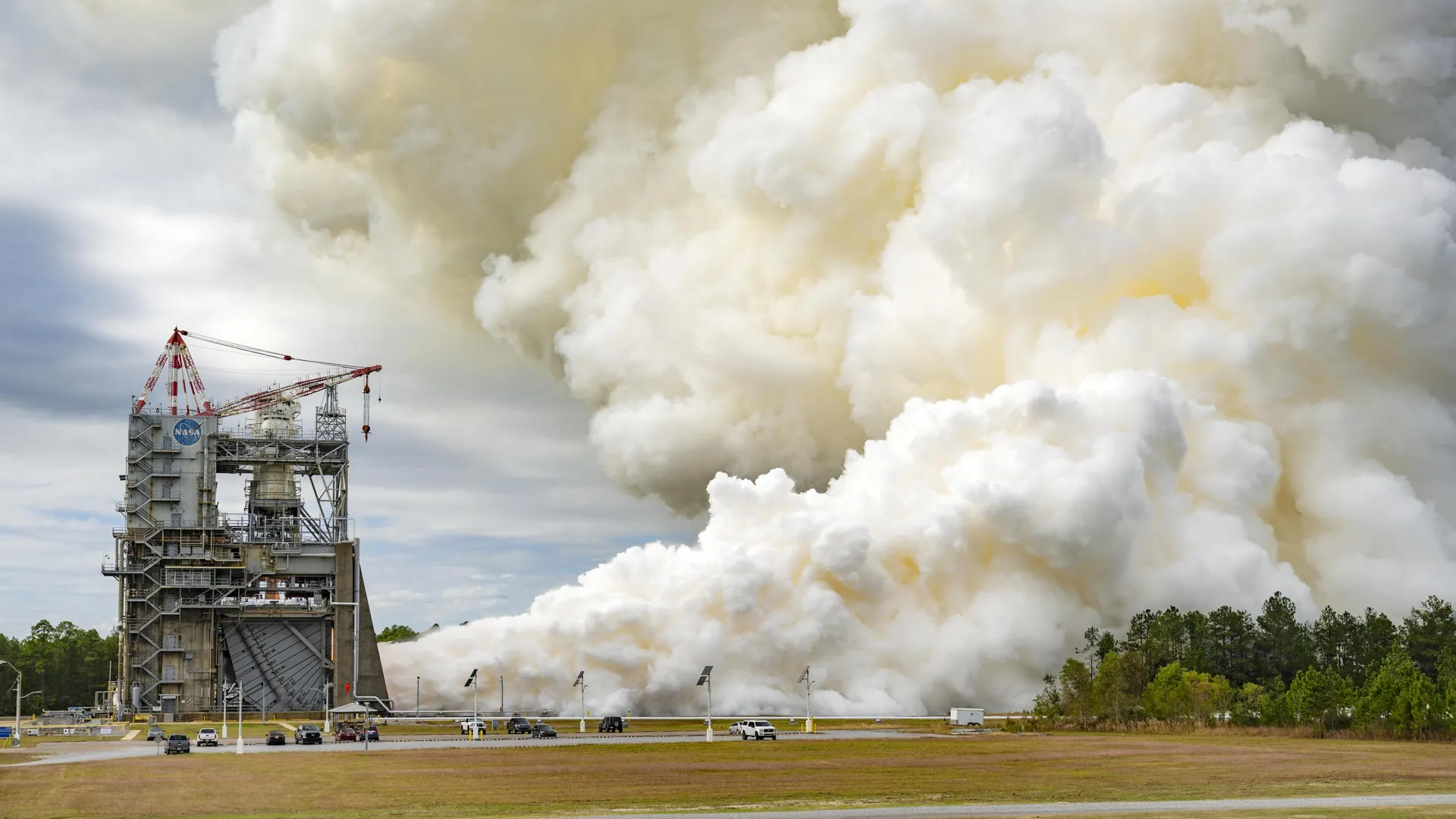
NASA has completed a full-duration test of an RS-25 rocket engine as part of its ongoing development work for future deep space exploration missions. The test took place at the Fred Haise Test Stand located at NASA’s Stennis Space Center near Bay St. Louis, Mississippi, on November 18. The developmental engine performed for its complete scheduled duration of three minutes and 20 seconds.
While this particular engine will not be used for actual spaceflight, the test results will provide NASA and its contractor L3Harris Technologies with critical performance data. The information gathered will help engineers enhance the power, efficiency, and reliability of RS-25 engines intended for upcoming Artemis missions.
The RS-25 engines are essential components of the Space Launch System rocket, with four engines mounted on each launch vehicle. Together, these engines can produce up to 2 million pounds of thrust needed to propel spacecraft away from Earth. NASA requires all RS-25 engines designated for flight to undergo rigorous testing at Stennis Space Center to confirm their ability to withstand the extreme conditions experienced during rocket launches.
NASA is targeting 2028 for Artemis IV, a mission designed to return astronauts to the lunar surface using the Space Launch System rocket to carry crew aboard the Orion spacecraft, which will launch from Kennedy Space Center in Florida. These missions represent part of a broader strategic initiative to establish sustained human presence at the Moon’s South Pole and develop the capabilities required for eventual crewed exploration of Mars.
The testing effort involves collaboration among specialists from NASA, L3Harris Technologies, and Nova Space Solutions, working collectively to ensure the engines meet all requirements for powering future exploration beyond Earth.
Article Attribution | Read More at Article Source
Article summary produced by Claude AI