

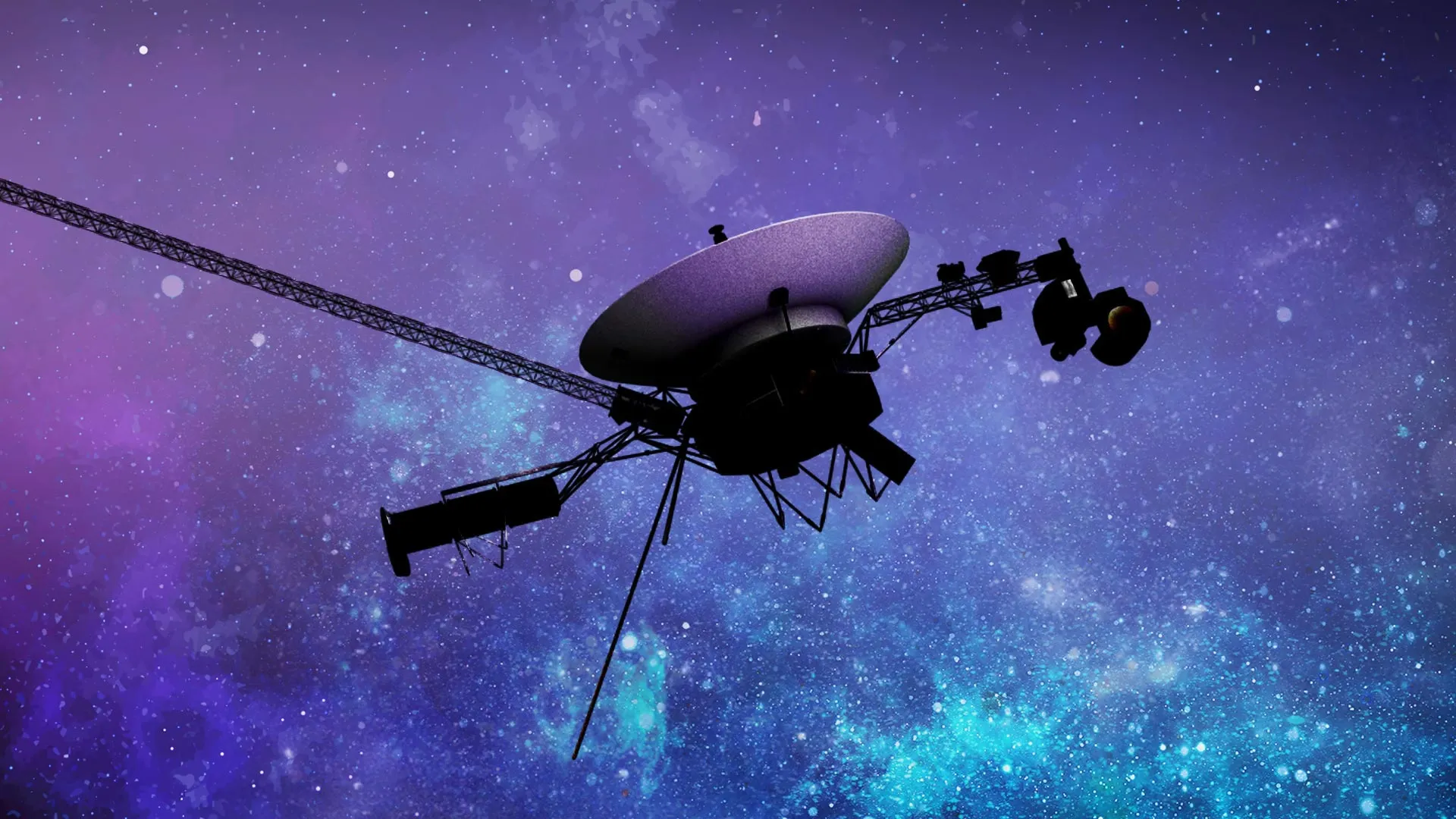
NASA’s Voyager 1 spacecraft is nearing a historic milestone as it approaches a distance of one light-day from Earth, expected to occur on November 18. This achievement marks an extraordinary journey for the probe, which launched in 1977 and has traveled approximately 16 billion miles. The one-light-day distance means that radio signals traveling at the speed of light require a full 24 hours to reach the spacecraft from Earth, with responses requiring another day to return, creating a two-day communication delay.
Maintaining Voyager 1’s operational status has become increasingly challenging due to its aging power systems. The spacecraft generates electricity through radioisotope thermoelectric generators that produce power from plutonium decay, but these systems lose approximately 4 watts of capacity annually. To address this decline, NASA engineers completed a major power-conservation initiative in early September, replacing three onboard devices with more efficient alternatives in a coordinated operation called the “Big Bang.” This upgrade, which took months to prepare, is designed to preserve the spacecraft’s remaining scientific instruments and extend their operational lifespan beyond previously anticipated timelines.
Voyager 1 has already experienced the deactivation of two of its original ten scientific instruments due to power constraints. The spacecraft’s remaining instruments are particularly valuable because they are the only instruments currently capable of directly measuring conditions in interstellar space, the region beyond the Sun’s heliosphere. Without the recent power-conservation upgrade, NASA would have faced the necessity of shutting down another instrument as early as summer 2027.
Complicating these ongoing efforts, Voyager 1 experienced an unexpected communication loss earlier in the week. NASA lost contact with the spacecraft on October 18 and 19 when the Deep Space Network failed to detect its signal. The spacecraft’s signal unexpectedly returned approximately 48 hours later on October 20. Engineers subsequently discovered that one set of thrusters had ceased operation and that the spacecraft had automatically activated backup thrusters through its fault protection system, a safety mechanism designed to address equipment malfunctions. NASA engineers continue investigating the cause of this incident while maintaining regular communication with the probe.
Article Attribution | Read More at Article Source
Article summary produced by Claude AI