

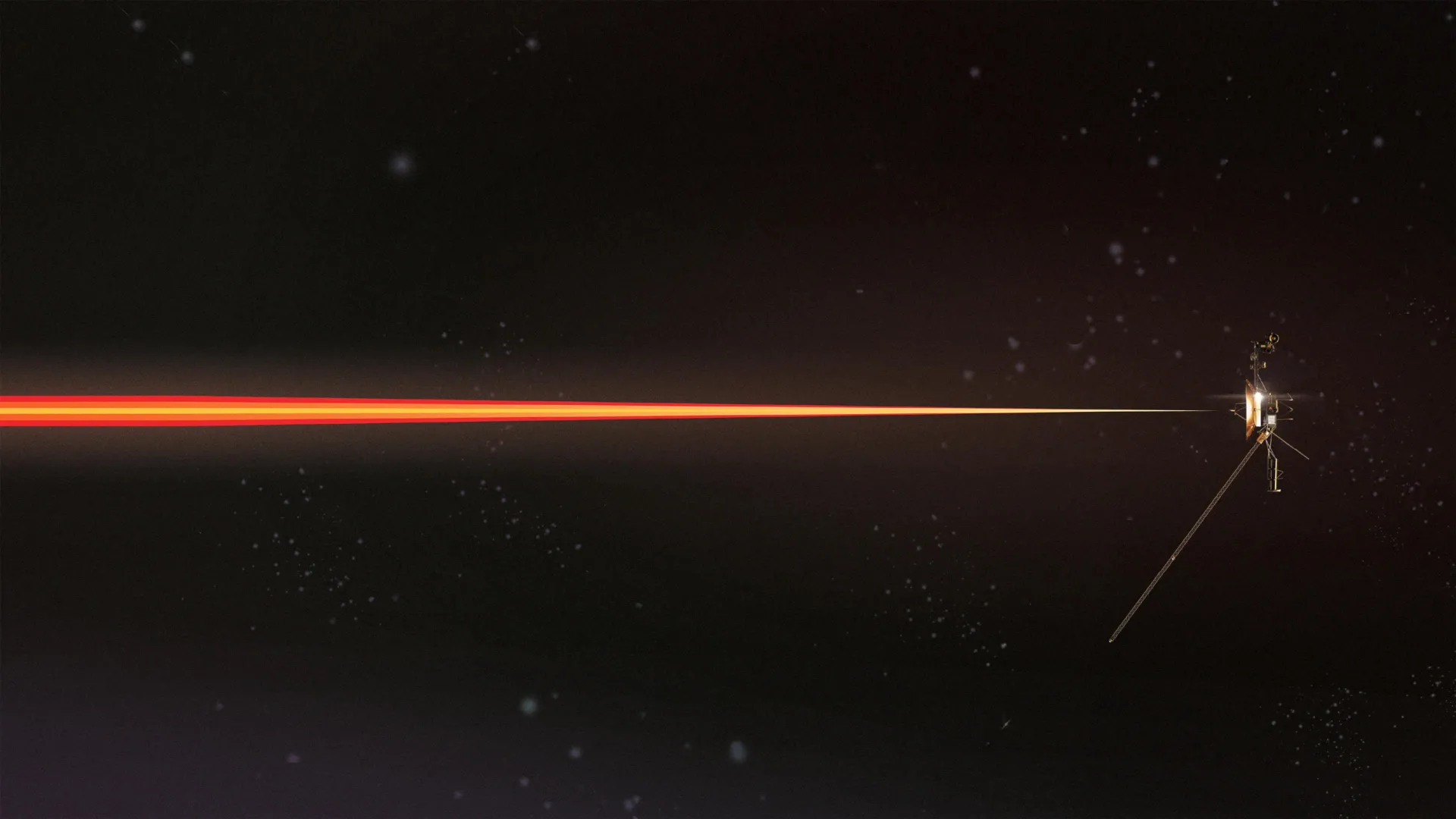
NASA’s Voyager 1 spacecraft achieved a historic milestone when it reached a distance of one light-day from Earth on November 18 at 2:16 a.m. PST. At approximately 16.1 billion miles from home, the spacecraft is now farther from Earth than any other human-made object. Because light takes 24 hours to traverse this distance at 186,000 miles per second, mission controllers at NASA’s Jet Propulsion Laboratory face significant communication delays when sending commands to or receiving responses from the probe.
The Voyager missions were launched in 1977 as twin spacecraft designed to explore the outer planets by utilizing a rare planetary alignment. Both probes successfully conducted close-up investigations of Jupiter and Saturn, while Voyager 2 continued to Uranus and Neptune, capturing the first high-resolution imagery of these distant worlds. Beyond their planetary investigations, both Voyagers crossed the heliosphere boundary in 2012, entering interstellar space where they remain the only human spacecraft to operate in that region. The probes continue transmitting scientific data about the Sun’s magnetic field across vast cosmic distances.
Currently traveling at approximately 38,000 mph through interstellar space, Voyager 1 continues to operate decades beyond its original mission parameters. Mission specialists recently verified the one light-day milestone by tracking the spacecraft’s carrier signal and calculating its trajectory, even as they investigate a data transmission issue that began on November 14. Each Voyager spacecraft carries a Golden Record containing images and sounds from Earth, intended as a message to potential extraterrestrial civilizations. Officials at NASA and Caltech emphasized that the milestone represents not only an engineering achievement but also a reflection of human curiosity and the dedication of multiple generations of scientists and engineers who have sustained the mission across nearly five decades.
Article Attribution | Read More at Article Source
Article summary produced by Claude AI