

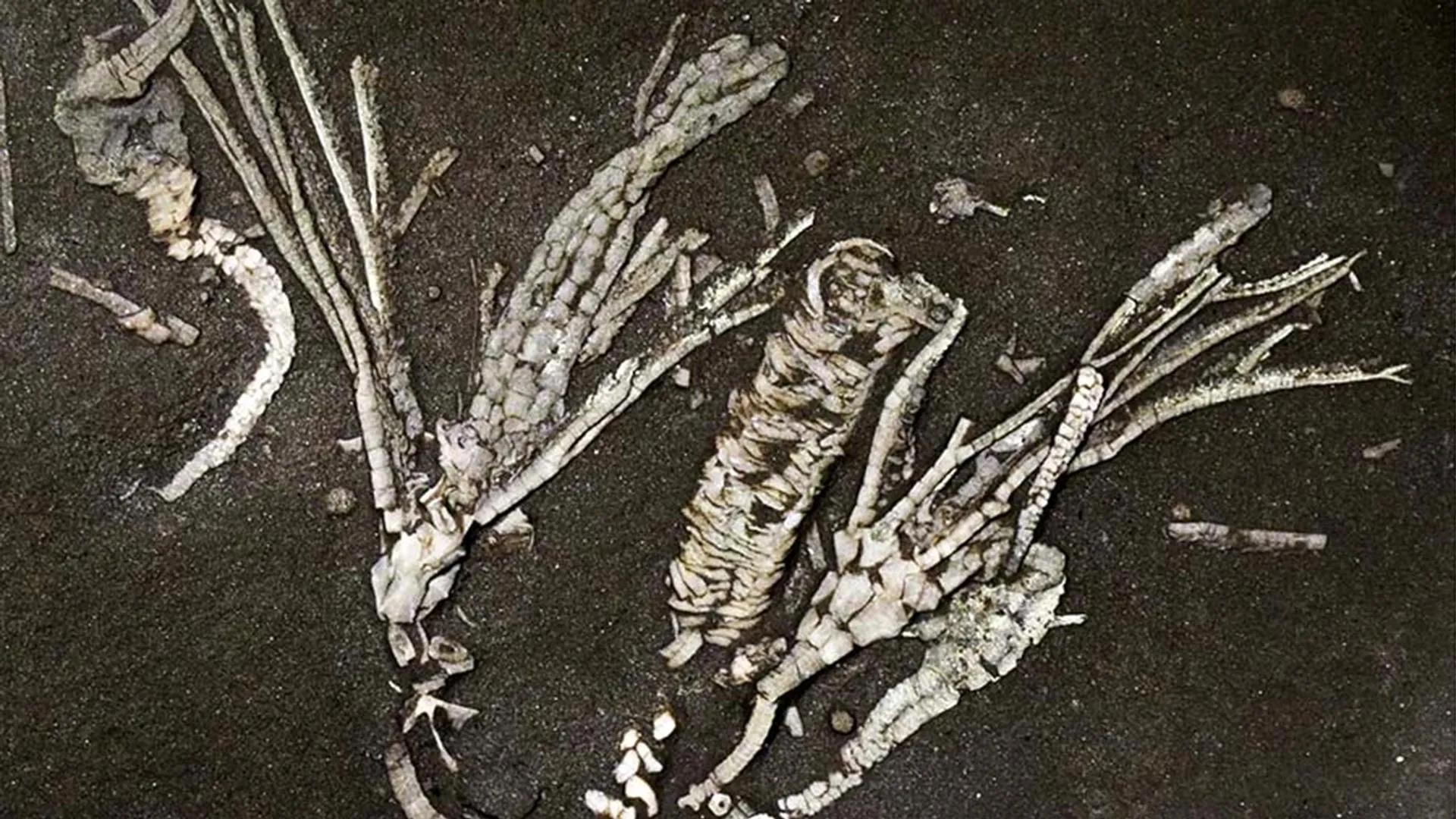
Researchers at the University of Oklahoma have documented an extraordinarily rare fossil discovery featuring soft tissue preservation from a crinoid that lived more than 450 million years ago. The specimen, belonging to the extinct species Dendrocrinus simcoensis, represents only the second known example of fossilized soft tissue found in crinoids and the oldest such discovery on record. According to paleontologist Dr. Lena Cole, soft tissues typically decay before fossilization can occur, requiring environmental conditions comparable to a natural refrigerator or vacuum-sealer to preserve delicate structures like skin, eyes, or internal organs.
The fossil’s preserved tube feet are of particular scientific value, as these small flexible structures provide evidence of how the ancient crinoid obtained food and interacted with its environment. Tube feet in crinoids function similarly to teeth in mammals, with their size, arrangement, and shape varying between species to reflect adaptations to specific habitats and feeding methods. Comparisons between the ancient specimen and modern crinoids reveal substantial anatomical differences in these feeding structures, indicating that crinoid feeding strategies have undergone significant evolutionary changes over hundreds of millions of years.
The discovery offers a window into marine ecosystems during the early Paleozoic Era, when crinoids were among the creatures flourishing in early reef communities. By studying soft tissue preservation in extinct species, researchers can identify feeding strategies and ecological roles that would be impossible to determine from skeletal remains alone. Dr. David Wright, co-author of the study, noted that some extinct animals possessed anatomical features with no close equivalent among modern relatives, making fossil records essential for understanding how evolutionary patterns and environmental factors shaped the modern biosphere.
Article Attribution | Read More at Article Source
Article summary produced by Claude AI