

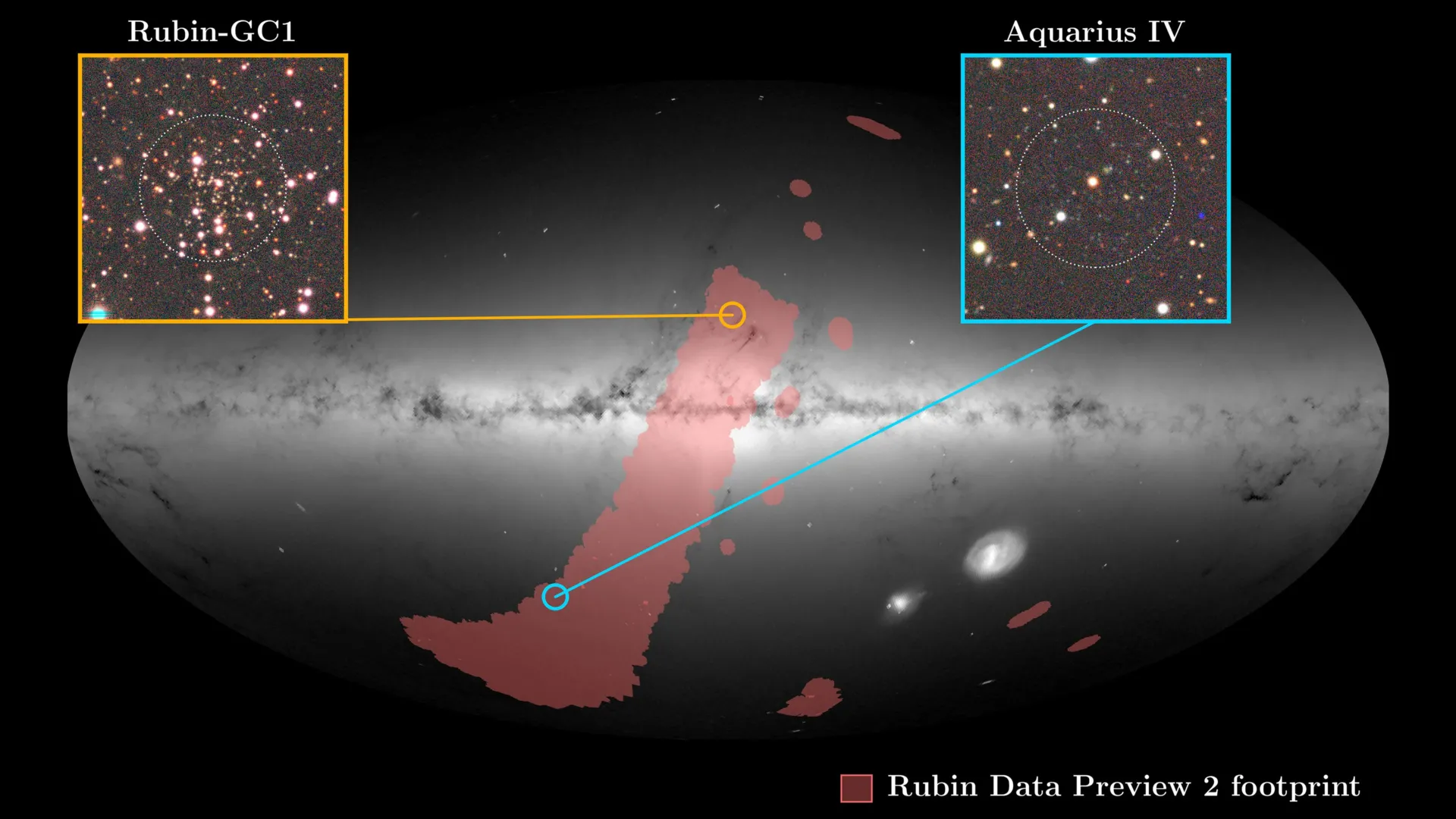
The recently completed Vera C. Rubin Observatory, located in the Chilean Andes, has made its first significant discoveries in the study of the Milky Way’s satellite systems. Using preliminary observations gathered before its official launch, researchers identified two faint celestial objects that had previously eluded detection. The first discovery, designated Aquarius IV, is a diminutive galaxy positioned approximately 355,000 light-years from Earth in the outer regions of the Milky Way’s gravitational influence. The second object, Rubin-GC1, represents a star cluster located on the opposite side of our galaxy within a region obscured by substantial cosmic dust.
These identifications are particularly significant because they were made using only a fraction of the data the observatory will accumulate throughout its operational lifetime. The facility, jointly supported by the National Science Foundation and the Department of Energy’s Office of Science, operates the 8.4-meter Simonyi Survey Telescope equipped with the largest digital camera ever built. The observatory commenced its ambitious 10-year Legacy Survey of Space and Time in June, with a primary objective of comprehensively mapping the Milky Way’s outer halo region and detecting faint structures that previous instruments could not observe. The preview observations that yielded the two discoveries covered merely 7 percent of the night sky, suggesting substantially larger returns as the survey progresses.
Astronomers estimate that hundreds of additional satellite galaxies may orbit the Milky Way beyond the approximately 65 currently identified specimens. These satellite systems are expected to provide valuable insights into fundamental astrophysical questions, particularly regarding dark matter and galactic formation processes. Ultra-faint galaxies like Aquarius IV are especially useful for dark matter research, as these objects contain relatively few stars yet are dominated by dark matter’s gravitational influence. Beyond advancing understanding of dark matter’s behavior, these discoveries could illuminate the assembly history of the Milky Way by revealing how the galaxy accumulated smaller systems and evolved over billions of years.
Article Attribution | Read More at Article Source
Article summary produced by Claude AI