

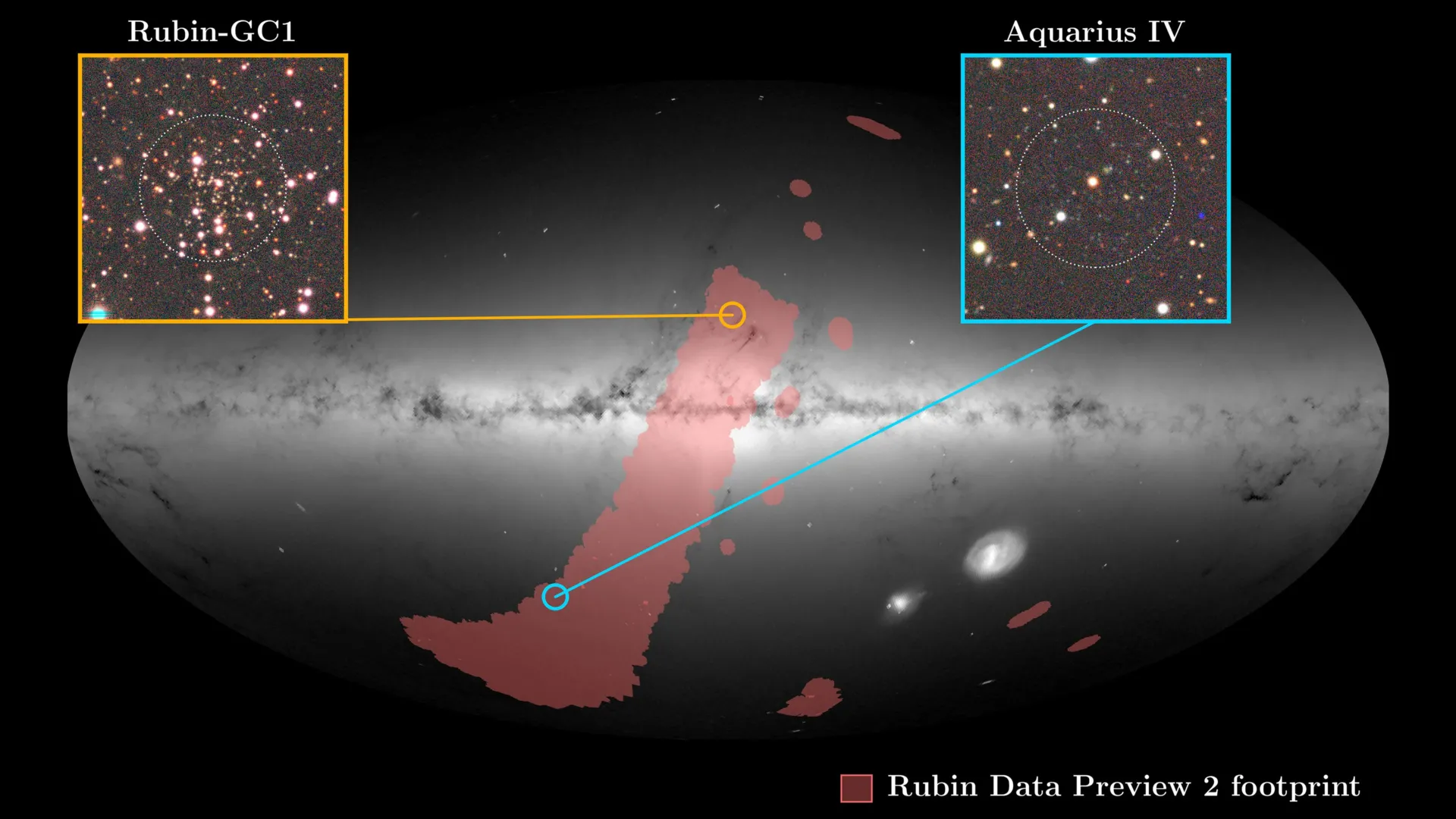
The Vera C. Rubin Observatory, located on Cerro Pachón in the Chilean Andes, has identified two previously unknown satellite galaxies orbiting the Milky Way during preliminary observations. The discoveries—Aquarius IV, a dwarf galaxy approximately 355,000 light-years from Earth, and Rubin-GC1, a star cluster hidden within cosmic dust on the opposite side of the galaxy—represent early successes for the facility’s ambitious observational program.
The findings emerged from data collected between April 2025 and January 2026, covering only about 7% of the night sky. Despite this limited dataset, researchers identified two exceptionally faint objects that had escaped detection by previous telescopes. The discoveries were documented in two studies led by researchers from Yale University and the University of Chicago, with contributions from an international consortium of institutions.
The Vera C. Rubin Observatory began its 10-year Legacy Survey of Space and Time in June, utilizing an 8.4-meter telescope equipped with the largest digital camera ever constructed, capable of capturing images at 3.2-gigapixel resolution. A primary objective involves mapping the Milky Way’s halo, a vast spherical region containing scattered stars, gas, dark matter, and faint satellite systems. Astronomers estimate that hundreds of satellite galaxies remain undiscovered around the Milky Way, with current knowledge limited to approximately 65 confirmed objects.
The discoveries hold significance beyond expanding the catalog of known galaxies. Ultra-faint satellite galaxies are particularly valuable for investigating dark matter, the invisible substance that dominates the universe’s mass. These small systems contain relatively few stars but are dominated by dark matter, making them ideal laboratories for testing theoretical models of galaxy formation and dark matter behavior. The positions, motions, and properties of satellites may also illuminate the Milky Way’s assembly history over billions of years.
Article Attribution | Read More at Article Source
Article summary produced by Claude AI