

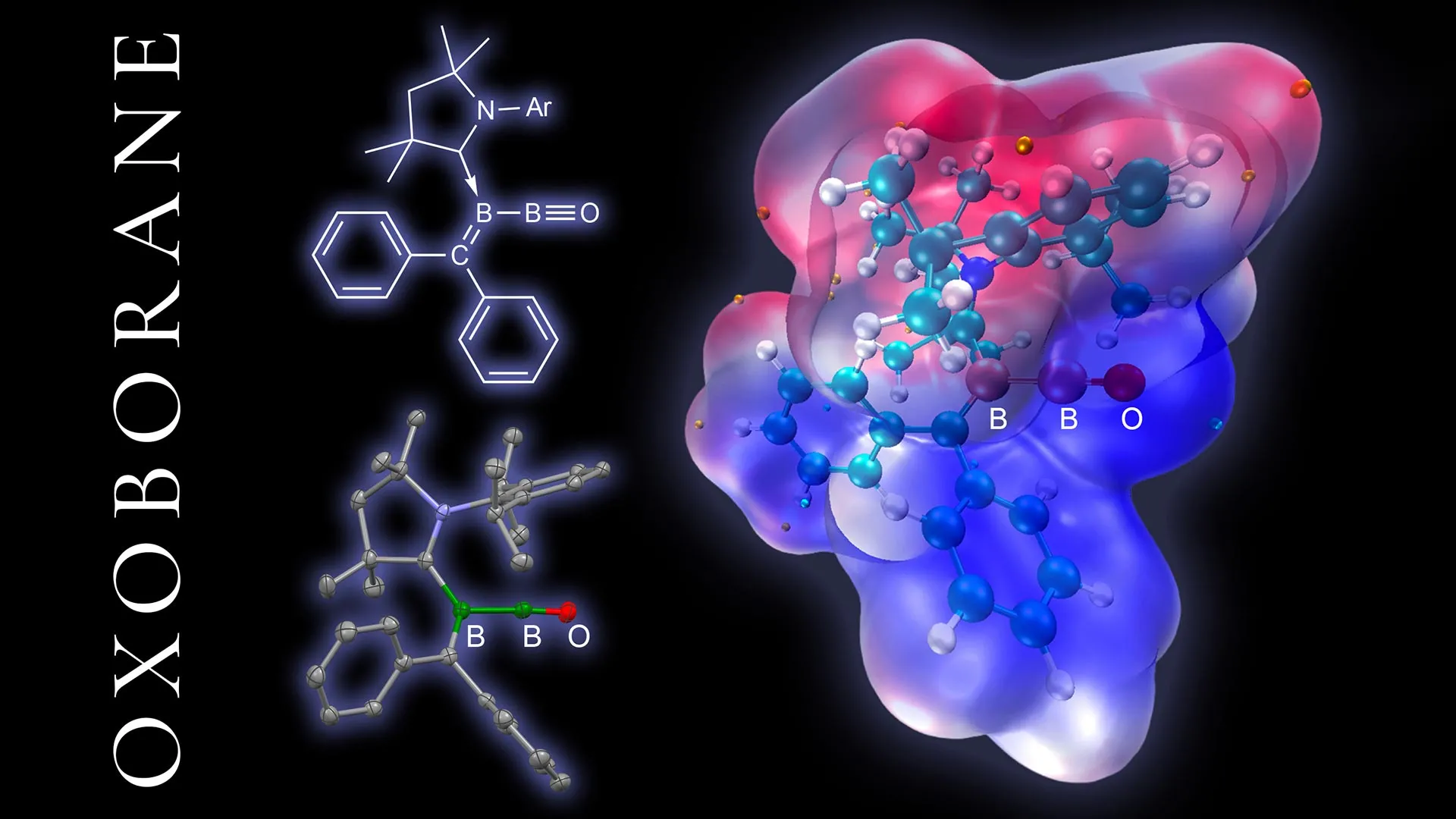
Researchers at the University of Würzburg in Germany have successfully overcome a longstanding chemistry challenge by developing a technique to produce and isolate oxoboranes, a class of molecules with triple bonds between boron and oxygen atoms. The discovery, reported in Nature Chemistry, was led by Professor Holger Braunschweig and involved computational support from Professor Ashwini K. Phukan at Tezpur University in India.
For more than six decades, scientists worldwide had pursued these compounds without success in isolating stable examples suitable for study. While researchers had detected oxoboranes under extreme conditions and created related derivatives since at least the early 1960s, obtaining stable molecules remained elusive. Braunschweig’s laboratory has focused on boron chemistry for over 15 years, achieving earlier breakthroughs including the first boron-boron triple bond in 2012 and the first neutral boron-carbon triple bond in 2025.
The breakthrough emerged unexpectedly during experiments conducted by doctoral students Lukas Lubczyk and Christian Markl. While investigating reactions between a diboracumulene compound and various ketones, both researchers independently observed the formation of distinctive orange or yellow solids. Rather than producing only anticipated outcomes, these reactions yielded oxoboranes as the primary products, despite other chemical pathways appearing more likely.
Using this newly discovered approach, the team successfully prepared three different oxoboranes, suggesting the method could provide access to a broader range of these previously inaccessible molecules. Braunschweig noted that the finding was particularly striking given widespread scientific skepticism about oxoboranes’ stability. The research team is now exploring how broadly this technique can be applied to other elusive compounds across the periodic table.
The work was supported by funding from the German Research Foundation, the German Academic Exchange Service, and India’s Department of Science & Technology.
Article Attribution | Read More at Article Source
Article summary produced by Claude AI