

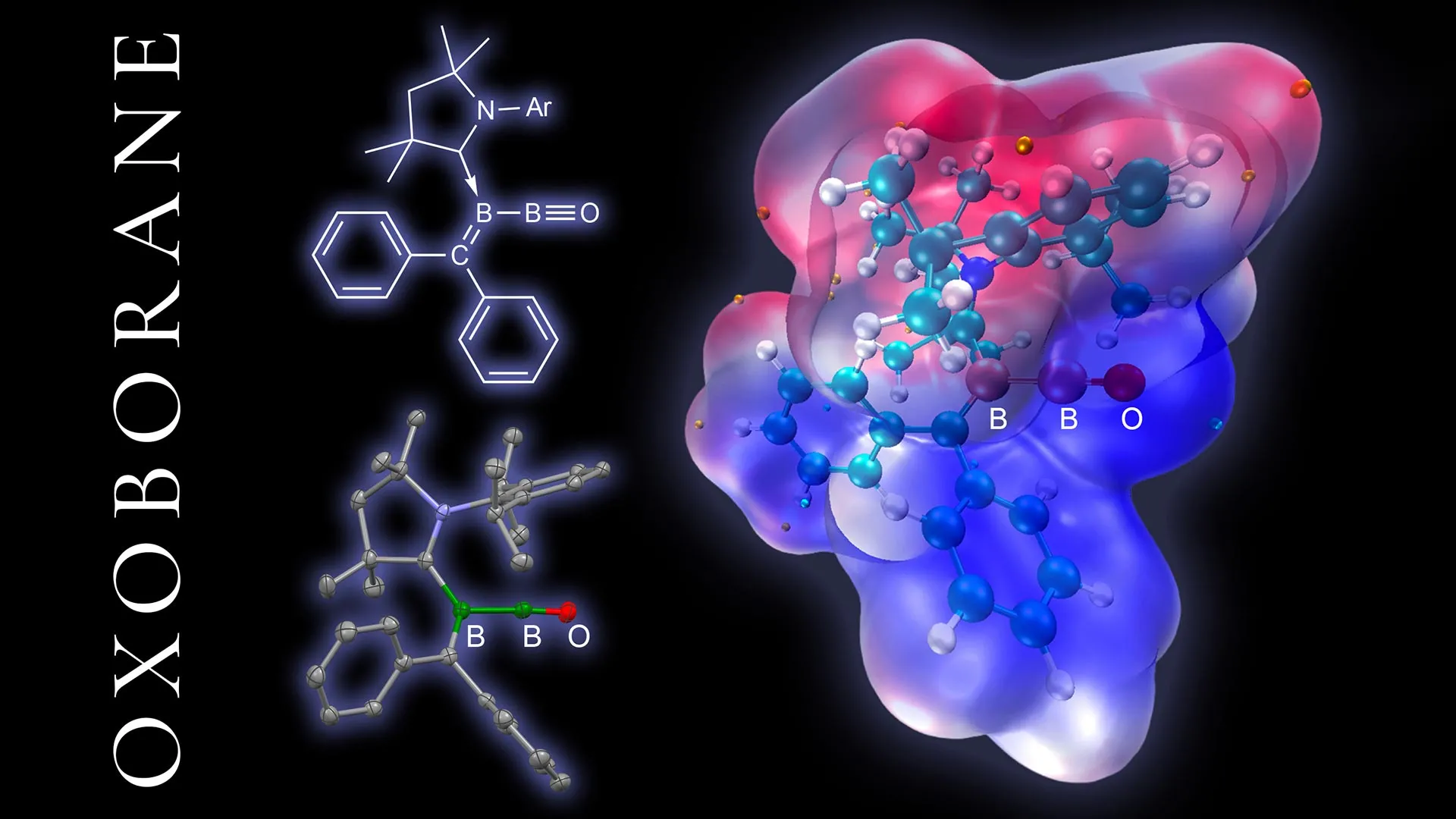
Researchers at the University of Würzburg in Germany have resolved a long-standing chemistry problem by developing a method to produce and isolate oxoboranes, a group of molecules characterized by triple bonds between boron and oxygen atoms. The breakthrough, published in Nature Chemistry, resulted from work led by Professor Holger Braunschweig in collaboration with computational researchers at Tezpur University in India.
Boron’s reluctance to form triple bonds has long challenged chemists. Braunschweig’s laboratory has pursued this problem for over 15 years, achieving several milestones including the creation of molecules with triple bonds between two boron atoms in 2012 and between boron and carbon in 2025. However, stable organic oxoboranes proved uniquely difficult to isolate, with scientists worldwide attempting unsuccessfully since at least the early 1960s. While researchers had detected these compounds under extreme conditions and created related derivatives, obtaining stable examples remained unsolved until now.
The discovery emerged unexpectedly from experiments by doctoral students Lukas Lubczyk and Christian Markl, who were investigating reactions between a diboracumulene compound and ketones. Rather than producing anticipated results, the reactions yielded distinctive orange or yellow solids containing oxoboranes as the primary products. The researchers succeeded in preparing three different oxoboranes using this method, suggesting broader applicability.
Braunschweig noted the surprise value of the finding, explaining that most researchers in the field had abandoned pursuit of oxoboranes due to perceived instability. The new approach demonstrates how unexpected chemical reactions can reveal possibilities previously considered impossible. The team now aims to determine how extensively the technique can be applied and whether similar strategies might unlock other elusive compounds across the periodic table.
The research received support from the German Research Foundation (DFG), the German Academic Exchange Service (DAAD), and India’s Department of Science & Technology (DST).
Article Attribution | Read More at Article Source
Article summary produced by Claude AI