

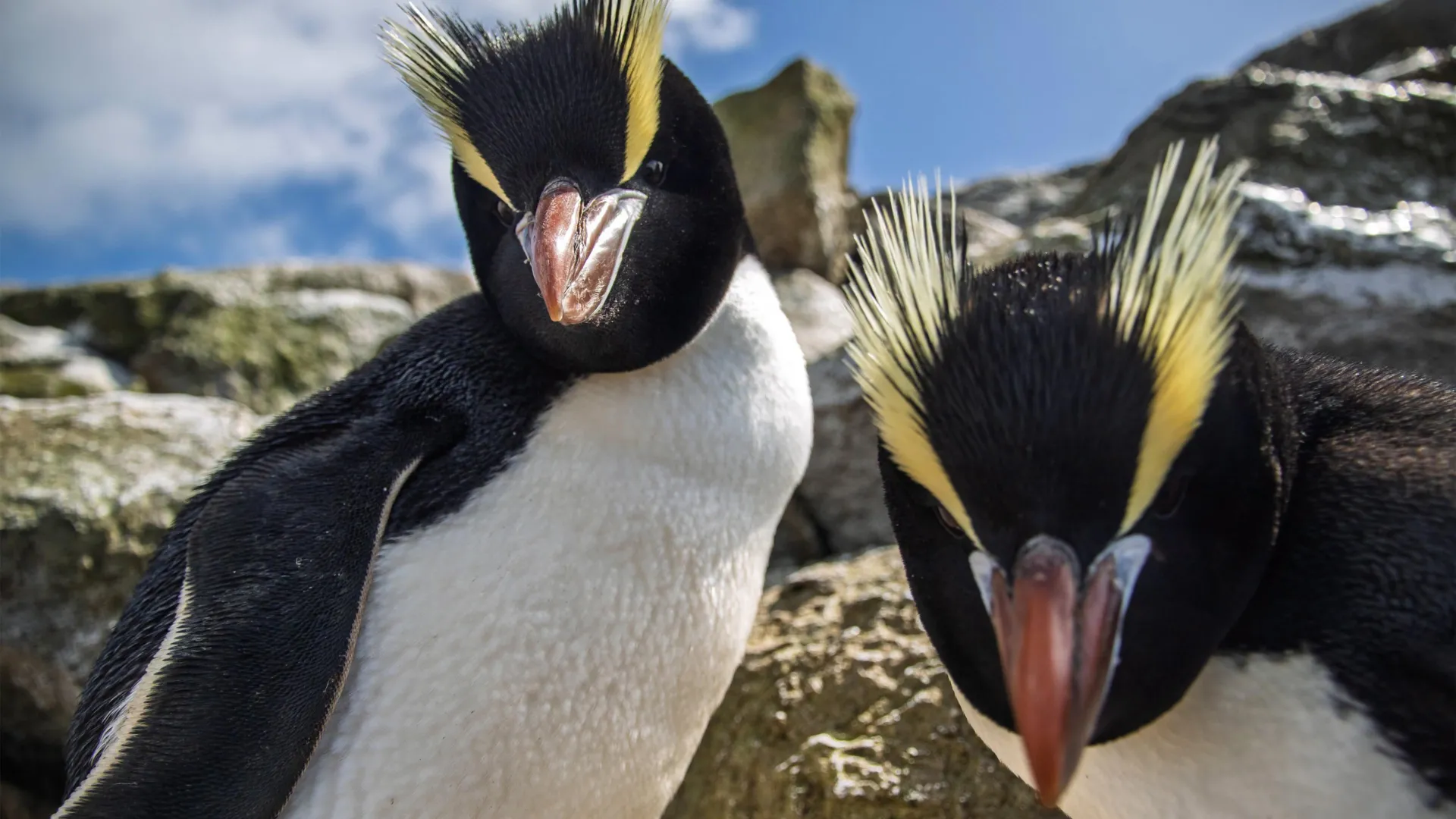
Researchers from the University of Otago have documented starkly different population trajectories for Erect-crested penguins, a critically endangered species found only on two remote island groups southeast of New Zealand. The study, published in PLOS ONE and conducted between 2022 and 2024, used drone surveys to produce the first comprehensive population count across both breeding locations. The Bounty Islands, despite covering only 50 hectares, contain approximately 27,800 breeding pairs—nearly equivalent to the 29,800 pairs on the much larger Antipodes Islands. While the Bounty population has remained relatively stable for at least 25 years, the Antipodes population has declined by more than 40 percent since the mid-1990s.
Multiple environmental and biological factors appear to drive these divergent outcomes. The loss of Eastern Rockhopper penguins across the Southern Ocean may have redirected predation pressure toward Erect-crested penguin colonies on the Antipodes Islands. As these colonies have shrunk, they have lost the protective advantage of large group sizes, making eggs and chicks more vulnerable to attacks by skuas, native subantarctic predators. Additionally, increasingly severe storms consistent with broader climate patterns have triggered landslides that fragment colonies on the Antipodes Islands. Geographic differences in migration and feeding patterns may also contribute significantly to the contrasting population trends, with Antipodes birds traveling greater distances into more exposed Antarctic waters while Bounty birds remain in more sheltered, potentially more food-abundant areas.
Researchers have characterized this situation as “Schrödinger’s Penguin,” a metaphor illustrating how viewing the species as a single unit masks the distinct realities of each population. Without detailed surveys, scientists previously assumed uniform circumstances across the species. The discovery that one population remains stable while another experiences sharp decline reveals how assessments based on species-level data can obscure critical differences between isolated subpopulations. This finding presents a conservation challenge, as the species’ current “Endangered” classification relies partly on decades-old population estimates. Combining the two populations into a single assessment could paradoxically improve the species’ threat designation despite the continued steep decline on the Antipodes Islands.
Article Attribution | Read More at Article Source
Article summary produced by Claude AI