

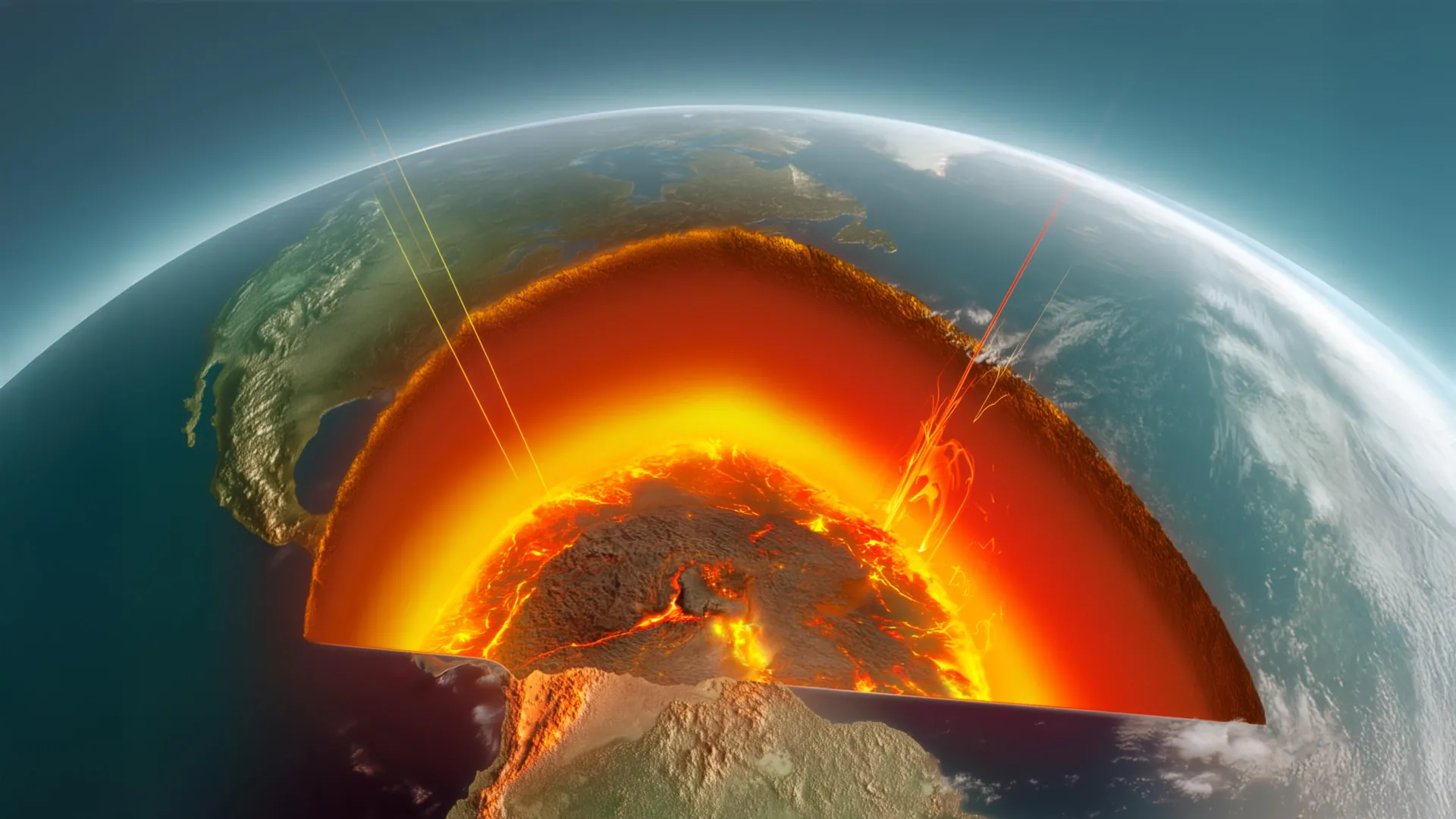
Researchers have identified that magma possesses a significantly greater capacity to store oxygen than earlier scientific models suggested. The investigation, conducted by an international team including Dr. Yanhao Lin and Dr. Ho-kwang Mao of HPSTAR alongside collaborators from Northwestern Polytechnical University and Vrije Universiteit Amsterdam, challenges conventional understanding of how molten rock behaves chemically. Results were published in National Science Review.
To reach their conclusions, the team conducted high-pressure laboratory experiments using synthetic mid-ocean ridge basalt samples. They subjected the material to pressures reaching 7 gigapascals—approximately 69,000 times atmospheric pressure—and temperatures between 1200 and 1800 °C. When exposed to platinum oxide in an oxygen-rich environment, the molten rock demonstrated remarkable oxygen absorption capabilities. At the highest pressures tested, excess oxygen accounted for more than 5% of the sample’s weight, compared to negligible amounts at normal atmospheric pressure. Spectroscopic analysis confirmed this oxygen had become structurally incorporated rather than merely trapped as gas bubbles.
Theoretical computer simulations using deep neural network models provided atomic-level insight into the phenomenon. The models demonstrated that oxygen dissolves into molten material until reaching equilibrium, with solubility increasing proportionally with pressure. This pressure-dependent behavior mirrors that of water and carbon dioxide, which similarly become more soluble in magma under extreme conditions. The simulations revealed that incoming oxygen atoms exhibit varied electrical charges and occasionally form peroxide-like bonds, explaining how the molten rock accommodates quantities beyond conventional chemical predictions.
The findings suggest oxygen should be reclassified as an independent component of silicate melts rather than being assessed solely through its relationship with other elements. Scientists propose that magma generated within oxidized regions of Earth’s mantle could have absorbed substantial oxygen quantities at depth, potentially transporting this element from the planet’s interior toward the surface through volcanic activity over geological timescales. This mechanism could establish a previously unrecognized connection between Earth’s deep interior processes and the historical development of the oxygen-rich atmosphere.
Article Attribution | Read More at Article Source
Article summary produced by Claude AI