

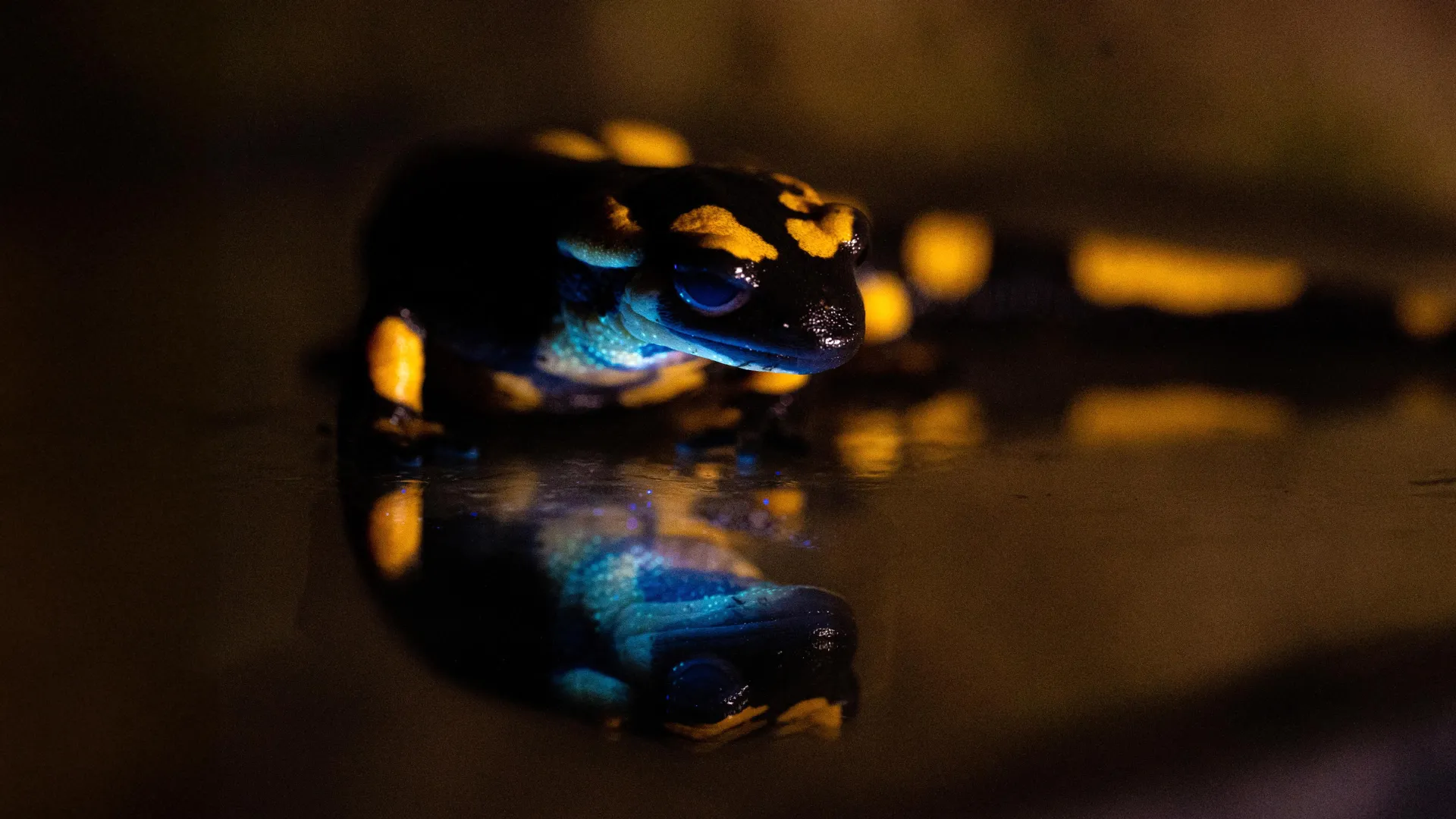
Researchers have identified a previously unknown fluorescent property in fire salamanders, one of Europe’s most recognizable amphibians. The discovery reveals that these black and yellow creatures, classified as vulnerable by the International Union for Conservation of Nature, emit a vivid green and cyan glow when exposed to ultraviolet light. The fluorescence is concentrated on the salamanders’ yellow underside and along their sides, originating from glands in their skin and the toxins those glands produce. Remarkably, the fluorescent secretions maintain their glow for more than 24 hours after leaving the salamander’s body.
The phenomenon occurs through a process known as biofluorescence, in which compounds in the salamander’s skin absorb ultraviolet radiation and reemit that energy as visible light. This differs from bioluminescence, where organisms like fireflies generate their own light through chemical reactions. While scientists once believed biofluorescence was exclusive to marine organisms, recent research has identified this property in various terrestrial animals, including reptiles, birds, and amphibians.
The biological purpose of the fire salamanders’ fluorescence remains undetermined. Researchers propose several hypotheses, including that the glow facilitates communication between individuals in dense or nocturnal forest environments, or that it enhances their existing warning coloration to deter predators. Fire salamanders already display distinctive yellow and black markings as a defense signal against their toxic skin secretions, which contain highly toxic steroidal alkaloids called samandarines.
One of the study’s most pressing questions concerns the chemical identity of the fluorescent compound. Researchers have not yet identified the specific molecule responsible for the glow, though evidence suggests it may be previously unrecognized in this species. Understanding this compound’s chemical nature could illuminate how the fluorescence develops and whether it serves a functional role in salamander behavior or survival.
The discovery demonstrates how modern research techniques can reveal biological traits that have remained undetected despite decades of scientific study. The findings may contribute to conservation efforts by helping researchers better understand fire salamander behavior and ecological requirements, information that could prove valuable as these amphibians face mounting threats from habitat destruction and fragmentation.
Article Attribution | Read More at Article Source
Article summary produced by Claude AI