

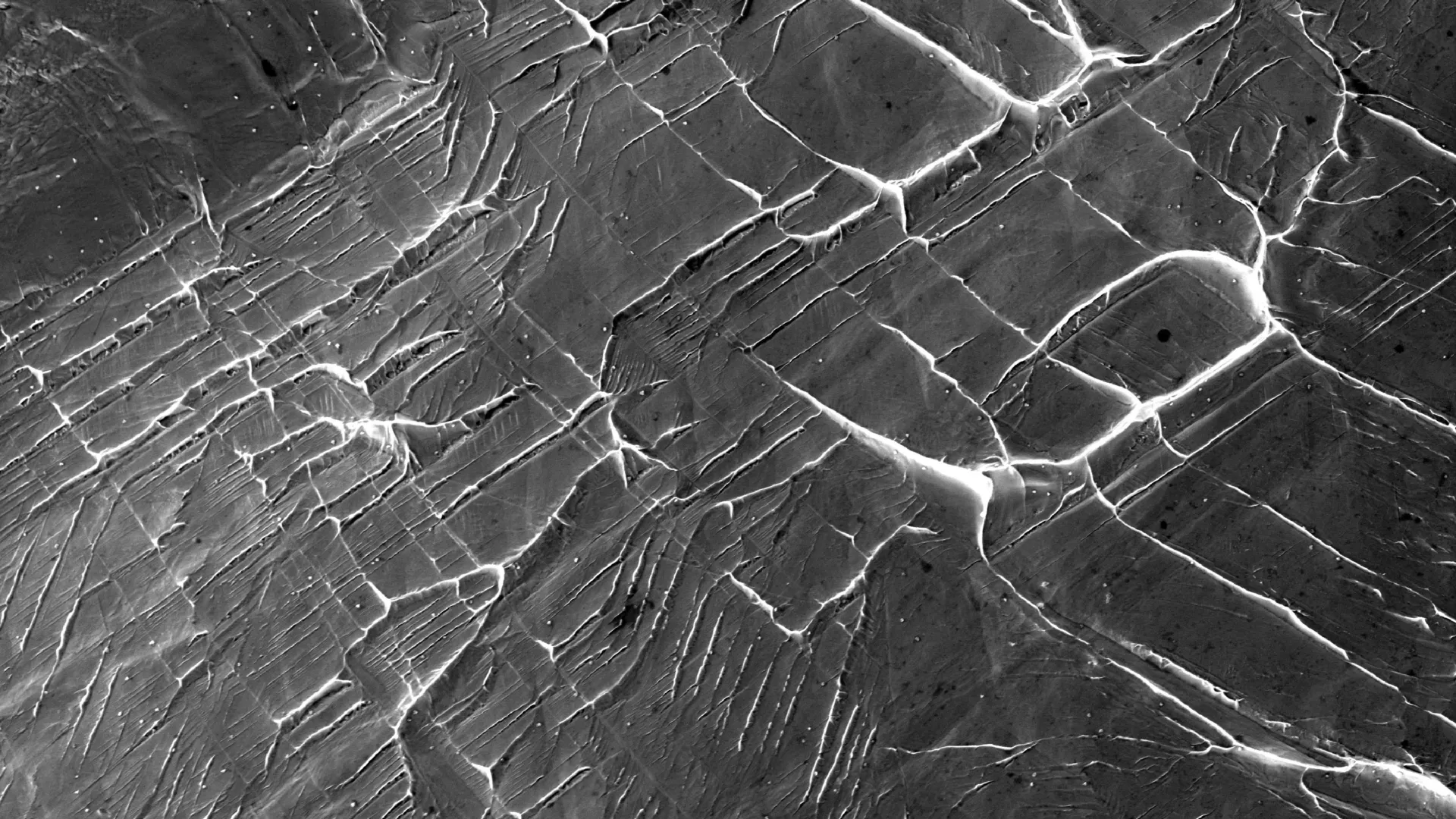
Researchers from UC Berkeley, Lawrence Berkeley National Laboratory, and the University of Oxford have identified an unexpected mechanism that allows specific metal alloys to resist brittleness at cryogenic temperatures near -253°C. The findings, published October 14 in Nature, demonstrate that two experimental alloys composed of niobium and titanium maintain impressive damage resistance even at 20 kelvin, defying long-established assumptions about how metals behave under extreme cold.
Metals typically become stronger when cooled, but this improvement often comes with a critical drawback: certain materials, particularly body-centered cubic metals such as iron, tungsten, and chromium, grow increasingly brittle as temperatures decrease. This brittleness occurs because their crystalline atomic arrangement makes them vulnerable to fracture when small cracks form. At temperatures approaching absolute zero, conventional deformation processes that normally allow metals to bend and absorb stress become severely restricted, making fracture more likely.
The research reveals that the experimental alloys employ an alternative response mechanism to prevent cracking. Rather than relying solely on the movement of tiny defects called dislocations—the standard way body-centered cubic metals accommodate stress—these materials activate a process known as nanoscale twinning. In this process, minute sections of the crystal structure rearrange into mirror-image patterns while simultaneously undergoing localized structural changes. When these rearranged regions meet crystal boundaries, they generate concentrated stress areas that create additional defects throughout the material. These new defects provide alternative pathways for the metal to deform and absorb forces around potential cracks, preventing abrupt failure.
The experimental methodology involved cooling metal samples using gaseous helium while subjecting them to tensile stress at the ISIS Neutron and Muon Source facility. Neutron beam measurements tracked the forces the materials could withstand, while subsequent electron microscopy and atom-probe analysis revealed the microscopic structural transformations occurring during deformation. The discovery suggests that generating new defects may be equally important as the movement of existing ones in determining whether metals become brittle, potentially reshaping how scientists design structural materials for extreme cryogenic environments in aerospace, energy, and transportation applications.
Article Attribution | Read More at Article Source
Article summary produced by Claude AI