

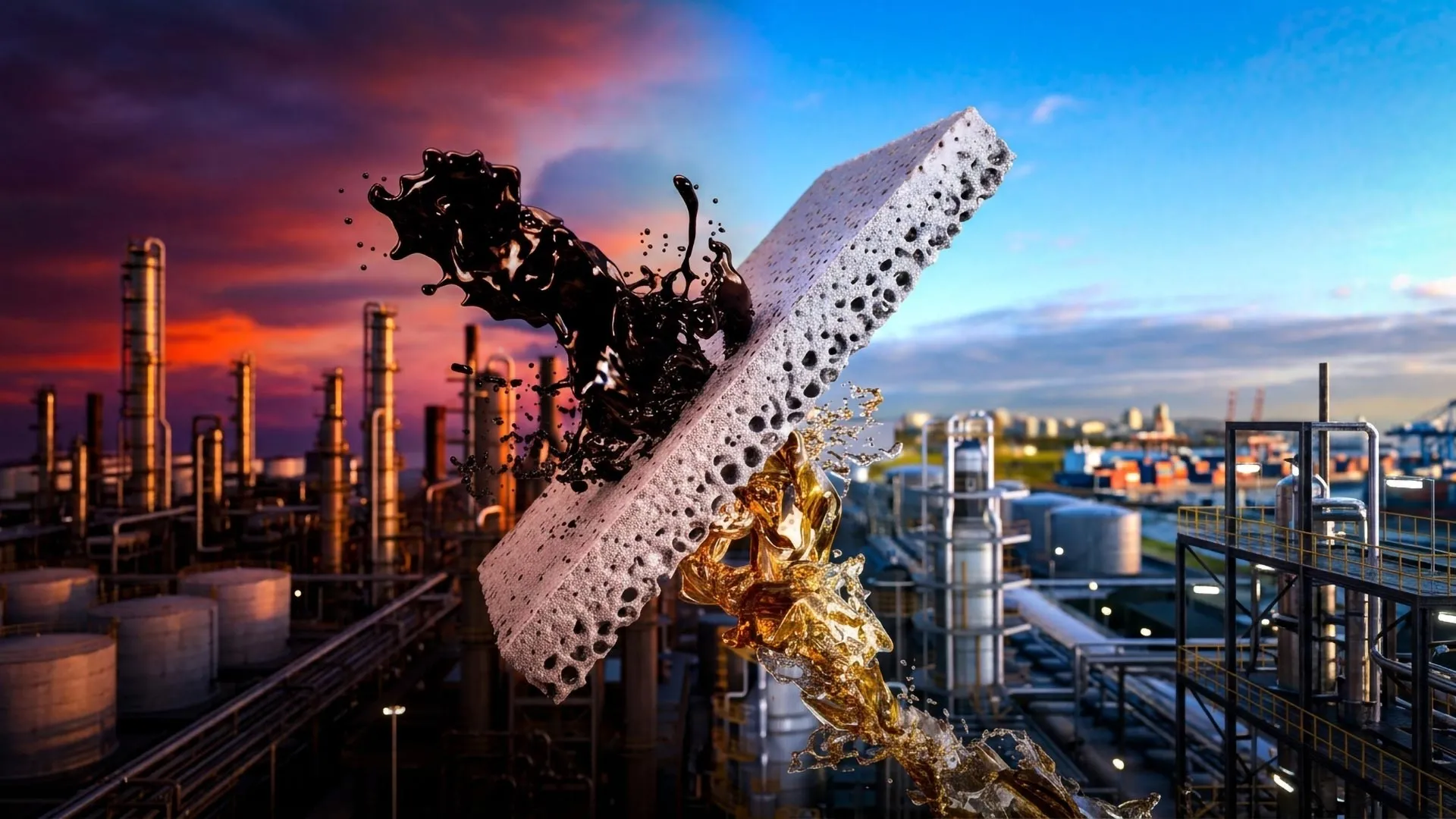
An international research team led by Professor Dong-Yeun Koh at KAIST and Professor Ryan Lively at Georgia Tech has demonstrated a novel approach to crude oil separation that could significantly transform industrial refining processes. The breakthrough uses a simple, uncoated membrane made from porous polyacrylonitrile, a widely available polymer already employed in industrial filtration systems. The findings were published in Nature and represent a departure from traditional methods that have dominated the industry for over a century.
Conventional crude oil refining relies on distillation, a process requiring temperatures exceeding 350 degrees Celsius to vaporize and separate oil components. Globally, this method consumes approximately 1,100 terawatt-hours of electricity annually, equivalent to the output of roughly 130 nuclear power plants. This massive energy demand contributes substantially to both fuel consumption and greenhouse gas emissions within the refining sector.
The researchers’ innovation emerged from an unexpected discovery: fouling, traditionally considered a problem in membrane systems, actually became advantageous in their design. As crude oil flows through the membrane’s pores, heavier hydrocarbon molecules accumulate along interior walls, gradually narrowing the openings to less than 2 nanometers. These naturally formed channels allow lighter oil fractions such as naphtha, gasoline, and kerosene to pass through efficiently while impeding heavier substances. The uncoated PAN membrane achieved permeation rates approximately 23 times higher than previous leading separation membranes while maintaining stable performance over 28 consecutive days.
Computer simulations indicate that integrating this technology into existing refineries could reduce energy consumption by 31.6%, decrease carbon dioxide emissions by 37.6%, and lower operating costs by 36%. The membrane could function as a modular preprocessing system, allowing facilities to retain much of their current infrastructure. Researchers estimate that implementing the technology across Korea’s refining and petrochemical industries alone could prevent approximately 10 million tonnes of annual greenhouse gas emissions. Beyond oil refining, the membrane technology may have applications in treating pyrolysis oil from plastic recycling, recovering solvents in battery manufacturing, and improving pharmaceutical and biofuel production processes.
Article Attribution | Read More at Article Source
Article summary produced by Claude AI