

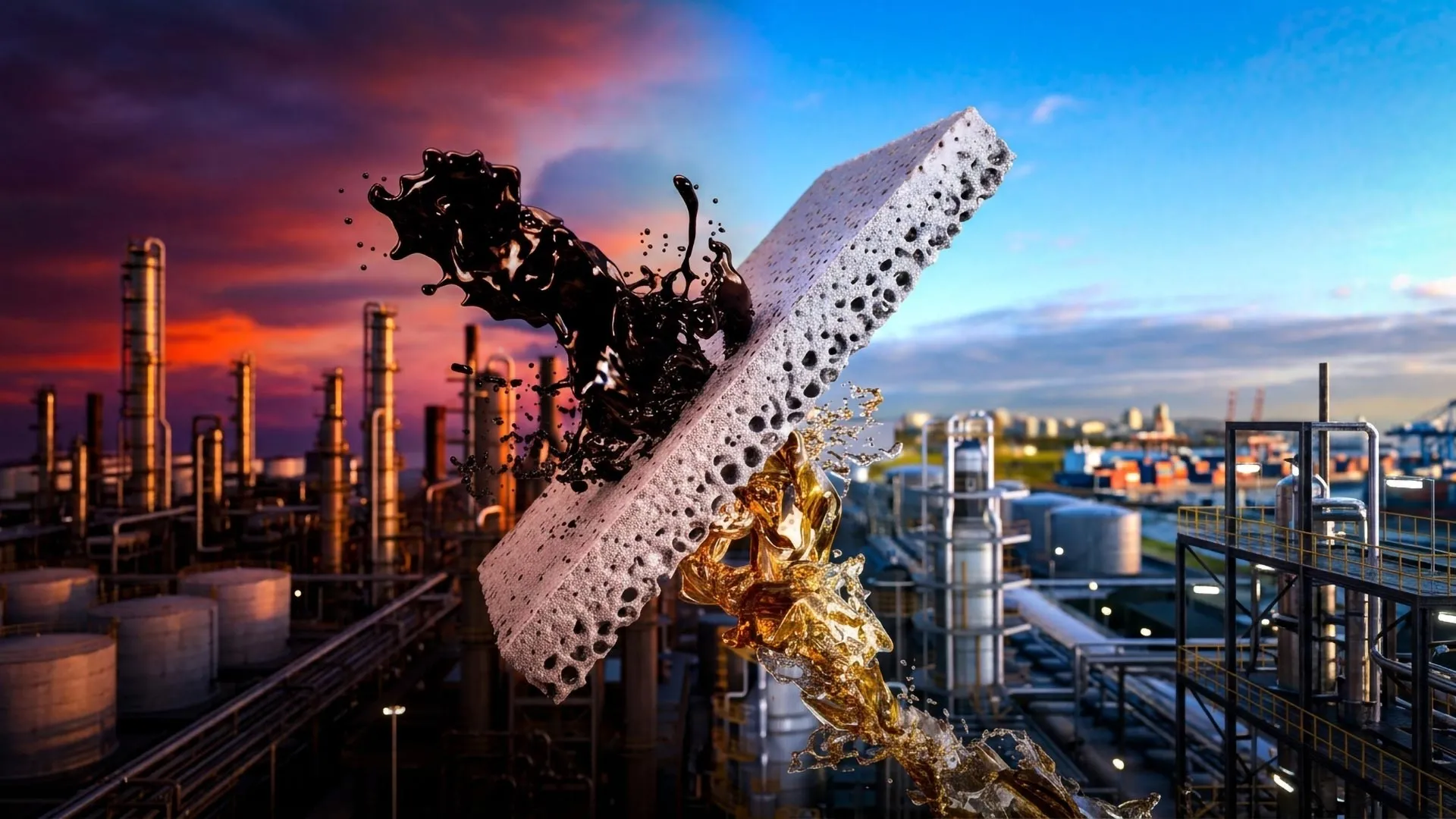
An international research team led by Professor Dong-Yeun Koh at the Korea Advanced Institute of Science and Technology, in collaboration with Georgia Tech researchers, has announced a breakthrough in crude oil separation technology. The findings, published in Nature, demonstrate a membrane capable of processing crude oil at room temperature, eliminating the need for the high-temperature heating currently required in conventional refining. The discovery addresses a significant challenge in industrial energy consumption, as traditional crude oil distillation accounts for approximately 1,100 terawatt-hours of electricity annually worldwide, a figure comparable to the combined output of roughly 130 large nuclear power plants.
The innovation relies on an uncoated membrane made from porous polyacrylonitrile, an inexpensive polymer commonly used in industrial filtration systems. As crude oil passes through the membrane’s pores, heavier hydrocarbon molecules naturally accumulate along the inner walls, gradually creating extremely narrow channels less than 2 nanometers across. This process, typically considered a problem in membrane filtration, instead enables the separation of lighter oil fractions such as naphtha, gasoline, and kerosene from heavier substances. The membrane demonstrated permeation rates approximately 23 times higher than previously reported leading crude oil separation membranes and maintained stable performance over 28 consecutive days of operation.
Computational modeling indicates substantial potential benefits if the technology gains widespread industrial adoption. Simulations project that incorporating the membrane as a modular preprocessing system could reduce energy consumption by 31.6%, decrease carbon dioxide emissions by 37.6%, and lower operating costs by 36%. Implementation throughout Korea’s refining and petrochemical industries alone could prevent approximately 10 million tonnes of annual greenhouse gas emissions, equivalent to the annual output of four million internal combustion vehicles. A key advantage is that existing refineries could install the system without replacing current equipment, instead using it as a preliminary filtration stage before conventional distillation.
Beyond crude oil applications, researchers suggest the membrane technology could serve multiple industries, including waste plastic recycling, solvent recovery in battery manufacturing, pharmaceutical purification, and biofuel production. The approach of using complex liquid mixtures to form microscopic filtration channels may provide a more economical and flexible alternative to conventional membranes requiring precisely manufactured surface coatings. The projected savings remain based on simulation results rather than demonstrated reductions at operating refineries, though the findings suggest membrane filtration could improve efficiency in existing facilities.
Article Attribution | Read More at Article Source
Article summary produced by Claude AI