

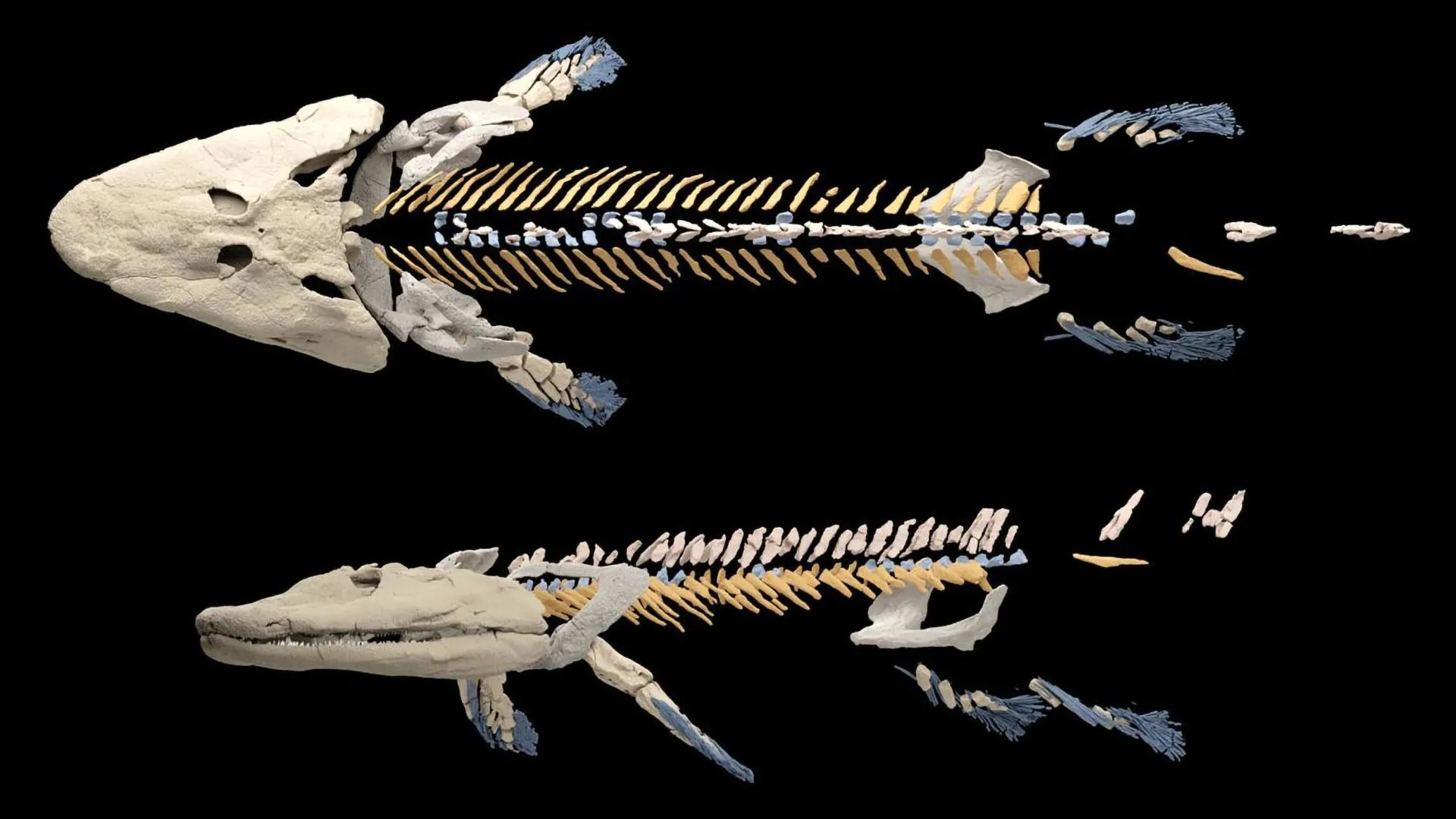
Researchers have challenged a longstanding scientific explanation for why early animals developed distinct necks during the transition from water to land approximately 380 million years ago. The traditional theory held that neck evolution granted these pioneering creatures greater freedom to move their heads as they adapted to aquatic and terrestrial environments. However, new evidence combining fossil analysis, observations of living fish, and computer modeling suggests the opposite: these early animals likely had remarkably inflexible necks.
The revised understanding emerged from an international research team that examined anatomical changes occurring during this critical period in Earth’s history. Rather than evolving primarily to enhance head movement, the research indicates that neck development was part of a broader skeletal reorganization that enabled animals to use their front limbs for movement on land. According to team member Tom Stewart of Penn State, this represents an important shift in understanding how vertebrates transitioned from aquatic to terrestrial life, with implications for understanding modern animal anatomy.
Key evidence came from studying Tiktaalik, a fossil fish discovered in Canada that provides crucial insights into this evolutionary transition. Tiktaalik exhibits an unusual combination of aquatic fish characteristics and features suggesting adaptation to shallow water and potential movement on land. The separation between its skull and shoulders created what appeared to be the first distinct necks, yet the new analysis suggests these structures were functionally quite rigid.
To test their hypothesis, researchers turned to modern sturgeon, fish that retain anatomical features similar to ancient species. The sturgeon’s backbone structure, featuring a notochord comparable to ancient animals, allowed scientists to model how much flexibility early vertebrate spines would have actually provided. This comparative approach revealed that the spinal arrangement in early tetrapods would not have permitted the significant head movement previously assumed, fundamentally altering the explanation for why necks initially evolved.
Article Attribution | Read More at Article Source
Article summary produced by Claude AI