

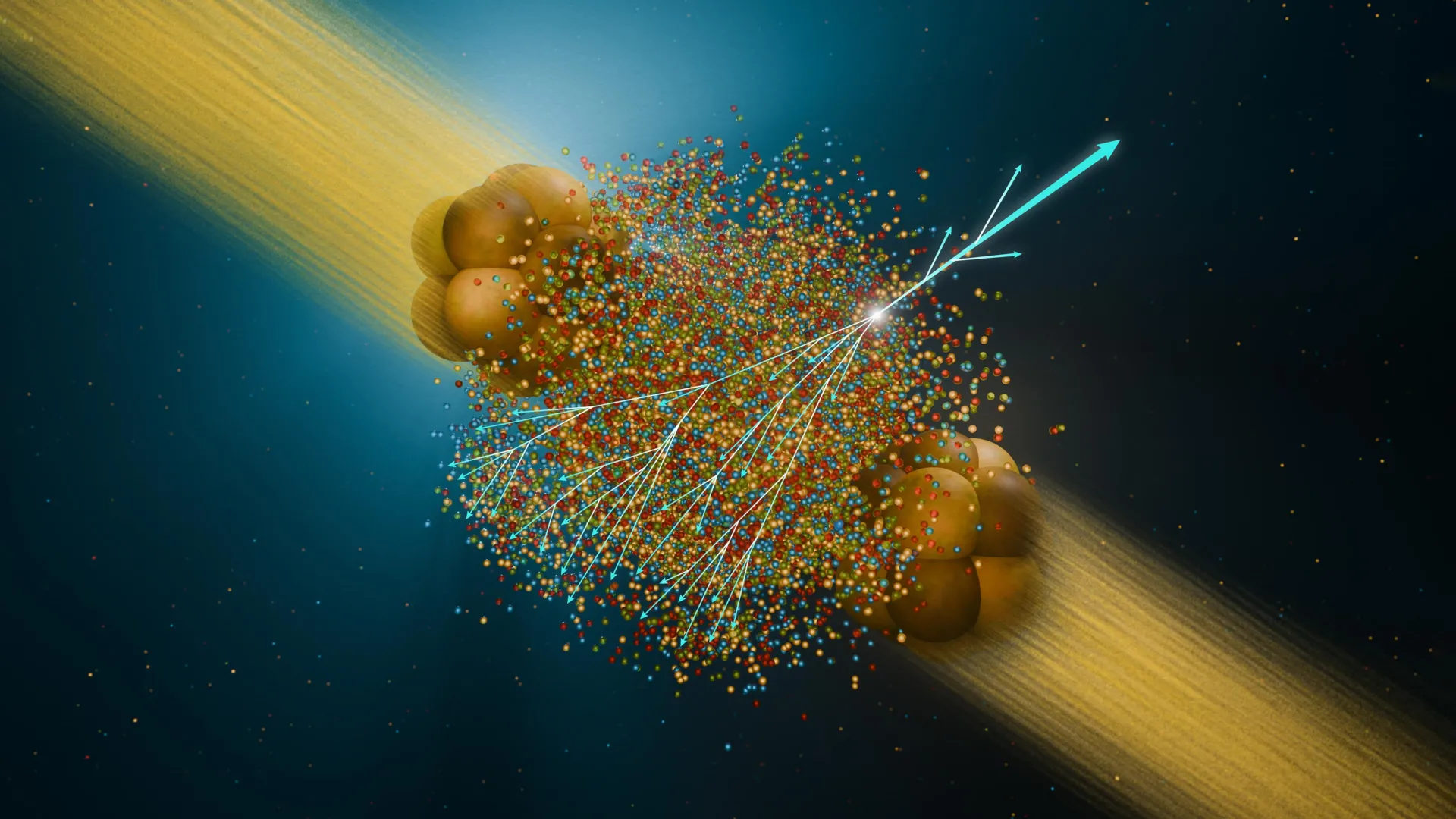
Scientists working with the STAR experiment at the Relativistic Heavy Ion Collider have reported new evidence that quark-gluon plasma, a form of matter existing in the earliest moments after the Big Bang, can be created through collisions of relatively small atomic nuclei. The research, published in Physical Review Letters, documents the detection of jet quenching—a phenomenon where high-energy particles lose energy while passing through the plasma—in oxygen nucleus collisions conducted at substantially lower energies than previously required to observe this effect.
The findings represent a significant advancement in understanding the conditions necessary to produce quark-gluon plasma in small collision systems. Researchers previously observed jet quenching in collisions involving much larger gold nuclei at RHIC and in oxygen collisions at CERN’s Large Hadron Collider. The new results establish a lower energy threshold at which this signature of quark-gluon plasma appears, providing important clues about the fundamental requirements for creating matter that resembles the substance filling the early universe before protons and neutrons formed.
Quark-gluon plasma is produced by accelerating atomic nuclei to near-light speeds and colliding them with tremendous force, causing the boundaries between protons and neutrons to break down and release the quarks and gluons contained within. The resulting plasma exists for less than a billionth of a billionth of a second before the quarks and gluons recombine into familiar particles. Scientists cannot observe the plasma directly but instead analyze particles emerging from collisions using large detectors, with particular attention to jets—narrow sprays of energetic particles that reveal how the plasma affects their energy levels.
The discovery builds on decades of research establishing multiple signatures of quark-gluon plasma formation. Beyond jet quenching, scientists have identified collective flow patterns, where particles from gold collisions move in coordinated patterns reminiscent of a near-perfect liquid with minimal internal resistance. These investigations into smaller collision systems help researchers determine whether similar signatures in tiny collision systems indicate actual plasma formation or result from other mechanisms, addressing ongoing questions within the physics community about when and how primordial matter can be recreated.
Article Attribution | Read More at Article Source
Article summary produced by Claude AI