

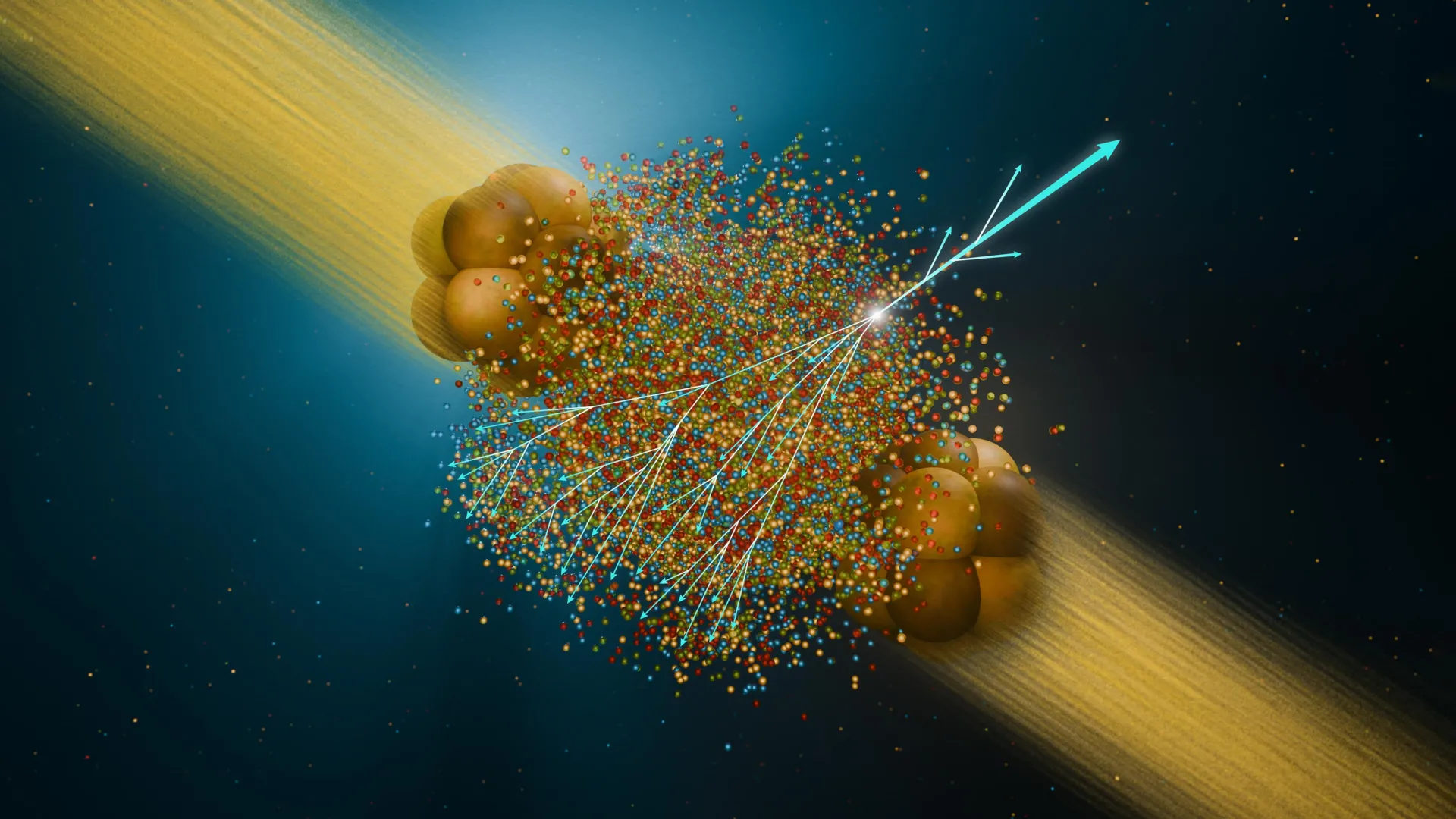
Researchers at the Relativistic Heavy Ion Collider have identified strong evidence of quark-gluon plasma formation in collisions between oxygen nuclei, according to findings published in Physical Review Letters. The discovery marks the first time scientists have observed this primordial form of matter—which existed in the early universe shortly after the Big Bang—being produced through relatively small atomic collisions at substantially lower energy levels than previously required.
The key indicator of quark-gluon plasma formation was a phenomenon called jet quenching, in which high-energy particle streams lose energy as they pass through the dense material created during the collisions. While scientists have previously detected jet quenching in larger nucleus-to-nucleus collisions at RHIC and at CERN’s Large Hadron Collider, observing this effect in smaller oxygen collisions represents a significant advancement. The findings establish a new lower boundary for the conditions capable of producing quark-gluon plasma in small collision systems, helping physicists understand the minimum requirements for recreating this exotic matter.
To study quark-gluon plasma, RHIC accelerates atomic nuclei to nearly the speed of light and smashes them together, causing protons and neutrons to break down and release quarks and gluons. When sufficient energy is applied, additional quarks and gluons are generated from pure energy, creating a fleeting droplet of primordial matter smaller than an atomic nucleus that exists for less than a trillionth of a second. Scientists cannot directly examine this substance, so they analyze particles produced by the collision using sophisticated detectors like the STAR instrument.
The research addresses a longstanding scientific question about whether very small collision systems can generate quark-gluon plasma. Previous experiments at both RHIC and the LHC had detected collective motion patterns in particles from small collisions, suggesting plasma formation, but definitive evidence remained elusive. The new oxygen collision data provides compelling support that quark-gluon plasma can indeed form in smaller systems, advancing physicists’ understanding of how matter behaved in the universe’s earliest moments.
Article Attribution | Read More at Article Source
Article summary produced by Claude AI