

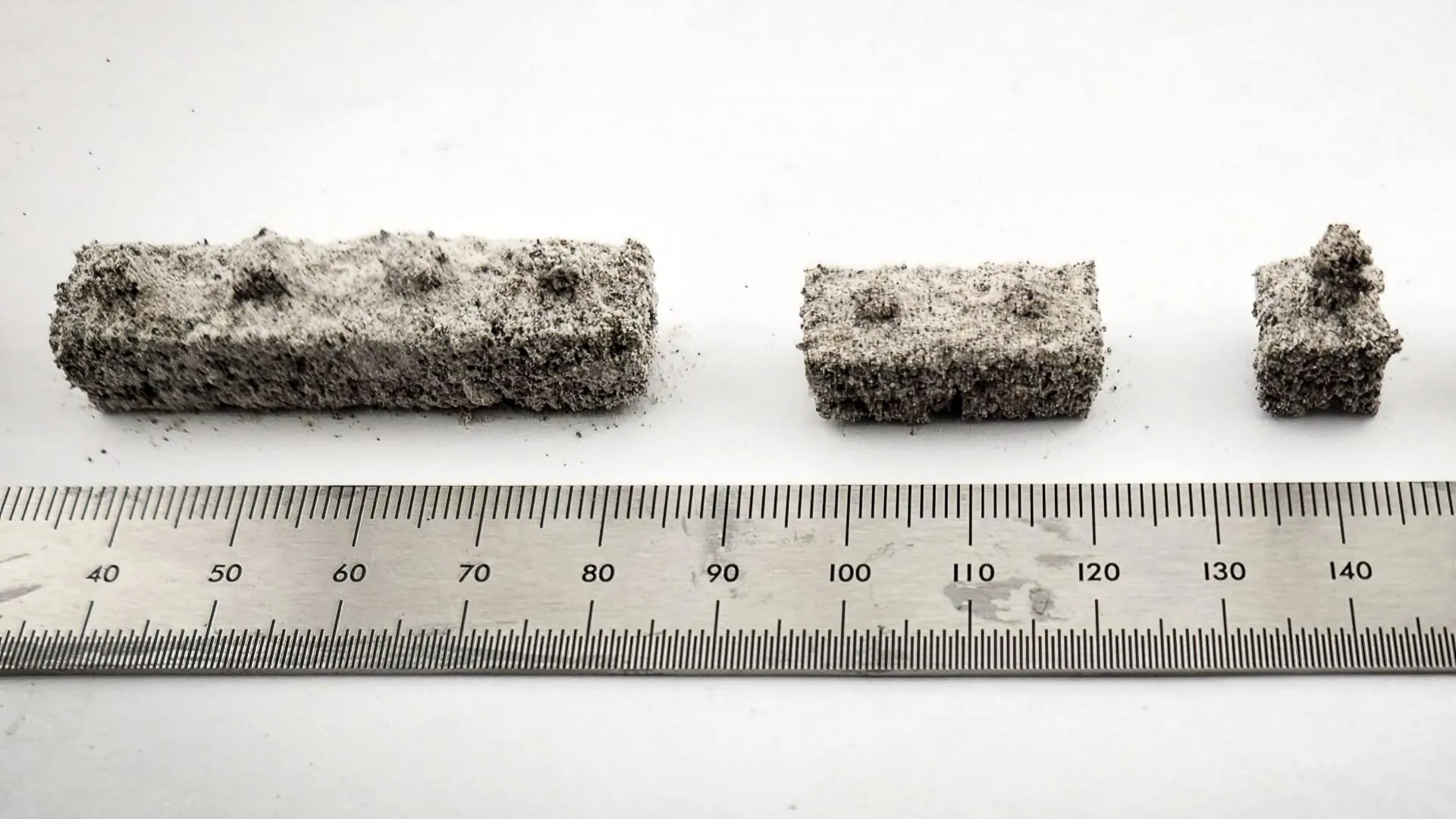
Scientists at the University of Arkansas have developed a method for converting simulated lunar dust into interlocking construction blocks using 3D printing technology. The research, led by undergraduate-turned-graduate student Cole McCallum and senior author Wan Shou, was published in NPJ Advanced Manufacturing. The work represents a potential breakthrough for establishing permanent human settlements on the Moon by enabling in-situ resource utilization.
The team employed laser powder bed fusion, a technique that spreads thin layers of powder and uses concentrated heat to fuse particles together through sintering. Rather than relying on binding agents that would require transport from Earth, the researchers demonstrated that lunar regolith particles can bond directly to one another. The resulting blocks feature interlocking designs comparable to LEGO pieces, allowing them to be assembled into larger structures. For their experiments, the team used Lunar Highlands Regolith Simulant, a commercially available material designed to replicate samples returned during NASA’s Apollo missions.
The prototype bricks, measuring several centimeters across and including cross and H-shaped configurations, represent a significant departure from previous approaches that required additional binding materials. However, the current structures contain more internal pores and exhibit lower strength compared to bound alternatives. McCallum acknowledged that while the structures can be self-supporting, they are not yet suitable for applications requiring load-bearing capacity.
Significant obstacles remain before the technology can be deployed on the lunar surface. Researchers must determine how the printing process would function under the Moon’s low-gravity environment and vacuum conditions, while also improving brick durability and structural integrity. Despite these challenges, Shou stated the technique could eventually provide an efficient method for manufacturing construction components for sustained lunar habitation.
McCallum graduated in May with degrees in mechanical engineering and physics, earning selection to the Lafayette Fellows program supporting students pursuing advanced studies in France. He is currently enrolled in an aerospace engineering program at ISAE-SUPAERO in Toulouse.
Article Attribution | Read More at Article Source
Article summary produced by Claude AI