

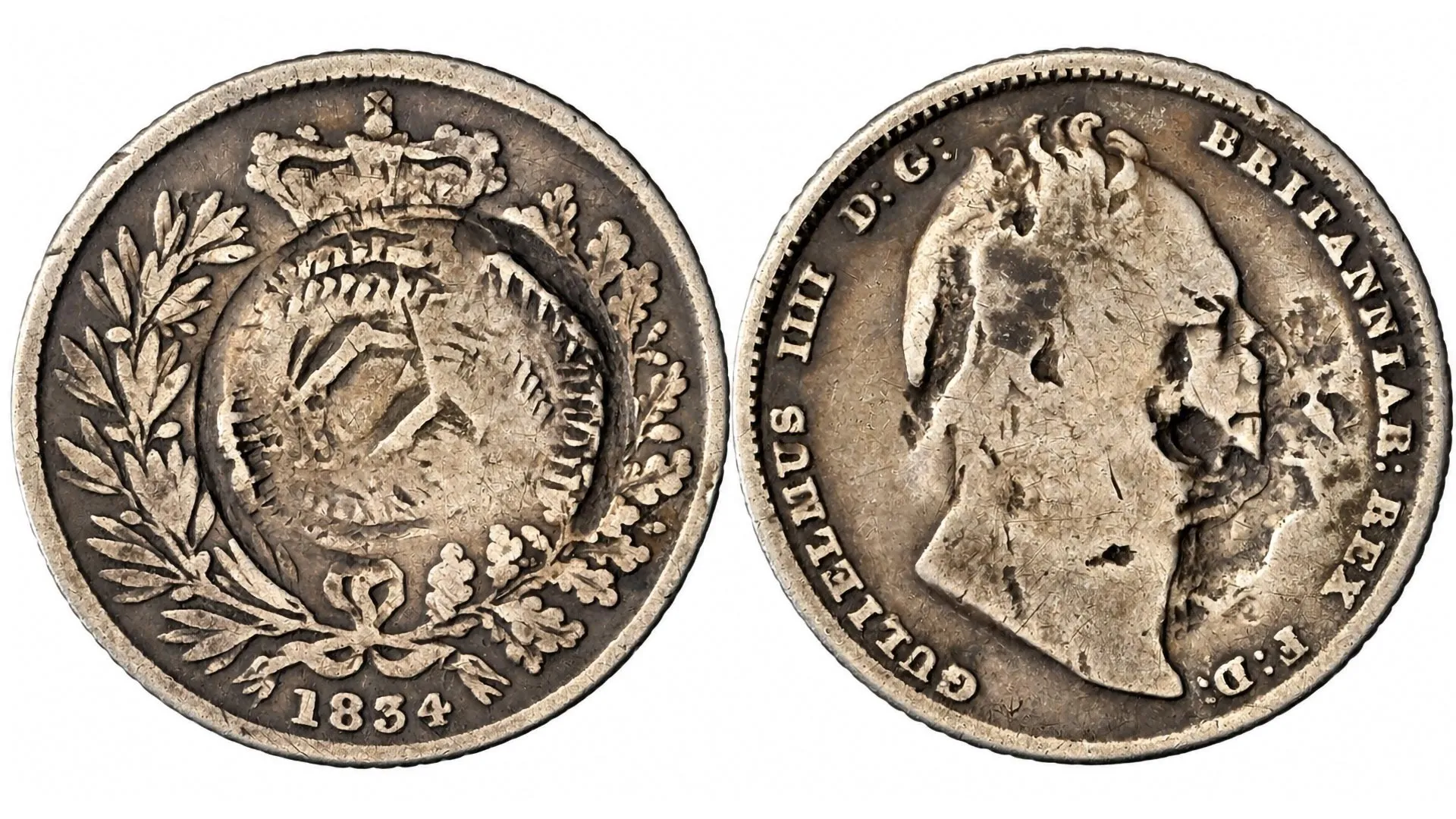
Researchers investigating a badly distorted British silver sixpence from 1834 have concluded that the coin’s unusual damage patterns most likely stem from a manufacturing problem that occurred during the original minting process. The coin, discovered in an album purchased at a car boot sale in Greater Manchester, England, displays severe crushing and distortion concentrated in its central region while its outer rim and edge grooves remain relatively intact. This distinctive pattern of preservation prompted scientists to examine the piece in detail to determine what caused such remarkable deformation.
Using advanced scientific techniques including scanning electron microscopy, energy-dispersive X-ray spectroscopy, and optical surface profilometry, researchers mapped the coin’s surface in three dimensions and identified its composition. The examination revealed deep depressions, elevated ridges, and overlapping metal displacement patterns, with variations in surface height reaching approximately 0.75 millimeters. Chemical analysis detected lower silver concentrations and higher copper levels in the most severely distorted regions, along with corrosion products concentrated within the depressions. However, these findings could not fully account for the extent and nature of the deformation observed.
The evidence points toward repeated compression of the metal while its lateral movement was restricted during the striking process. This explanation better accounts for the observed damage pattern than ordinary wear, which typically smooths surfaces gradually, or corrosion, which generally removes material chemically. The findings suggest the sixpence may represent a rare surviving example of a manufacturing defect that would normally have been identified during mint inspections and melted down during the early era of mechanized coin production in Britain.
The investigation demonstrates how non-destructive scientific analysis can distinguish manufacturing defects from later damage in historic metal objects by combining multiple lines of evidence. While determining with absolute certainty whether the damage occurred at the mint remains challenging due to the complex history of metal objects over centuries, the convergence of structural, chemical, and compositional evidence supports the manufacturing defect hypothesis. The research illustrates the application of contemporary analytical techniques and computational tools to historical mysteries preserved in physical artifacts.
Article Attribution | Read More at Article Source
Article summary produced by Claude AI