

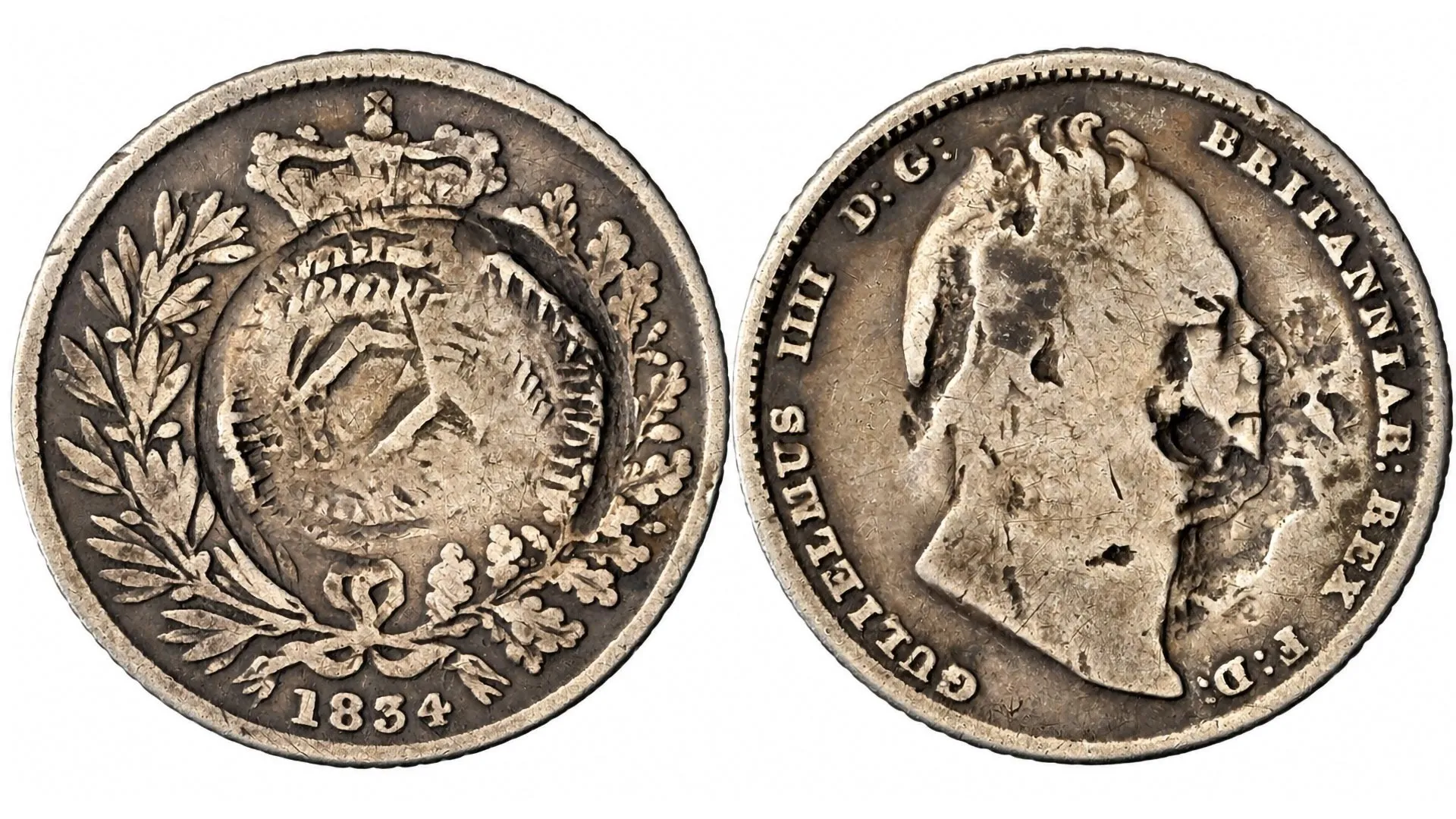
Researchers have applied sophisticated scientific techniques to explain the unusual damage found on a badly distorted British silver sixpence dating to 1834. The coin, discovered in a collection purchased at a car boot sale in Greater Manchester, England, bears the portrait of King William IV and exhibits severe crushing concentrated in its central regions while its outer rim remains relatively well preserved.
The investigation employed multiple analytical methods including scanning electron microscopy, energy-dispersive X-ray spectroscopy, and optical surface profilometry to examine the coin’s physical characteristics and chemical composition. Three-dimensional surface measurements revealed deep depressions, elevated ridges, and stepped surfaces in the damaged areas, with height variations reaching approximately 0.75 millimeters across the distorted portrait region. The researchers found that the underlying metal contained a silver and copper alloy, with more severely damaged areas showing different chemical compositions and signs of corrosion and contamination concentrated in the depressions.
Based on the pattern and extent of deformation, the scientists concluded that repeated compression applied to a restricted area most likely caused the damage, rather than gradual wear, corrosion, or a single impact occurring after minting. The findings were published in the journal npj Heritage Science through IA STUDIO. During the period when the sixpence was produced, coins with significant striking defects were typically identified during mint inspections and melted down for reuse, making this piece potentially a rare surviving example of a manufacturing failure that would normally have been removed from circulation.
The study demonstrates how non-destructive scientific techniques can distinguish manufacturing defects from later damage in historic metal objects by combining chemical and structural evidence. The investigation also explored the role of artificial intelligence in analyzing historical mysteries, with computational tools assisting in the initial evaluation of high-resolution photographs before laboratory analysis was conducted.
Article Attribution | Read More at Article Source
Article summary produced by Claude AI