

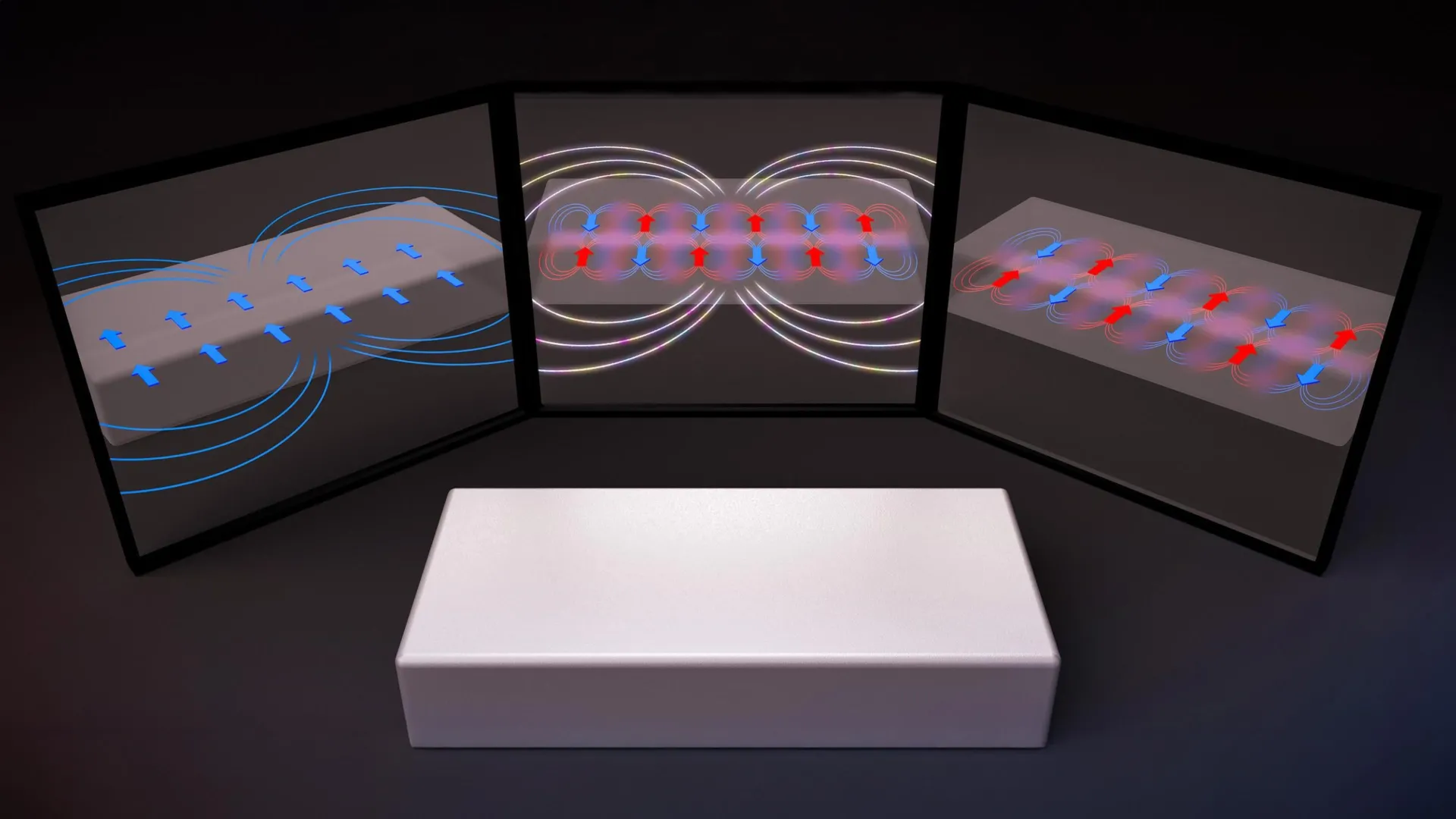
Researchers at the U.S. Department of Energy’s SLAC National Accelerator Laboratory have presented experimental evidence confirming the existence of altermagnetism, a previously theoretical third category of magnetic materials. The findings, published in Science, demonstrate that this magnetic phase combines characteristics of the two traditionally recognized types: ferromagnetism and antiferromagnetism. Lead author Daniel Jost, an associate scientist at SLAC and Stanford Institute for Materials and Energy Sciences, explained that while physicists have observed phenomena in recent years that did not fit neatly into the existing ferromagnet-antiferromagnet framework, this research provides robust confirmation of the third phase.
For approximately 90 years, scientists have categorized magnetic materials into two main types based on electron spin alignment. In ferromagnetic materials, electron spins align uniformly in the same direction, producing a detectable magnetic field. Antiferromagnets, identified in 1933, feature neighboring spins pointing in opposite directions, which cancel out to produce no overall magnetization. The newly confirmed altermagnetism combines features of both: it exhibits alternating spin orientations without overall magnetization while also supporting useful spin currents, a property typically associated with ferromagnetic behavior.
The research team focused on manganese telluride, a material long classified as an antiferromagnet. The critical distinction of altermagnets lies in their atomic arrangement, where alternating spin orientations are accompanied by rotated crystal structures surrounding oppositely aligned spins. This rotation breaks a symmetry present in conventional antiferromagnets and fundamentally changes electron behavior. The team identified chirality—a distinctive asymmetry in the material’s magnetic structure—as the key signature differentiating altermagnets from conventional antiferromagnets.
To detect this chiral signature, researchers conducted experiments at the European Synchrotron Radiation Facility in France using precisely controlled circularly polarized X-rays. By measuring how manganese telluride scattered left-handed and right-handed polarized X-ray beams differently, they obtained definitive evidence of the material’s chiral properties. This chiral response matched predictions for altermagnetism and would not appear in conventional antiferromagnets, providing the conclusive experimental confirmation scientists had been seeking.
Beyond its significance for fundamental physics, the discovery could facilitate development of magnetic materials for advanced technologies. Potential applications include next-generation memory systems, quantum devices, and more energy-efficient data centers, leveraging the unique properties that altermagnetism makes possible.
Article Attribution | Read More at Article Source
Article summary produced by Claude AI